
A continuation of Part 1 – Poverty in the Poorhouse
By Tony Mansell
Opposition to the ‘Old Poor Laws’ (referred to those prior to 18434) grew at the beginning of the 1800s when they received wide criticism for being too expensive and widely abused. There was also a desire to implement a universal system, one which would distinguish the needy from the scroungers. The hardliners also considered poverty to be a conscious choice and advocated that workhouses should be institutions that disciplined the able-bodied poor. 1 In response, the government established a Royal Commission to consider how best such a system could be introduced.
The Royal Commission firstly examined the workings of the Old Poor Law – that currently in place. It then recommended a fundamental overhaul of how help should be delivered without huge demands on public funds. Its findings formed the basis of the Poor Law Amendment Act of 1834.
The ‘Act for the Amendment and better Administration of the Laws relating to the Poor in England and Wales,’ better known as the ‘1834 Poor Law Amendment Act’ and often referred to as ‘The New Poor Law,’ was passed by the Whig government led by Prime Minister Earl Grey with the backing of both major parties, the Whigs and the Tories.
It directed that financial help to able-bodied poor people was to cease and, instead, it forced them to enter the new style workhouses to receive food and shelter. In essence, it shifted the primary form of welfare from home assistance to the stark, regimented environments of workhouses. Life there was to be ‘worse than that of the poorest free labourer outside of the workhouse’. In other words, conditions were to be so uninviting that anyone capable of coping outside would choose not to be in one. By forcing able-bodied people into deliberately unpleasant workhouses, the government sought to stop what they considered to be laziness.
The operation of the new centralised workhouses was to be the responsibility of new unions (Cornwall was to have 13, all formed in 1837) which would be governed by a board of elected Guardians. Each workhouse would have a master and matron plus other staff as required. Outdoor relief was to be phased out for the aged and infirm and abolished altogether for the able-bodied. Instead, applicants would be offered the workhouse or nothing.
The parishes were to continue to provide funding through the parish Poor Rate 2 but as with the poorhouses, there was the assurance that the cost would be offset by the sale of goods produced by the workhouse inmates. There was also to be a rule that male paupers entering the workhouse had to take their wives and children with them albeit, they would be housed in different blocks with little or no contact with each other.
Many people hated and feared the new rules and the workhouses were said to be ‘prisons for the poor’. Riots broke out in many areas across Cornwall declaring the proposals to be inflexible and unfair. 3 In particular, there was great concern at the separation of mothers and their children and the magazine ‘Punch’ openly derided this proposal.
Either through resistance to the proposals, lack of funds or procrastination, the construction of Cornish workhouses did not proceed everywhere at the required pace, and some not for 20 years. Official letters were soon being delivered to the more dilatory unions requiring them to proceed with more urgency.
For the inmates, admission to the workhouse was a degrading and embarrassing experience. They were searched for prohibited items such as alcohol, cards, dice and matches and then subjected to a medical examination which dictated whether they would end up in the wards or the infirmary.
They were then classified, based on gender, age, and ability to work:
Class 1: Aged or infirm men
Class 2: Able-bodied men, and youths above 13 years old
Class 3: Youths and boys above 7 and under 13 years old
Class 4: Aged or infirm women
Class 5: Able-bodied women, and girls above 16 years old
Class 6: Girls above 7 and under 16 years old
Class 7: Children under 7 years old
Families were segregated and admitted to their wards according to their classification and from then on, they had little or no contact with other members of their family. Children below the age of seven remained with their mothers while those over that age were housed in separate wards with very limited familial contact.
An exception to the strict permanent classifications were vagrants or casuals. These were individuals seeking temporary, one-night shelter. They were housed in separate ‘casual wards’ and were required to perform hard labour, such as breaking stones, in exchange for their night’s lodging and morning meal.
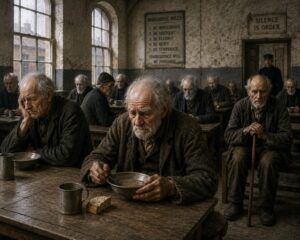
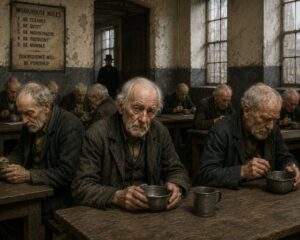
The permanent inmates were given a haircut, stripped and bathed under supervision before being provided with a workhouse uniform. Their own clothes were fumigated and placed in the store in case they ever chose to leave. For them, the sound of the first early morning bell must have been received with considerable trepidation. It signalled the time to rise from their bed as very soon the master or matron would be there to perform the roll-call. Following that, the chaplain arrived and joined them in prayers. These were taken before breakfast and later in the day, after supper. The bell was also a call for meals which had to be eaten in silence, a rule that was eventually relaxed.
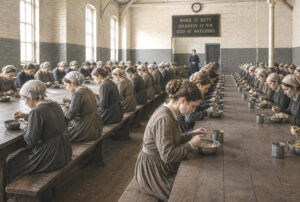 Meal time in the workhouse
The daily routine for the inmates was based on their classification with classes 2 and 5 being assigned to difficult, monotonous, and sometimes punitive labour such as breaking rocks for road-building, grinding bones for fertiliser, or oakum-picking (unravelling old ropes for use in caulking the wooden hulls of ships).
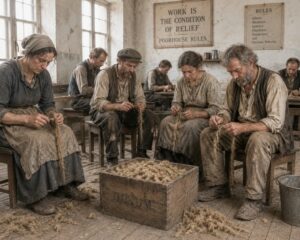 Picking Oakum
The other classes: the aged, infirm, and young, were usually given lighter tasks such as laundry, sewing, housekeeping or working in the kitchen.
Dietary portions were scaled according to class, with labourers receiving different rations to the children and the elderly. These were often adjusted in size as a punishment for bad behaviour. Some of the meals were little more than gruel and one ‘Oliver Twist’ boy was asked why he had removed his shirt. His somewhat brave retort was that he was going to dive in to see if he could find any solids!
Life was tough but there were periods of relaxation but games of chance, such as cards or dice, were banned, and idle chatter was viewed as disorderly behaviour.
Children had to attend school for at least three hours a day to learn the ‘three Rs’ and Christian principles. They also had to work – the boys at basic trades or gardening and the girls in sewing, knitting, and laundry – to prepare them for domestic service.
Meals for the children were plain and simple, usually bread, broth, and cheese, with meat served only occasionally. Second helpings were strictly forbidden so there was no “Please, Sir, I want some more.”
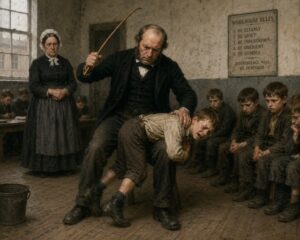
Regulations for child discipline was severe and often at the discretion of the master. For minor offenses like disorderly conduct or swearing, their food could be reduced to a meagre diet of bread and potatoes, or they could be forced to skip meals entirely. For more serious offences, physical punishment could be used on the boys (not the girls) and it was often brutal and to be administered by the master or the schoolmaster. The rules provided that no child under twelve was to be placed in a dark room or punished during the night.
The Thirteen Cornish Workhouses
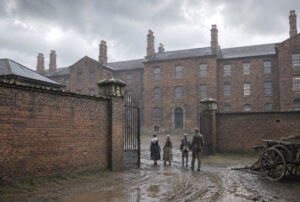
Whether through bad fortune, unwise decisions, drink or depravity, some found themselves unable to fend for themselves. With no chance to improve their situation, they took the only path available to them – to walk through a door which they may never exit.
Bodmin Union Workhouse was located off Cross Lane and opened circa 1842 with room for 250 inmates drawn from the many parish poorhouses within the Union’s jurisdiction. It became a Public Assistance Institution in 1930 and passed to the control of Cornwall County Council. It was renamed Berry Tower House, or Berry Towers. The buildings have been converted to domestic and commercial uses.
Camelford Union Workhouse was located to the west of the town and opened in 1858 with room for 80 inmates. This was one of the unions dragging its feet and it was not until 1854 that it invited ‘builders desirous of preparing plans, specifications and estimates to send tenders, plans, specifications, and estimates, for the new workhouse’. Tenders were not to exceed £1,200 and must include all costs, charges, and expenses whatsoever. 4 Royal Cornwall Gazette – Friday 13 January 1854 On closure, the site was developed for residential use.
Falmouth Union Workhouse was located at Budock, about two miles north-west of Falmouth, and opened in 1852, with room for 320 inmates. In 1898 the new Falmouth Workhouse infirmary was approaching completion and on closure as a workhouse, the building became Budock Hospital.
Helston Union Workhouse invited applications to ‘build a workhouse, in the Borough of Helston’ in 1853 in Meneage Street 5 and in 1855 it opened with room for 280 inmates.
In 1879, a fire broke out in the workhouse and the inmates, both young and old, had to be evacuated to a nearby field while firefighters tackled the blaze. A large part of the roof was destroyed but the internal damage was not great. 6 West Briton and Cornwall Advertiser – Thursday 08 May 1879
In 1948 it was taken over by the National Health Service and became Meneage Hospital providing geriatric care. The hospital closed in the 1990s and the remaining buildings were converted to residential accommodation.
Launceston Union Workhouse opened in 1838 with room for 150 inmates. 7
In December 1837, the Guardians of Launceston Union had invited tenders for the construction of a new workhouse at Page’s Cross, at the junction of Hurdon Road and Tavistock Road.
Liskeard Union Workhouse invited applications on the 4th August 1837 in the ‘Royal Cornwall Gazette’ to ‘build a workhouse at Station Road, Liskeard and in 1839 it opened with room for 350 inmates.
A new infirmary, at the west of the workhouse, was built in the late 1890s and after closure as a workhouse, the building became a hospital.
Penzance Union Workhouse opened at Madron in 1838 with room for 400 inmates. The buildings were eventually converted to residential and commercial use.
Redruth Union Workhouse opened in 1838 to accommodate 470 inmates – the largest in Cornwall – 8 and a new infirmary was added in 1897 and is still in use today.
During the First World War, Redruth Workhouse was used to house 90 German prisoners who had been captured fleeing to the USA in August 1914.
In 1948, the workhouse became Barncoose Hospital under the new National Health Service and that remained the case until 1996 when it became the Camborne-Redruth Community Hospital. The old workhouse wards were demolished in 1999 and only the 1897 infirmary remained.
St Austell Union Workhouse was built on Priory Road, to the north of St Austell town centre. It opened in 1838 with room for 300 inmates. After 1948, it became Sedgemoor Priory Hospital providing care for geriatric patients and it closed around 1969 and all the buildings were subsequently demolished.
St Columb Union Workhouse invited applications to tender in February 1838 for the construction of a workhouse at St Columb. 9 It was built to the north of St Columb Major and opened circa 1840 with room for 150 inmates.
In August 1914, a group of German Prisoners were incarcerated there and between 1915 and 1919, children from Truro Union were temporarily transferred to there while the Truro Workhouse was used as a Naval Hospital.
In 1933, the workhouse was turned into a home for ‘mental defectives’ and in January 1935 it became known as The Retreat with 111 inmates. At the turn of the century, the former workhouse was converted for use as housing.
St Germans Union Workhouse was built in Torpoint and opened circa 1839 with room for 250 inmates. The Contract for medical supplies at Millbrook Poorhouse was terminated as soon as the paupers were to be transferred to the new workhouse at Torpoint. 10
On closure in the early 1930s, the workhouse was redesignated as a Public Assistance Institution but in 1940 its use ceased and it became derelict for many years and was finally demolished in 1962 and replaced by a block of flats.
Stratton Union Workhouse was built off Bentley Drive / Hillhead Road, Stratton: it opened circa 1856 with room for 80 inmates. Strangely, an advertisement had appeared in the ‘West Briton and Cornwall Advertiser’ on Friday 28 April 1837 inviting tenders for the preparation of plans and specifications for the proposed Stratton Workhouse for 125 to 140 inmates. However, there seems to have been a reluctance to proceed and for almost 20 years, the union made use of the existing parish poorhouses. The Guardians again announced its intention to proceed and on Friday the 21st April 1854, an invitation to builders to undertake the construction as issued.
The workhouse buildings were eventually demolished and the site is now occupied by industrial premises.
Truro Union Workhouse opened ‘on the turnpike road now called Tregolls Road,’ in 1952 with accommodation for 450 inmates.
Initially, the new union made use of existing parish poorhouses and there seems to have been a reluctance to proceed with construction work but the guardians eventually announced their intention to commence building a workhouse.
Construction began in 1849 and completion was achieved by the 3rd March 1852 and it was then that Truro Union expressed their ‘entire and unqualified satisfaction’ of Samual Rugg, Surveyor Civil and Hydraulic Engineer, Architect ‘in the superintendence of the erection of the central workhouse of this union’. 11
An advertisement for a Medical Officer in April 1852 stated that the union workhouse contained about 270 inmates. West of England Conservative – Wednesday 7th April 1852
In 1898, consideration was being given to the provision of a hot water system and gas lighting to replace the use of candles.
In 1915, the building was in use as a 210-bed Naval Hospital with the inmates having been temporarily transferred to other unions. By 1919, with the war over, it re-opened as a workhouse and the inmates returned.
In 1930, Truro Institution was home to 117 inmates of various classes and in 1940 the building became the Cornwall Isolation Hospital. After just eight years it was renamed St Clements Hospital catering for geriatric patients with office space for the Cornwall Hospital Management Committee.
Another change in 1974 saw it become the headquarters of the Cornwall and Isles of Scilly Health Authority but this was to change entirely in 1996 when it was sold and converted to residential use’
News items from Cornish Workhouses
Although these reports are many, they are only a small proportion of those found, and considered for inclusion. They provide both a picture of the treatment received by the inmates and the conditions that the staff had to endure. Many are taken from newspaper reports of the time and where relevant, the references are available to anyone seeking to undertake further research.
Most of the foregoing are true cases but some (those in boxes) are of people who did not exist and although their names and comments are fictitious, they embody the lives of many who found it necessary to turn to the workhouse.
1842: Alice Gribble, an inmate at Redruth Workhouse, was found guilty of stealing blankets and sheets belonging to the union. She had been admitted with an illegitimate child and had a history of dishonesty. She was sentenced to six months hard labour.
1844: Mary Miller had ‘died by her own hands’ in the Penzance Union Workhouse in consequence of the brutal conduct of the master who had caused her to be violently forced into the refractory cell adjoining the dead-house. The master was dismissed by order of the Commissioners, but the guardians not only interceded on his behalf, but when compelled to dismiss him, gave him a vote of thanks.
1844: There were ‘41 insane persons, including six idiots and several violent lunatics’ in the Redruth Union Workhouse and it was felt that some of them should be transferred to a lunatic asylum.

1847: On Thursday, the 16th, an inquest was opened at the Redruth Union Workhouse, on the body of Richard Repper the illegitimate child of Grace Repper of Camborne. The suspicion was that the child had died from starvation and neglect on the part of the mother but after hearing evidence at great length, the jury returned a verdict from natural causes.
1851: Philip Paddy was born in 1765 and was my 4-x gt grandfather. He was the blacksmith at Tregorland Manor, St Just in Rosland, and died on the 27th Feb 1851 at Truro Union Workhouse, just over a year before it opened! So far, we have not found the answer to this conundrum and our assumption is that he died in the infirmary which may have opened in advance of the main building.
1856: Wanted, a Master and Matron for the Launceston Union Workhouse, Salary £80 per Annum, and double rations. The salary was considered to be given for the following services: The ordinary duties of the house, £60; for superintending the breadmaking in the house, £15; and for superintending the garden, £5.
1856: Grace Best gave birth to twins, a son and daughter at the Bodmin Union Workhouse. To avoid the stigma, later birth certificates often stated the street number rather than the name of the institution.
1857: Thomas Andrew, relieving officer of the St Columb Union and John Oxenham Roberts, master of the St Columb Union Workhouse were charged with intent to cause Emanuel Jenkins, a poor person, to become chargeable to the parish of Kenwyn. They arranged transport and provided money for him to leave the parish so that he would become the responsibility of another union. Both were fined but of a negligible amount.
Catherine Tyrrill was committed for one calendar month’s imprisonment, with hard labour, for deserting her illegitimate child by leaving it inside the gate of the Truro Union Workhouse.

1863: Benjamin Nicholls, a long-term inmate of Falmouth Union Workhouse, committed ‘self-destruction’ by deliberately cutting his throat whilst in the bedroom at the workhouse, from which he died in a few minutes. About two months previously he had attempted to strangle himself by putting a quantity of rags in his throat. He was described as “a most disagreeable and troublesome inmate, and fond of making mischief against the other inmates.”
1865: The employment of the industrial teacher at Truro Workhouse was to continue despite the fact that he had been found ‘beastly drunk’ on two occasions.
1866: The 244 inmates of St Austell Union Workhouse were regaled with the usual Christmas dinner of beef and plum pudding.

1868: John Perry was sentenced to a month’s imprisonment for violently assaulting John Pascoe, an old man, in the Helston Union Workhouse. Perry beat him severely with a stick and then threatened to murder him.

1868: This report was not an unusual case in union workhouses. ‘An application was made on behalf of the Guardians of the Launceston Union Workhouse to authorise one of the relieving officers of the union to receive from James Langdon the amount of an order recently made on him in a case of bastardy, tried before the bench. The complainant, Sarah Ann Snell, with her child, being chargeable to the union.’
1869: Life for the inmates was not all bad, however. The children had a summer excursions to Carn Brea and Portreath and the adults were allowed a day out a week. At Christmas, 350 Redruth paupers were treated to roast beef and plum pudding, with beer for adults and oranges for children!
1871: James Richards, a pauper at Falmouth Workhouse, was charged of attempting to murder Mr Kenwood, the master of the workhouse.
1872: The ‘East Cornwall Times and Western Counties Advertiser’ reported, ‘There can be little doubt that at a time of prosperity like the present, out-door relief should, as a rule, be refused the able-bodied. Thus, by the compulsory application of the ‘workhouse test’ to all who appealed to the Guardians for assistance, except the infirm and the aged, the way would be opened gradually for the total abolition of the system of out-door relief’.
1874: Violence towards staff, inmates and property was common and at and Camelford Workhouse inmate, Jane Pearn, was ‘committed to gaol for fourteen days with hard labour for refusing work and wilfully destroying oakum’.
1874: At Christmas in Bodmin Workhouse, about 130 inmates enjoyed a sumptuous Christmas Day dinner of roast beef and plum pudding, together with a barrel of beer courtesy of the brewery. After dinner the children were given a feast of nuts, oranges, apples and the old people were presented with packets of tea.
1875: A young man, named Tregurthon, considered to be harmless and inoffensive, had shown strong indications of lunacy, escaped from Penzance Union Workhouse. He had gone to Penzance where he had smashed windows. He did not deny the offence and said that he had climbed over the workhouse wall using a ladder. He was charged with the offence and safely confined.
1875: Outdoor Relief was organised by the Receiving Officer who reported to the Guardians of Redruth Union. It was said that the Guardians there had a reputation for meanness. In 1870 Mary Webster had requested a pair of shoes but was refused. She was so angry that she took off one of her old shoes and, aided by her mother, assaulted the Receiving Officer ‘violently about the head’. Both mother and daughter were jailed for a month with hard labour.
1875: There were so few able-bodied women in the Stratton Union Workhouse that the matron was obliged to hire women to do the laundry work.

1876: Elizabeth Bray, about 21 years of age and described as a stubborn pauper, was charged with refusing to work as an inmate at Redruth Workhouse. She had disobeyed the master by declining to scrub floors and was sentenced to 14 days hard labour.
1876: The number of inmates in the Penzance Union Workhouse was 192, an increase of 15 over the previous year.
1876: A domestic servant gave birth on Tuesday to a child at a farm house Camborne and mother and child were taken to Helston Union Workhouse. At first, they were refused admission but the mother was in a bad state and the master soon relented and they were admitted.
1877: Irregularities at Launceston Workhouse – Extraordinary Disclosures’. The ‘Royal Cornwall Gazette’ reported that the master was the subject of to an enquiry on three charges: firstly, with neglecting to maintain proper discipline in the House, secondly, with not supporting the schoolmistress as he should do and thirdly, with immoral conduct with inmates and staff.
1877: The Clerk of the Board of Guardians, applied for a summons against Thomas Hoskin, cattle dealer, for refusing to contribute towards the maintenance of his wife and seven children, who were in the Launceston Union Workhouse.

1878: A strange situation arose at Camelford Workhouse when John Purcell and W Smith, two vagrants, were charged with destroying their clothes which they tore up into hundreds of small pieces and refused to work. They were both committed for one month with hard labour. On their return to the workhouse, they used such language and violent threats against the master that he swore the peace against them before Sir Wm Onslow, who bound them over for three months. They were lodged in the Camelford lockup on Friday night, and when their breakfast was brought to them it was found that they had again torn all their clothes into shreds and were quite naked. A second suit had to be provided before they could be sent to prison.
1879: Gabriel Glanville, aged 79, a former farmer, was partaking of his tea in the St Columb Workhouse Infirmary, when he accidentally upset a tin of hot tea over his chest, causing a great shock to his system, from which he shortly afterwards died.

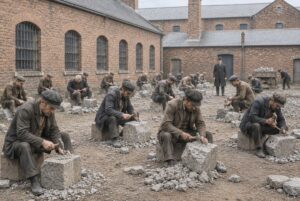 Breaking stone for the roads

1879: Tom was an inmate at St Columb Major Union Workhouse. A native of Padstow, he was celebrating his one hundredth birthday.
1880: Grace Brent, a pauper in the Camelford Workhouse, was sent to the House of Correction for seven days with hard labour for assaulting another inmate. Mr Short, the master of the house, said Brent’s conduct was so bad that he could do nothing with her: she was almost daily assaulting one or other of the inmates.

1880: Elizabeth Ann Colwill was committed to prison for seven days for disobeying the orders of the master of the Bodmin Workhouse when requested to work. Three weeks earlier, she had been sent to prison for 14 days for assaulting the master of the workhouse at Stratton.
1880: Bodmin Workhouse housed 123 inmates.
1880: Jessie Eustice, a pauper who had persistently refused to enter the union workhouse, was committed to prison for threatening the Chairman of the Guardians. Her illegitimate children had been removed to Penzance Workhouse but it was felt that if she demanded that they should be returned to her when she was discharged then the master would not be justified in detaining them. If she became an inmate of the workhouse and afterwards wished to leave with her children, neither she nor her children could be detained after the expiration of the requisite notice.
1881: The ‘Cornishman’ of the 16th June 1881 reported that Liskeard Workhouse had 157 inmates, 13 less than the previous year.
1883: Amelia Jewell, an inmate of Stratton Workhouse, was sent to prison for fourteen days with hard labour, for assaulting Elizabeth Kinsman, another inmate, and for threatening the master.
1883: A woman by the name of Kemp was apprehended and charged with deserting her three children, whom she is alleged to have left outside the door of the Redruth Workhouse.
1886: At the meeting of Truro’s Board-of Guardians it was stated that the number of inmates in the workhouse was 184 against 169 in the corresponding week the previous year. Seventy-five belonged to the Church of England, 103 were Dissenters, and one was a Roman Catholic. Cornishman – Thursday 13 May 1886
1886: Henry Blue, an inmate of Launceston Workhouse was charged with stealing eggs. He was in possession of a skeleton key and had used it to wander through the building, including the women’s ward, at all hours of the night.
1887: There were 32 illegitimate and 21 legitimate children in the Liskeard Workhouse.
1889: Emma Parnell and Eliabeth Annie Matthew, at Truro Workhouse, were warned that any repeat of bad behaviour would be punished by them having to pick oakum.
1889: Ann Sory was charged with assaulting another pauper at Camelford Workhouse with a poker and wilfully breaking some articles the property. She was sentenced to seven days hard labour.
1890: This statement by a religious minister seems to have been well-received by many liberal-minded people of the time. “I would rather be a tramp than live in many of the workhouses which, in this enlightened age, are the homes of the poor. To be voluntarily cramped within the confining walls of a workhouse, with only liberty to step outside them once a month, or once a quarter, is to make this theoretical home a miserable prison… The idea of some is to make workhouse life so repugnant to the distressed that they will half starve themselves rather than submit to being immured within the walls. There should undoubtedly be a classification of inmates, so that the deserving should be separated from the lazy and dissolute: and the lives of the aged poor should be brightened as much as possible… The suggestion of an inmate of the Redruth Workhouse that some of the guardians should come and live in the house for a week in order to see what hardships some of them suffered was received by the board with a burst of hilarity… Since the new master has taken office, the inmates have been clothed like ordinary human beings instead of in an obnoxious and hideous uniform… they are about to have new bathroom appliances in place of the rotten and unsanitary ones which should have been abolished years ago; considerable improvement has been made in the dietary of the inmates and the close-cropped hair system has been abandoned. There is no excuse for these improvements not having been made years ago but still, better late than never. This democratic sentiment is rather startling, coming from such a source, and yet it is satisfactory to know that there are ministers whose eyes are open to the great crises in the social life of the nations which are at hand.”
Nathaniel Wadge, a labourer, pleaded poverty when charged with not maintaining his four children who had been in the St Germans Workhouse since 1888. He had previously ignored the order made on him.
1890: At Redruth Workhouse, the old uniforms were abandoned in 1890 and the elderly were allowed to go for short walks at the front where seats were provided for them. Diets were also improved and hair cropping ceased.
1890: The ‘Cornish & Devon Post’ reported that Elizabeth Ann Pooley, an inmate of the Launceston Workhouse, and an old offender, was charged with breaking seventy-two panes of glass, the property of the guardians and was sentenced to two months’ imprisonment with hard labour.
‘The master [at Truro Workhouse] was authorised to punish inmates for breaking any of the rules of the workhouse. He was to report all punishment in the workhouse punishment book, which was inspected by the guardians at their fortnightly board meetings. Rule breaking could include swearing, quarrelling, smuggling food or refusing to work. For a first offence, a pauper could receive a reduced diet of bread and water. Serious offences such as damage to workhouse property or desertion were punishable by a period of solitary confinement within the workhouse refractory or punishment cell’. The House on Union Hill (The Story of Truro Union Workhouse)
1890: One of the Truro Union guardians complained that the water supply was pumped from a well operated by two imbecile paupers. He protested that the board was taking advantage of weak intellect men.

1891: St Columb Workhouse children were attending the local Board Schools.
1893: A concert for the inmates at St Columb Workhouse was described as one of the best ever given in St Columb.
1893: The Bodmin Guardians decided that “there was, at present, no necessity for the classification of inmates.” It was not a unanimous view, however. It was recorded that the inmates were very comfortable and had all the liberty they desired, both in visiting the town or walking around the workhouse grounds. The Master stated that he never refused leave to any inmate to whom he could safely grant the favour. The Guardians were anxious to attract the aged poor into the workhouse and make their life there as pleasant as possible but they faced the difficulty that the poor regarded it as a prison. It was said that they believed that once within its walls they were confined in a sort of Bastille, where they had no rights, and little intercourse with the outside world. It was necessary ‘to disabuse their minds of such an erroneous impression in order to induce the poor to come in’. It was claimed that some of the inmates, especially the old women, frequently said that if they had known they would have been so well treated there they would not have stayed out so long – it was most unfair that the idea should be spread that the inmates were badly treated in the workhouse. Inmates, when out on leave, were allowed to wear clothes which prevented their identification as paupers and instructions had been issued to the master and matron that inmates should be given food that they could eat, whether the doctor ordered it or not.
1893: It seems that, for whatever reason, the number on inmates in Bodmin Workhouse was dropping and in both 1893 and 1894 there were just 61.
1894: Charles Hunter, an elderly man, admitted into the Liskeard Workhouse on Friday, was on Saturday charged with maliciously breaking glass. He complained that the master had assaulted him and that he committed the offence after much provocation. He was sent to prison for seven days’ hard labour.
1894: Thomas Maunder, an inmate of the Launceston Workhouse ran away wearing the union clothes. He was apprehended and charged with the offence. He was then sent back to the workhouse again. (Although inmates were free to leave after giving three hours’ notice, absconding wearing workhouse attracted a charge of theft).
1894: The water supply at Bodmin Workhouse was obtained from a pump which took four men to operate but because of the scarcity of able-bodied male inmates, women had to work it. This, it was claimed, contravened the rules of the house and the guardians proposed that either men from outside the house should be employed or a supply should be obtained from the water company.
1894: Joseph Quintrell was charged with neglecting his work and escaping from Redruth Union Workhouse. The union porter testified that while he was involved in returning a mad man who had escaped into the yard, the defendant who had previously acted as watchman over the lunatic, escaped over the wall. The defendant was sentenced to seven days’ imprisonment.
By 1895, the decline in mining had forced many men to seek their fortunes abroad. More and more women and children became dependent on the parish. (E.g. 100 illegitimate children were born in Redruth Workhouse.)
1895: The workhouse infirmary at Truro was licensed for 78 beds and in winter it is probable that the greater number of beds were occupied, yet there was only one nurse in charge of the patients. It was commented, “… that whatever allowance is made for the difference between the class of patients in the Poor-law infirmaries and those in hospitals, it will hardly be maintained that these sick people are nursed in the sense in which medical men and trained nurses are accustomed to use that word.”
1895: It was not all work, however, and in August 1895 the inmates at Camelford Workhouse were taken to Trebarwith Sands and ‘were said to have thoroughly enjoy themselves’.

1895: A relaxation of a rule was announced that Liskeard Workhouse children are to play with other little ones in the fields and on the Green on Saturday afternoons.
1895: The judicious use of the straight jacket by the two nurses, acting under medical instructions, to restrain a violent old man at nights was approved by the guardians of Liskeard Workhouse.
1896: The inmates of Penzance Workhouse had their annual Christmas treat In the morning, at eight o’clock, when they had enjoyed a good breakfast of coffee and bread-and-butter, after which they unitedly sang the carol. ‘Hark what news the angels bring’. At 12.30pm came the event of the day, when they all sat down in the dining-hall to a good dinner of boiled beef, pudding and fruit, the latter kindly given by Mrs Robins Bolitho and Mrs Glynn Bolitho. After dinner a party of carol-singers, some of-whom have been doing the same kindly office for 25 years, delighted the inmates with selections of carols and anthems. They also sang in the sick wards, and were much enjoyed. At six o’ clock all sat down to a cake-tea, to which they did hearty justice. From finish of tea to nine o’clock a very enjoyable time was spent in singing carols, etc. Presents of fruit were kindly sent by Messrs. N J Hall and C Hill, grocers, Penzance.
1896: John Goldsworthy from the St Columb Workhouse, was apprehended at Porthleven for sleeping out near the limekiln and was sentenced to six days’ hard labour.
1896: George Williams was charged with attempting to commit suicide at Falmouth Workhouse on the 29th December and was remanded.
1897: A tragic case involved Charles Macdonald Langdon, a boy in Camelford Workhouse, who was suffering from measles. He had left his bed to warm himself and caught his nightshirt on fire. The Matron found him enveloped in flames and he died from his injuries.
1897: There were seven cases of diphtheritic croup in St Columb Workhouse, with two deaths; and four suspicious cases under observation. Efforts were made to prevent the disease spreading but with large numbers of people in confinement must have made it difficult.
1897: The master of Camelford Workhouse reported that he had intercepted medicine sent from London to one of the female inmates for which she had apparently paid eleven shillings. She claimed that she could not remember if she had ordered it. It was reported that she had been out of the house by permission and it was thought that she had obtained the money then. The Board decided to send the communication and the medicine to the London police.
1898: It was reported that they had got rid of most of the able-bodied loafers, leaving the Falmouth Workhouse mainly for the sick and the children. The inspector had gone into a room where he said the atmosphere could be cut with a knife. There were about fifteen men huddled together picking something pretty much equivalent to oakum, an occupation considerably discarded in workhouses. He said that such tasks had a sort of penal air about them. Surely, with land at their disposal, the Falmouth Guardians could give the men more healthy and suitable work. He did not like the fact of the boys being under the charge of an old pauper, who had nothing to earn if he looked after them well, and could not be punished if he looked after them badly.
1898: Bodmin Workhouse was accused of being twenty years behind the times. Mr Preston Thomas, a Local Government Board Inspector, referred to the hot water arrangements and pointed out that the supply to the hospital was inefficient. The cost of making the necessary alterations would be comparatively small and he thought the Board would like to be up-to-date. He also noticed that the boys slept double-bedded, an arrangement that was dying out. There was plenty of available unoccupied space and plenty of empty beds and he recommended that the children should have separate beds. In all other respects, however, he said that the house was satisfactory. As regards the increased number of casuals visiting workhouses, he recommended teaching them the ‘charms of work’.
1914: An interesting comment by the Rev. E J Hardy was entitled ‘The Women Who Couldn’t’. “The poorhouses are full of women who thought that they could reform their husbands.”
1923: During the depression following the First World War, over 600 unemployed men gathered at the workhouse to demand help. They burst in on the Guardians and demanded £1 a week for man and wife, but were forced to accept 15 shillings before being removed by the police. A similar event involved single ex-servicemen who had been offered 10 shillings a week.
1919: Mr John Pethybridge reported that the Board of Control agreed to the request to release a Liskeard woman sent to the Bodmin Workhouse by the Liskeard magistrates now that her husband was home to look after her.
1936: A sad comment from the end of the workhouse era: “We dreaded the poorhouse [workhouse], where the poor, the imbeciles, the diseased and the criminal were all mixed together.”
A comment from Michael Tangye of Redruth gives us an insight into an outsider’s view of Redruth Workhouse just before its closure. “I well recall the utter barrenness of the male ward – the iron bedsteads, the bare walls, totally void of any colour or picture, peeling paint, bedraggled curtains; then the deep groaning of the sick pauper, and in the silence of a prayer, the sound of urine being noisily passed into a receptacle – indeed the whole building reeked with the smell of stale urine and tobacco.”

For many years after its closure, the old Redruth Workhouse remained as a place of dread and many old people were afraid to be sent there. It was the case with my grandmother who died there in 1973 although she was unaware where she was.
********
In 1909, the Old Age Pension became available albeit it was means-tested. This, and subsequent National Insurance schemes, began to reduce the need for poor relief. Coupled with these measures, the support available from Friendly Societies and other charitable organisations, signalled the approaching end of the workhouse.
The Poor Law Institutions Order of 1913 reflected the changing times, it revised various rules and changed the term Workhouse to ‘Poor law Institution’.
in 1930, the end of the institutions was in sight but it was not until 1948 that they were finally abolished.
As a conclusion, I have included a 1903 poem by George R Sims. One which has become synonymous with the workhouse and one which raises a tear, even after all this time. It seems to epitomise the bleak lives of those who lived and died both within and outside these institutions.
Christmas Day in the Workhouse
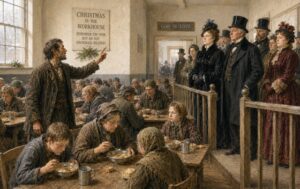
It’s Christmas Day in the workhouse,
And the cold, bare walls are bright
With garlands of green and holly,
And the place is a pleasant sight;
For with clean washed hands and faces,
In a long and hungry line
The paupers sit at the table,
For this is the hour they dine.
And the guardians and their ladies,
Although the wind is east,
Have come in their furs and wrappers,
To watch their charges feast;
To smile and be condescending,
Put pudding on pauper plates.
To be hosts at the workhouse banquet
They’ve paid for – with the rates.
Oh, the paupers are meek and lowly
With their “Thank’ee kindly, mum’s!”
So long as they fill their stomachs,
What matter from whence it comes!
But one of the old men mutters,
And pushes his plate aside:
“Great God!” he cries, “but it chokes me!
For this is the day she died!”
The guardians gazed in horror,
The master’s face went white;
Did a pauper refuse the pudding?
Could their ears believe aright?
Then the ladies clutched their husbands,
Thinking the man would die,
Struck by a bolt, or something,
By the outraged One on high.
But the pauper sat for a moment,
Then rose ‘mid silence grim,
For the others had ceased to chatter
And trembled in every limb.
He looked at the guardians’ ladies,
Then, eyeing their lords, he said,
“I eat not the food of villains
Whose hands are foul and red.
Whose victims cry for vengeance
From their dark, unhallowed graves.”
“He’s drunk!” said the workhouse master,
“Or else he’s mad and raves.”
“Not drunk or mad,” cried the pauper,
“But only a haunted beast,
Who, torn by the hounds and mangled,
Declines the vulture’s feast.
I care not a curse for the guardians,
And I won’t be dragged away;
Just let me have the fit out,
It’s only on Christmas Day
That the black past comes to goad me,
And prey on my burning brain;
I’ll tell you the rest in a whisper
I swear I won’t shout again.
Keep your hands off me, curse you!
Hear me right out to the end.
You come here to see how paupers
The season of Christmas spend;
You come here to watch us feeding,
As they watched the captured beast.
Here’s why a penniless pauper
Spits on your paltry feast.
Do you think I will take your bounty,
And let you smile and think
You’re doing a noble action
With the parish’s meat and drink?
Where is my wife, you traitors
The poor old wife you slew?
Yes, by the God above me,
My Nance was killed by you!
Last winter my wife lay dying,
Starved in a filthy den;
I had never been to the parish
I came to the parish then.
I swallowed my pride in coming,
For ere the ruin came,
I held up my head as a trader,
And I bore a spotless name.
I came to the parish, craving
Bread for a starving wife,
Bread for the woman who’d loved me
Through fifty years of life;
And what do you think they told me,
Mocking my awful grief,
That ‘the House’ was open to us,
But they wouldn’t give ‘out relief’.
I slunk to the filthy alley
‘Twas a cold, raw Christmas Eve
And the bakers’ shops were open,
Tempting a man to thieve;
But I clenched my fists together,
Holding my head awry,
So I came to her empty-handed
And mournfully told her why.
Then I told her the house was open;
She had heard of the ways of that,
For her bloodless cheeks went crimson,
and up in her rags she sat,”
“Bide the Christmas here, John,
We’ve never had one apart;
I think I can bear the hunger
The other would break my heart.”
“All through that eve I watched her,
Holding her hand in mine,
Praying the Lord and weeping,
Till my lips were salt as brine;
I asked her once if she hungered,
And as she answered ‘No’,
The moon shone in at the window,
Set in a wreath of snow.
Then the room was bathed in glory,
And I saw in my darling’s eyes
The faraway look of wonder
That comes when the spirit flies;
And her lips were parched and parted,
And her reason came and went.
For she raved of our home in Devon,
Where our happiest years were spent.
And the accents, long forgotten,
Came back to the tongue once more.
For she talked like the country lassie
I woo’d by the Devon shore;
Then she rose to her feet and trembled,
And fell on the rags and moaned,
And, ‘Give me a crust – I’m famished
For the love of God!’ she groaned.
I rushed from the room like a madman
And flew to the workhouse gate,
Crying, ‘Food for a dying woman!’
And the answer came, ‘Too late’.
They drove me away with curses;
Then I fought with a dog in the street
And tore from the mongrel’s clutches
A crust he was trying to eat.
Back through the filthy byways!
Back through the trampled slush!
Up to the crazy garret,
Wrapped in an awful hush;
My heart sank down at the threshold,
And I paused with a sudden thrill.
For there, in the silv’ry moonlight,
My Nance lay, cold and still.
Up to the blackened ceiling,
The sunken eyes were cast
I knew on those lips, all bloodless,
My name had been the last;
She called for her absent husband
O God! had I but known!
Had called in vain, and, in anguish,
Had died in that den – alone.
Yes, there, in a land of plenty,
Lay a loving woman dead,
Cruelly starved and murdered
for a loaf of the parish bread;
At yonder gate, last Christmas,
I craved for a human life,
You, who would feed us paupers,
What of my murdered wife!
There, get ye gone to your dinners,
Don’t mind me in the least,
Think of the happy paupers
Eating your Christmas feast;
And when you recount their blessings
In your smug parochial way,
Say what you did for me, too,
Only last Christmas Day.”
End notes:
- https://bernarddeacon.com/2020/02/18/resisting-the-workhouse-poor-relief-in-nineteenth-century-cornwall/
- The ‘Poor Rate’ was a local tax in England and Wales used to fund relief for the destitute. Established under the Poor Relief Act of 1601, parish overseers assessed and collected this tax from property occupiers. The funds supported the elderly, ill, and orphans, laying the foundation for modern local property taxation
- https://bernarddeacon.com/2020/02/18/resisting-the-workhouse-poor-relief-in-nineteenth-century-cornwall/
- Royal Cornwall Gazette – Friday 13 January 1854
- Exeter and Plymouth Gazette – Saturday 08 October 1853
- West Briton and Cornwall Advertiser – Thursday 08 May 1879
- Royal Cornwall Gazette – Friday 08 December 1837
- Cornishman – Thursday 1st June 1899
- Royal Cornwall Gazette – Friday 23 February 1838
- Royal Cornwall Gazette – Friday 01 March 1839
- West Briton and Cornwall Advertiser – Friday 19 March 1852
Sources:
- Various Newspaper reports
- The House on Union Hill (The Story of Truro Workhouse) by Lin Eudon ISBN 978-1-5262-0551-3
- The work of Peter Higginbotham recorded on https://www.workhouses.org.uk
- https://en.wikipedia.org/wiki/English_Poor_Laws
- Workhouse scenes created using ChatGPT
- https://en.wikipedia.org/wiki/Workhouse
Further Reading:
- ‘Memories of the Union Workhouse – Barncoose’ Redruth OCS 90th Anniversary Booklet.
- The House on Union Hill (The Story of Truro Workhouse) by Lin Eudon ISBN 978-1-5262-0551-3
- Peter Higginbotham records on https://www.workhouses.org.uk
- https://en.wikipedia.org/wiki/English_Poor_Laws

Tony Mansell is the author of several books on aspects of Cornish history. In 2011 he was made a Bardh Kernow (Cornish Bard) for his writing and research, taking the name Skrifer Istori. He has a wide interest in Cornish history, is a researcher with the Cornish National Music Archive and co-editor of Cornish Story.