
Cornish Religious Revivals
By Tony Mansell
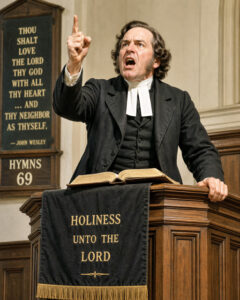
The chapel was packed: every seat filled, every corner occupied. The response was huge and they now listened intently to the impassioned pleas of the revivalist preacher. Soon, he would have them in the palm of his hand. Soon, there would be no turning back. It will be just a few to begin with but before long the entire congregation will be affected, stirred into a frenzy of religious fervour by the rhythmic incantations of the speaker. Then it began … loud cries and violent gesticulations. Some sank to their knees with upraised arms. Some fell to the ground and roared. All crying out for mercy. Everywhere there was turmoil, shouts, groans and sounds like the noise of wild animals – on and on, unending for hours until exhaustion finally took over.
One New Connexion minister described a Cornish revival as very stormy, enough to “astound and alarm you frigid northerners.”
Religious revival meetings were impassioned outpourings intended to encourage repentance, renew faith and achieve mass conversions. They involved passionate preaching, public prayer, singing and testimonies of faith and were usually led by a revivalist, a preacher with a gift for inspiring and motivating congregations.
My memories of ‘hell fire’ preachers in the 1950s still linger in my mind. They were a bit scary to this young lad but they were tame affairs compared to the events of a hundred years before.
Michael Marcel toured the revival sites of West Cornwall and wrote, “I was surprised to find that there appear to have been more revivals in that part of the nation than anywhere else in the world, except probably Wales.” (1)
Within Cornwall, they occurred mainly in the nineteenth century but Marcel refers to one taking place at St Just in 1782 and another at Redruth in 1794, when the Reverend Joseph Benson led a revival meeting and hundreds remained the whole night in the chapel.
In Fire from Heaven (see Further Reading), Paul Cook wrote that in 1799, “revivals broke out in many places.”
The Great Revival of 1814 started in the Camborne/Redruth area and one claim states that it had its beginnings at a prayer meeting in Redruth Workhouse. It quickly spread to involve the whole peninsula beyond Truro. There were many meetings with huge numbers crying out for mercy and many conversions – 2,000 converted in the first week and 5,000 to 6,000 within a few weeks,
It spread like an epidemic and at Truro, two spinsters, Elizabeth and Mary Downe, were expelled from the Bible Christian community for excessive fervour including shouting and screaming during the services. They founded a new order, built a chapel and became known as the ‘Shouters or Trumpeters’. Thomas Preston of Norfolk described them. “[They] are vulgarly called ‘Shouters and Jumpers’ … they pretend they are inspired by the Holy Spirit, and throw themselves into convulsions sometimes on the floor, sometimes jumping or as they think most applicable… Some make the noise of a cock, others the screech of an owl. One night they made such a noise and at such a late hour, the constables forced open the door and broke up the meeting.” (2)
Porthleven, Breage and Ponsanooth held revival meetings in 1817 and of one Bible Christian meeting William Lyle, Primitive Methodist Minister, recorded, “In the evening, the Lord was present with a mixt multitude: some fell down crying for mercy; whilst others were so overpowered by the Spirit of God, that they were encouraged to carry them away between two. Monday we were at St Neot and oh what shrieks and cries did I hear…”
Paul Cook in his paper, The Forgotten Revival, refers to the work of Cornishman William Carvosso in Mousehole and the revival there in 1818. “They were brought to repent of their disunity. This was followed by earnest prayer being offered to God to revive his work among them.” The home prayer meetings increased so rapidly that they had to be transferred to the chapel and soon, hundreds were attending the and the whole town was filled with a sense of the presence of God. (3)
The Reverend Thomas Shaw referred to Wesleyan preachers who told Bible Christians, “You are possessed with the spirit of the devil.”
Revival meetings were held in Camborne and Tuckingmill during 1821 and 1822, at Kehelland in 1822 and at Constantine in 1823.
Historian Michael Tangye researched and recorded a sad case in Redruth. It was held at the Redruth Wesleyan Chapel over six or seven weeks in January and February 1824. The meeting house was kept open and used for two or three days both by day and night. One of those who attended was Emma George, a 19-year-old Bal maiden, who was so affected that she returned home and hanged her young brother so that he would go to heaven. (4)
Ponsanooth held a revival in 1824, Mevagissey, Mylor Bridge and Flushing in 1827, Mousehole in 1828, Camborne in 1831 and Mylor Bridge and Flushing again in 1833.
In 1834, the St Austell circuit reported, “we have been favoured, during the last six weeks, with a copious outpouring of the Holy Spirit’s influence.” This ‘move of God’ spread to the surrounding areas as well as the town itself. (5)
One newspaper was less impressed with such meetings as it reported on one at Porthtowan in 1838: “We are informed that what is called a Revival of Religion has occurred among the Wesleyans Methodists at Port-Towan, in consequence of which about 70 have been added to the Society. We rejoice at the spread of religion everywhere but, having paid much attention to the subject of revivals, we have formed so decided an opinion of their hurtful effects, that we are always sorry to hear them.” (6)
Redruth had another revival in 1839 and at Skinners Bottom in the 1840s, there was a nine-week revival during which miners cried for mercy. (7)
The Revd William Haslam claimed that revivals were happening every year but whether or not that is true, they did occur very frequently either in one location or over a large area of Cornwall.
The Revd William Haslam, Vicar of Baldhu, was a committed revivalist which was unusual as he was an Anglican. He visited Mount Hawke in 1852 and later wrote of his experience. “Here on the appointed Saturday afternoon I found no fewer than 3,000 people assembled on the Common, they had erected a kind of platform with a canvas awning to shelter me from the wind. There I stood and beheld the concourse of people evidently full of eager expectation. I gave out the hymn, ‘Oh for a thousand tongues to sing, my Great Redeemer’s praise,’ this was heartily sung and after prayer I announced my text: ‘Christ Jesus came into the world to save sinners’. I pressed the thought and a mighty power of the Spirit of the Lord came on the people. It was quite impossible to go on preaching. After about an hour someone suggested that we should go to the schoolroom as it was getting dark. The clergyman of the parish was in the lane watching proceedings. I asked him if we could have the use of the schoolroom, ‘Oh yes,’ he replied, ‘certainly, certainly, anything’. He seemed very frightened. When I reached the place, I found it impossible to get in for it was already full besides a throng standing at the doors. I was taken to a window at last and got in through that. Against the wall, men had after miner’s fashion, set up with clay, some candles which were beginning to bend over with the heat of the room. I left at 10 o’clock and the meeting continued all night and all the next day without cessation. That same meeting was prolonged without any intermission day or night till the evening of Sunday, the eighth day after it began.” (8)
The Revd Joseph Whitehead recorded his memories of his time at St Agnes during 1853 to 1855. “The people yield themselves up to the spirit of excitement on these occasions and the effects are somewhat extraordinary. When a person is awakened by the Word and Spirit of God, and gives evidence of it, he is said to be ‘taken down’ and sometimes an individual so affected falls down in his pew and cries aloud for mercy.”
John Peek, from the Callington area, kept a diary in which he recorded an 1860 meeting when a revival broke out in the chapel and several were converted and others convicted of sin.
At Blackwater in November 1881 there was said to have been a “Great revival … when people were afraid that the world was coming to an end.”
This newspaper report was headed, “A Strange Story of a Great Revival Time in Cornwall 1887,” and here I include it in full. “… About that time, too, a great revival broke out. Why, in a few days it spread and spread about. Of course it began in the chapels and nearly all Sunday it went on, and then on week nights, every night, prayer-meetings and revivals: sometimes one or two, sometimes five; and many as twenty converted in one night – men shouting till they were so hoarse they could hardly speak; young men and young women, boys and girls, and little children shouting, yes, little children. That brings to my mind what old Dickey Dobma said to a little boy who had been on his knees crying to the Lord to have mercy on him and then said he believed and jumped-up rejoicing. Dicky said to the boy, ‘Now theer’t converted isn’t that better for thee than a penny orange?’ Tis true, for several people heard him say it to the boy. He was very queer, old Dickey was, and said very queer things … Well, the revival spread about till it got into the mines. It would sometimes break out in the daytime; all work would be stopped; and there would be nothing hardly all day long but people praying, singing, and crying for mercy or shouting ‘Glory, glory, glory,’ and the mine-girls would be seen tearing the finery off their hats and bonnets, because they suddenly thought it wasn’t right for religious people to wear it … Then from the floors it spread to underground, and men left their work and went to pray and sing in the plats and levels, all the underground places ringing with the sound; and they came up sweating and hoarse, and had meetings in the dry and the blacksmith’s shop and all about. But there were something very funny about it too, though I don’t think such things should be made fun of if one can help it. … Then there was a poor girl, who spoke of her experience at a love-feast and she told how that the preacher had alarmed her by telling her what was coming on the earth to punish the sinners. He said there would be earth-cakes and pistols and famines and fisterlas all comen upon the face of the earth; and I got converted. … And now people do say that I am so happy as forty cats in a bonfire. And there was a poor old woman got converted, and when she went to class-meeting, her leader, when he began to give his advice to the old-woman, said, ‘You must deny yourself and cut off the right hand and pluck out the right eye’. So upon that the old woman looked up frightened and said, ‘Why, my dear creetar, I can’t afford to do that, for I got my living to git’. But there was a dear man that was so happy and excited that he used to fall into a trance now and then and see such wonderful things. His wife had died not long before and the old woman was blind in one eye. One time, after the old man had got out of a trance and was telling what he had seen and heard, he said, ‘I seed beetiful things you don’t know and I heerd beetifil singen and seed beetiful angeels with dimonds for their wings, and I seed my old woman Matha – up there too – weth wings and dimonds pon them, and I knowed her quite well too, cause, don’t e see, I should be sure to know Matha, cause she only got one eye. And they was all singen such beetiful things and hymns.’ So they said to him, ‘What hymns did you hear them singing?’
‘Why,’ said he, ‘I heerd them singin And am I born to die, to lay this body down’. Then the girls, from the excitement of the meetings and the awful stories they heerd from the pulpits and other places, used to have fits; and one of them – a great, big, strong girl, at one of the mines – had those fits quite commonly. She would be taken suddenly and go off without any warning, and she would be so strong and so violent that it took several men to hold her; then all at once she would be quiet; and then she would open her great glassy eyes and fix them upon one-spot and stare a most unearthly stare for some minutes. Oh, it was terrible to look at. All at once she would come to herself and seem stupid and wondering, as if she had just waked up from sleep…” (9)
Not everyone considered revival meetings to be a force for good and occasionally a voice was raised against them. In part perhaps, because of the influence they had over weak-minded people but also because the resultant increase in membership was usually followed by a decline.
It seems the frequency of such meetings was beginning to slow by the last few years of the century and I can offer no reason for this other than the weight of opinion against them. Even the Methodist conference raised its concern about them and the judge in the 1820s Redruth Revival Murder (above) urged pastors and teachers to, “… suppress these extravagant reactions against their weaker listeners,” or steps will be taken against them.
A letter to a Cornish newspaper in 1885 from ‘A London Reader,’ also deprecated them. “In Cornwall, more than in any other part of the country, have I found the opinion – or some would perhaps prefer to call it conviction – to exist, that a man is ‘doomed’ unless ‘converted at a revival’ – a process that is considered incomplete if unaccompanied by hysterical shouts or ‘transports of joy,’ as they are sometimes described.” The writer goes on to quote from a sermon by an American Methodist minister, the reverend Dr R S Foster, in which he considered that for the most part they do more harm than good. Dr Foster denounced them as “noisy services and religious crudities” and asked his fellow Christians to cease calling a man a sinner because he does not shout. (10)
The last occurrence I have found was at Skinners Bottom on the 22nd January 1891 where there was said to be a “Revival going on at Skinners Bottom Chapel.”
These revival meetings were of a different age, when religion played a far bigger part in most people’s lives. It is difficult for us to understand the fervent reaction to the impassioned revivalists promising salvation to a largely illiterate and downtrodden population. Perhaps though, the congregations were eager for salvation that all it needed was someone to light the fuse, someone with the ability to whip a crowd into a frenzy.
End notes:
This paper has been compiled with information drawn from many authors and commentators on the subject of Cornish Religious Revival.
- Michael Marcel in uk wells (https://ukwells.org/revivalists/revival-cornwall)
- https://cornishstory.com/2021/01/03/mapping-methodism-truro-shouters-or-trumpeters/
- https://www.evangelical-times.org/the-forgotten-revival/
- https://cornishstory.com/2023/11/15/the-redruth-revival-murder/
- Michael Marcel in uk wells (https://ukwells.org/revivalists/revival-cornwall)
- Falmouth Express of the 20th October 1838
- J C C Probert Primitive Methodism in Cornwall
- Memories of Mount Hawke by Clive Benney and Tony Mansell ISBN 978-0-9545583-7-6
- Cornishman of Thursday the 5th May 1887
- Royal Cornwall Gazette of Friday the 2nd October 1885)
Further Reading:
Revival Cornwall by Michael Marcel: (https://ukwells.org/revivalists/revival-cornwall)
The Forgotten Revival by Paul Cook: https://www.evangelical-times.org/the-forgotten-revival/
Fire From Heaven – Times of Extraordinary Revival by Paul Cook. ISBN 13 978-085234-709-6
Diary of John Peek of St Cleer – Kresen Kernow reference AD909/1
Tony Mansell is a Cornish historian with a diverse interest in Cornwall’s past and present. He is a Cornish Bard (Skrifer Istori), a researcher with the Cornish National Music Archive and Co-editor of Cornish Story.

Very interesting and well written. Thanks Tony.
I’ve known about Cornish revivals for a long time but never thought of them as being such rowdy affairs; more as mass conversions in which miners and others swore off drink while perhaps waving their arms and shouting the occasional ‘Hallelujah’.
Thanks Marion, Tony