
Poverty and the Poorhouse
By Tony Mansell
Writing this article has been a sobering experience. I have developed a better understanding of those who were forced to seek relief, and the realisation that some of my ancestors were among those who entered the poorhouses, begging for help, has enhanced my empathy. Of course, there were the undeserving and scroungers but many, perhaps most, were deserving cases for whom destitution had shaped the course of their lives.
This article is in two parts: the first covers what happened in the distant past including when parishes were required to provide for those unable to care for themselves.
Part two will follow at a later time and covers the period from the introduction of the 1834 Poor Law Amendment Act which brought with it the Poor Law Unions and their ‘dreaded’ workhouses.
Setting the Scene
Early attempts to relieve the suffering of the poor was largely down to religious societies and guilds. They attempted to prioritise the needy – the widows, sick and disabled – and to differentiate between those who were willing to work but could not, and those who were able to work but would not. The monasteries, often described as less than perfect, were an important source of charitable help by distributing food – clothing and money left at their doors by well-meaning parishioners. This was swept away, however, with their dissolution in the mid-1500s by Henry VIII and Thomas Cromwell: it left a void and until that was filled, If people couldn’t beg, borrow or steal, they often starved.
Begging was common in a society reeling from plagues and natural disasters and, regrettably, it was aggravated by its attraction to able-bodied individuals who chose it over a hard day’s work.
A detailed examination of all the laws relating to the poor has not been made but it is hoped that the following extracts demonstrate Parliament’s attempts to address the twin problems of poverty and refusal to work. It also shows how we have become a more caring and tolerant society. Some may claim, too tolerant, and it does seem that every age has had its ‘entitled individuals,’ those who choose not to work whilst accepting ‘hand-outs’ from society. A frustrating attitude and disincentivising to those who get up in the morning and go out to ‘earn a crust’.
The Vagabonds Act of 1547 defined a vagrant as an able-bodied person who refused to work. It has been described as brutal because of the punishments inflicted and without doubt, it was a law that advocated the ‘stick’ rather than the ‘carrot’. Those caught begging or wandering were brought before local leaders and branded on their chest or forehead with a large ‘V’ (for vagabond). They could also be handed to another person as an unpaid slave for a period of two years. If they absconded, they could be branded with an ‘S’ and forced to remain a slave for the rest of their life. A second escape attempt was treated as
treason and punished by death. The punishments were consider so cruel and extreme that local magistrates often refused to inflict them and because of that, the law was repealed just three years later.
The first ‘Poor Rate’ 1 was introduced under the Vagabonds Act of 1572. It established the principle that if the able-bodied poor needed support, they had to work for it. For those unable to work, however, the state sought to provide help – or more correctly it sought to ensure that help was provided – so that the deserving poor had a place to live and enough food to survive. The Act shifted the responsibility for poor relief from the church to local parishes and introduced a compulsory tax on households to meet the cost.
The 1576 Act for the Relief of the Poor directed that ‘Houses of Correction’ 2 were to be built by subjecting able-bodied individuals to incarceration where they were made to work. It sought to eradicate ‘masterless men’ and the scourge of unemployment and those convicted were often flogged in an attempt to make them conform.
The 1598 Act for the Relief of the Poor directed that four officials were to be appointed in each parish (usually churchwardens or local inhabitants of some standing) as ‘Overseers of the Poor’ 3 (previously termed ‘Collector of Alms’). Their role was to assess the Poor Rate, collect it, and distribute the relief. Being totally local, these overseers were considered to be well-placed to decide if claimants deserved the help. The system relied on their impartiality and honesty and it was reasonably effective and in place for many years.
The 1598 Act for the Punishment of Rogues abolished the death penalty for vagrants but travellers found begging were to be whipped and returned to their own parish.
The Poor Law of 1601 amalgamated previous measures and encouraged the establishment of almshouses 4 which were built and supported by private donations to look after the people who were believed to be the deserving poor.
Under this law, the poor were categorised:
- The Impotent Poor: the sick, elderly, blind, and disabled who couldn’t work, were to be providedwith indoor relief 5 (housing) or outdoor relief, 6 (money, food and clothes) while living in their own homes. For many years, this was the main form of support in England and Wales.
- The Able-bodied Poor: those able to work but unable to find employment were to be given jobs in poorhouses or have their wages supplemented.
- The Idle Poor: the vagrants, beggars and others too lazy to work, were to be considered criminals and sent to a House of Correction where they could be whipped if they still refused to work.Also under this Act was the requirement that the children of paupers and the destitute were to be set to work. It empowered parish churchwardens and overseers of the poor to ‘bind out’ poor children as ‘parish or pauper apprentices’ if their parents could not afford to maintain them. Boys until aged 24 (later reduced to 21) and girls until aged 21 or until they married. This was so ‘they could become productive members of society’.
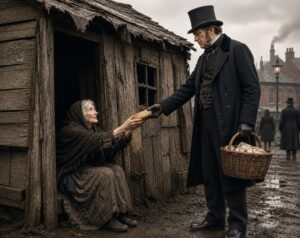
An overseer delivering bread to an aged widow
The Workhouse Test Act of 1723 forced poor people to enter a poorhouse and do manual labour if they wanted to receive financial help. Parishes used this ‘test’ to reduce the cost of outdoor relief, although it didn’t eliminate it, and to deter claims from the undeserving. It was a way to test if a person really needed help and many starving or homeless people had to accept the harsh conditions of a poorhouse or go without. It directed that in return for providing poorhouses, parishes could retain any profits from the paupers’ labours. It also permitted parishes to unite and build larger, more cost-effective poorhouses.
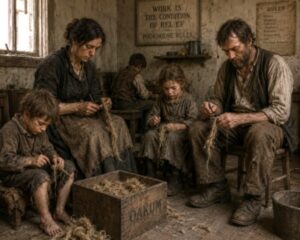 A family picking oakum
Those who had to fund the provision of help for the poor, the wealthiest householders, were becoming increasingly angry at having to meet the cost of providing outdoor relief and there are many documented cases of violent protests across Cornwall. Because of this, many more poorhouses were brought into use and most parishes had at least one. In spite of this, there were many paupers who steadfastly refused to enter them and even cases where husbands chose to sell their wives rather than do so.
The sequence of measures described above changed how society viewed the poor, how it helped them, and how the work-shy were dealt with. The gradual shift from outdoor relief to one where those seeking help had to relinquish their independence was huge and paved the way for the future Poor Law Amendment Act of 1834 and its dreaded workhouses.
Cornish Poorhouses
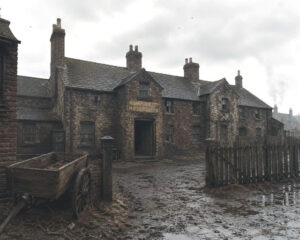
There is a blurred line between the term poorhouses and workhouses and I have chosen to use the term, poorhouse here, so as to differentiate with what came later
There must have been more than a hundred spread across Cornwall varying in size and condition.
Bodmin’s Poorhouse was built in the 1750s and James Neild, the Quaker and prison reformer, visited there in 1804 and found it in a very dirty state. He was shown into a room where a poor lunatic was confined, stretched out on a bed of dirty straw and rags. He referred to the man’s fixed, intent eyes, his shaggy hair, long beard, dirty and livid face which gave him the appearance of a monster rather than a man. James wrote, “He took no notice, either when I opened the door or during the time I was in his room, but when I came close up to him, he took his eyes off his book and looked at me with a more forcible appeal to humanity than I had ever felt. The floor of this room was earth, and literally a puddle of water and dirt more than one inch deep. It was with difficulty I could step into it without treading in his excrement, which laid everywhere about on the floor; and, from the appearance of what was in the fire-place, must have been there a fortnight or more. The keeper had most unmercifully beat the poor fellow, and given him two black eyes. I endeavoured to investigate the matter, but the mistress kept such an incessant clack that I could not put in a word edgewise.” 7
James Neild also visited Launceston Poorhouse where, “… a scene of filth, rags, and wretchedness, presented itself… The large room below stairs has a mud-floor; and whole families, men, women, and children, pig together. The upper room had several bedsteads in it, with the most ragged and dirty bedding I ever saw; the windows very small and closed, the want of ventilation and decent cleanliness produced a stench almost insupportable. I was in the room but a few minutes, before I was seized with sickness, which obliged me to withdraw.” 8
It is not known when Redruth had its first poorhouse but a comment in 1798 refers to the building, or possibly rebuilding, of a workhouse in the west end of the town. In some respects they were the workhouses of the future in that able inmates had to undertake work to pay for their keep. In 1829, the Redruth Workhouse was inspected and found to be wanting in terms of clothing and food. One of the inspectors requested to see a certain man’s bed and found that it was, “Totally without bedding of any kind and the room not fit to stop in.” It was also recommended that disorderly females be separated from the old women and children and that parish apprentices, who are returned for bad conduct, should be sent out for employment, “as they are too old to be kept in idleness.”
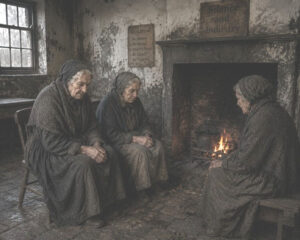 All hope gone
and disorder” and he hoped that the union authorities would take action to close them. The Commissioners responded by suggesting that it should be sold but if it were not, then they would take steps to enforce a proper regulation and management of the paupers who lived there. They concluded, “it is a workhouse in the meaning of the law.” 9
This extract from a post 1893 article, ‘Truro in the Old Days – How the Poor Were Provided For,’
commented on how and where the poor were cared for before the union workhouse at the top of Tregolls Road opened. “Most, if not all of the parishes that now comprise the Truro Board, had its own poorhouse, and it is said that there was great disparity at the way the poor were cared for. The three Truro parishes each had its poorhouse.”
The original St Mary’s Poorhouse, in St Clement Street, Truro, seems to have been built in the 1740s and a report in 1777 states that it could accommodate 56 inmates. In 1779, the building was deemed inadequate and the Corporation granted St Mary’s a 500-year lease on Hospital Meadow on which to build a new workhouse for eighty inmates. The new St Mary’s Parish Poorhouse was built to the rear of the Pydar Street Almshouses on ground which had been used as grazing land for a cow which had provided milk for the Almshouse residents. Then, ignoring the terms of the deed, a corporate need took over and the land was used for the erection of a workhouse and later, the Town Prison. The Poorhouse opened circa 1781 and served the parish of St Mary until Truro Union Workhouse opened.
Another extract from the article ‘Truro in the Old Days – How the Poor Were Provided For,’ referred to the former St Mary’s Poorhouse being the 1893 isolation hospital for infectious diseases.
Heritage Gateway has this to say about St Mary’s Poorhouse:
“The 1841 Tithe for Truro St Mary’s records a poorhouse at this location. By 1907 the same building is marked but is recorded as an Isolation Hospital and is still recorded on the 1933 edition of the OS 1:2500 historic maps. It was an open ‘U’ shape building with loggias around the central courtyard. Built in 1779, … it was closed when the Truro Workhouse opened at the top of Tregolls Road in 1851, and the building was acquired by Truro Council in 1891 for use as an infectious diseases’ hospital, opened in 1893. It treated patients with diphtheria, scarlet fever, typhoid fever, erysipelas, tuberculosis and measles, until its closure in 1925. The building was demolished in 1966.” 10
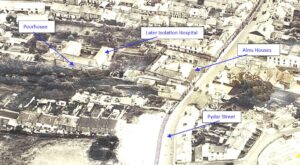
St Mary’s Poorhouse
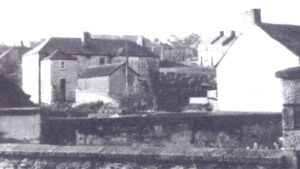
St Mary’s Poorhouse circa 1781 to 1852
St Clement Parish Poorhouse, Truro, was at the top of St Clement’s Hill and is now a house called Penarth. It was built in 1829 for 150 inmates and Heritage Gateway has this to say about it: “Extant C19 boundary wall associated with an extant C19 workhouse. The surviving sections of walling are important for their physical form in defining spaces and the status and security of the more private external areas within the historic complex as well as for their historic value in terms of their construction, design and character as an integral element of the heritage assets. The surviving traditional slate coping, the construction and external finishes, the wall alignment and continuous nature and extent of the enclosure afforded by it are important aspects of the significance of this element of the historic building complex.” 11
The post-1893 article ‘Truro in the Old Days – How the Poor Were Provided For’ states that St Clement’s Poorhouse was at the top of St Clement’s Hill, that the premises were being adapted by Messrs Whitley and Crowle, and that it became known as known as Penarth.
Kenwyn Parish Poorhouse, Truro, was at the top of Kenwyn Street, at the corner with Back Lane, now City Road. Heritage Gateway states that in 1851 the workhouse in Kenwyn Street housed only 43 girls, two servants and their school mistress. It also locates it on a 1776 map as being a few doors down from the corner but it may have stretched that far. 12
This extract from an article (unknown source) stated: “The Kenwyn Poorhouse was at the top of Kenwyn Street, just at the corner of Back Lane (now City Road). Some of the old walls are yet standing, though there are several new houses on the site, and the street has been widened and improved. There was a courtyard in the centre, and the entrance gate was just at the corner, at the junction of the two roads. Just inside the gate were the porter’s rooms and the kitchen. Reminiscences of the liberal fair provided have been handed down. ‘Pudden’ full of figs and ample supply of gravey [sic] sharpened the appetite of the youngsters who peered through the chinks of the door, for those inside this particular house fared better than many of the folks outside. Many of those in the house lived in separate apartments. The place was more like a cluster of cottages with a dining hall supplied by a common kitchen, than the present workhouse style of management. There were also two apartments for mad people, in which the poor unfortunates were kept chained, as a brute to the bed. Afterwards this property was converted into cottages (now Rilstone’s Court) …” 13
In 1820, two inmates, Jane and Mary Ann Waters, sisters, were sent to Bodmin gaol for assaulting the master of Kenwyn Poorhouse where they had been admitted as paupers. They had refused to have their hair cut short and, in resisting, had assaulted the master and a female attendant and threatened the life of the mistress. Eventually, their hair was cut and they were transferred to the House of Correction as the only place in which they could be safely trusted. 14
The St Agnes Poorhouse seems to have opened its doors in the late 1600s when it was located on the right of the main road heading out of the village towards Truro. It was opposite Presingoll Farm, just before the railway station. Were they Almshouses or poorhouses? Both names have been found and to some extent, they are interchangeable but, in general, almshouses were provided by charitable organisations (which these were initially) and poorhouses were supported by the parish which is what the St Agnes building became in 1833.
Heritage Gateway has this to say about St Agnes Poorhouse: “Nicholas Kent of Mingoose…devised to John Hosken, vicar, Hugh Tonkin Esq. and Michael Crocker, Gent. a dwelling house and garden, which said house is divided into four rooms and four poor widows placed by him therein – to be replaced by another widow whenever one of the rooms shall become vacant … The house no longer exists” 15
St Agnes historian, John Branfield, wrote that, “The building of the poorhouses, and their upkeep, was funded through the 1688 will of Nicholas Kent. They were to provide houses or rooms for one or more poor decayed widows not having to pay of the parish. By 1833, the responsibility for the almshouse was in the hands of the Overseers of the Poor, a committee usually of churchwardens and substantial householders whose duty it was to set the poor to work and see that ratepayers’ money was well spent.” 16 Only eight years later, in 1841, despite the cost of recent repair work, the poorhouse was demolished. 17
This report in the ‘Royal Cornwall Gazette’ of Friday the 24th August 1849 reflected on the old poorhouses of about 20 or 30 years previously. “Each of them [the parishes] indeed had a house, but it was a mere independent residence for the inmates, who lived in it as they might have done in their own cottages. Thus Gluvias poorhouse contained four men, ten women, and two children, under no authority or control whatever. One of the women was charged with the care of the house, and received, with her bedridden husband, just the same allowance as the paupers. The helpless received 3s. per week for men, and 2s. 3d. for women, with fuel, clothes, and bedding, providing themselves with food. One of the men was employed on the roads at 7s. 6d. per week, and lived in the house with his wife and two children. An old man slept in the same room with the women. There was no restraint or discipline which could make such a house a test of destitution, and consequently there was no check upon pauperism… The poorhouse of Mabe was a ruinous hovel of two rooms: the lower, which had no flooring but the common earth, was tenanted by a man, his wife, and three children, who had houseroom and nothing more; the upper room contained a man and three women, who pigged together day and night, and lived as they could or choose … Mawnan had a decent and comfortable house, but with no authority or restraint. One of the paupers acted as governor. The inmates were two men, six women, and six children, of whom six supported themselves and eight received a weekly money allowance. Mylor had a tolerably large house, 12 rooms on two floors. As in the other cases, there was no authority. The paupers had shelter, shifted for themselves, and did as they pleased. There were eight men, 17 women, and seven children, of whom the helpless had a money allowance, and the able-bodied supported themselves. The house had an odd appearance for a parish poor-house. The sails and oars of watermen were stowed in the passages, and a barber who carried on business in the house hung out his pole at the door… The destitution of Flushing, in consequence of the removal of the packets from the port, has led to this increase of pauperism. On the other hand, we find that the town of Falmouth … had previously a good and well-ordered workhouse; and though part of the increased burden is due to poverty from the removal of the packets, and much of it to Municipal Reform …”
By the 1830s, most parishes had at least one poorhouse, but it was claimed that many were badly managed. In his 1797 work, ‘The State of the Poor,’ Sir Frederick Eden wrote: “The workhouse is an inconvenient building, with small windows, low rooms and dark staircases. It is surrounded by a high wall, that gives it the appearance of a prison, and prevents free circulation of air. There are eight or ten beds in each room, chiefly of flocks, and consequently retentive of all scents and very productive of vermin. The passages are in great want of whitewashing. No regular account is kept of births and deaths, but when smallpox, measles or malignant fevers make their appearance in the house, the mortality is very great. Of 131 inmates in the house, 60 are children.”
Before the passing of the Poor Law Amendment Act in 1834, each parish had been responsible for maintaining a poorhouse but these institutions were then absorbed into unions with their large, central, workhouses. In most cases, the old poorhouses were no longer needed – some were put to other uses, whilst many were allowed to decay. 18 In some areas, however, the unions were very dilatory in providing a workhouse requiring the old poorhouses to continue in use until the inmates could be transferred.
The writing was firmly on the wall for these old poorhouses and the future delivery of poor relief lay in the unions and their workhouses. These are covered in Part 2 – Poverty and the Workhouse
St Agnes historian, John Branfield, wrote that, “The building of the poorhouses, and their upkeep, was funded through the 1688 will of Nicholas Kent. They were to provide houses or rooms for one or more poor decayed widows not having to pay of the parish. By 1833, the responsibility for the almshouse was in the hands of the Overseers of the Poor, a committee usually of churchwardens and substantial householders whose duty it was to set the poor to work and see that ratepayers’ money was well spent.” 16 Only eight years later, in 1841, despite the cost of recent repair work, the poorhouse was demolished. 17
This report in the ‘Royal Cornwall Gazette’ of Friday the 24th August 1849 reflected on the old poorhouses of about 20 or 30 years previously. “Each of them [the parishes] indeed had a house, but it was a mere independent residence for the inmates, who lived in it as they might have done in their own cottages. Thus Gluvias poorhouse contained four men, ten women, and two children, under no authority or control whatever. One of the women was charged with the care of the house, and received, with her bedridden husband, just the same allowance as the paupers. The helpless received 3s. per week for men, and 2s. 3d. for women, with fuel, clothes, and bedding, providing themselves with food. One of the men was employed on the roads at 7s. 6d. per week, and lived in the house with his wife and two children. An old man slept in the same room with the women. There was no restraint or discipline which could make such a house a test of destitution, and consequently there was no check upon pauperism… The poorhouse of Mabe was a ruinous hovel of two rooms: the lower, which had no flooring but the common earth, was tenanted by a man, his wife, and three children, who had houseroom and nothing more; the upper room contained a man and three women, who pigged together day and night, and lived as they could or choose … Mawnan had a decent and comfortable house, but with no authority or restraint. One of the paupers acted as governor. The inmates were two men, six women, and six children, of whom six supported themselves and eight received a weekly money allowance. Mylor had a tolerably large house, 12 rooms on two floors. As in the other cases, there was no authority. The paupers had shelter, shifted for themselves, and did as they pleased. There were eight men, 17 women, and seven children, of whom the helpless had a money allowance, and the able-bodied supported themselves. The house had an odd appearance for a parish poor-house. The sails and oars of watermen were stowed in the passages, and a barber who carried on business in the house hung out his pole at the door… The destitution of Flushing, in consequence of the removal of the packets from the port, has led to this increase of pauperism. On the other hand, we find that the town of Falmouth … had previously a good and well-ordered workhouse; and though part of the increased burden is due to poverty from the removal of the packets, and much of it to Municipal Reform …”
By the 1830s, most parishes had at least one poorhouse, but it was claimed that many were badly managed. In his 1797 work, ‘The State of the Poor,’ Sir Frederick Eden wrote: “The workhouse is an inconvenient building, with small windows, low rooms and dark staircases. It is surrounded by a high wall, that gives it the appearance of a prison, and prevents free circulation of air. There are eight or ten beds in each room, chiefly of flocks, and consequently retentive of all scents and very productive of vermin. The passages are in great want of whitewashing. No regular account is kept of births and deaths, but when smallpox, measles or malignant fevers make their appearance in the house, the mortality is very great. Of 131 inmates in the house, 60 are children.”
Before the passing of the Poor Law Amendment Act in 1834, each parish had been responsible for maintaining a poorhouse but these institutions were then absorbed into unions with their large, central, workhouses. In most cases, the old poorhouses were no longer needed – some were put to other uses, whilst many were allowed to decay. 18 In some areas, however, the unions were very dilatory in providing a workhouse requiring the old poorhouses to continue in use until the inmates could be transferred.
The writing was firmly on the wall for these old poorhouses and the future delivery of poor relief lay in the unions and their workhouses. These are covered in Part 2 – Poverty and the Workhouse
End notes:
- The ‘Poor Rate’ was a local tax in England and Wales used to fund relief for the destitute. Established under the Poor Relief Act of 1601, parish overseers assessed and collected this tax from property occupiers. The funds supported the elderly, ill, and orphans, laying the foundation for modern local property taxatio
- House of Correction (also known as Bridewells after the name of the first one opened at Bridewell Palace) was an early penal institution designed to punish and reform the idle poor, vagrants, and petty offenders through forced labour.
- Overseers of the Poor were local parish officials responsible for administering public welfare to the destitute. Dating back to the late 16th-century English Poor Laws, these unpaid community members levied taxes and distributed funds, food, and clothing to help those unable to work.
- Almshouses are charitable housing units—usually small houses or flats—provided by independent charities. They are designed to offer affordable, independent, and dignified living for people in need, particularly older individuals with lower incomes or those connected to specific professions or local communities.
- Indoor Relief was a part of the welfare system where destitute people could move into a poorhouse.
- Outdoor Relief was a part of the welfare system that provided direct aid such as money, food, or clothing – to poor people living in their own homes. It allowed families to get help without being forced to move into a poorhouse.
- https://www.workhouses.org.uk/Launceston/ Lunacy Patients Admission Registers
- https://www.workhouses.org.uk/Launceston/
- Dr James Whetter, St Gorran OCS in the Old Cornwall Journal Vol. XII, No. 3 Autumn 1998
- Heritage Gateway MCO58254
- Heritage Gateway MCO77870
- (Heritage Gateway MCO58644)
- Truro in the Old Days – How the Poor Were Provided For’ – written post 1893
- West Briton 11th September 1820
- Heritage Gateway 19148
- The Journal of the St Agnes Museum Trust 2014 No.19
- Friendly Retreat by M H Bizley ISBN 0 9523561 0 4
- Cornish Guardian – Thursday 23 February 1961
Sources:
- Various Newspaper reports
- The House on Union Hill (The Story of Truro Workhouse) by Lin Eudon ISBN 978-1-5262-0551-3
- The work of Peter Higginbotham recorded on https://www.workhouses.org.uk
- https://en.wikipedia.org/wiki/English_Poor_Laws
- Poorhouse scenes created using ChatGPT
- https://en.wikipedia.org/wiki/Workhouse
Further Reading:
- ‘Memories of the Union Workhouse – Barncoose’ Redruth OCS 90th Anniversary Booklet.
- The House on Union Hill (The Story of Truro Workhouse) by Lin Eudon ISBN 978-1-5262-0551-3
- Peter Higginbotham records on https://www.workhouses.org.uk
- https://en.wikipedia.org/wiki/English_Poor_Laws

Tony Mansell is the author of several books on aspects of Cornish history. In 2011 he was made a Bardh Kernow (Cornish Bard) for his writing and research, taking the name Skrifer Istori. He has a wide interest in Cornish history, is a researcher with the Cornish National Music Archive and co-editor of Cornish Story.