
By Tony Mansell
Cornwall once had many railway branch lines but, sad to say, only a few remain. One that still operates is the Looe Valley Line but without the the need to transport minerals from Caradon to quayside, it would never have been built.
Perhaps that statement is not entirely true: who knows whether or not that is the case, but it was an industrial need that was the driving force behind its construction.
Back in the 1830s, the impetus was to find a practical and cost-effective way of transporting minerals from the area around Caradon to the quayside at Looe. The journey comprised two distinct sections, each presenting different characteristics and problems. The northern section, from the mines and quarries high up on Bodmin Moor down to Moorswater, involved a desolate and hilly terrain whilst in the southern section, from Moorswater to Looe, the land was reasonably level and, arguably, more hospitable.
Packhorses or horse drawn wagons were the traditional mode of transport and they must have been a familiar sight as they made their way down to Moorswater, but from the late 1820s a new innovation had made the remainder of the journey infinitely easier.
The Liskeard and Looe Union Canal
The idea of creating a canal had been kicked around for many years and in 1825 it came to fruition when the Liskeard and Looe Union Canal Company began work near Terras Bridge on the East Looe River. The motivation to build a canal was to transport sand, coal and lime, inland. The sand was for use on the acidic agricultural land as was the lime which was burnt in the many lime kilns along the route.
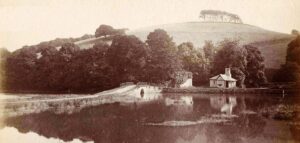 Terras Bridge and Lodge in the 1870s showing the defunct limekiln and lodge (Photo: courtesy Malcolm McCarthy)
The canal was about six miles long with over 20 locks, and without the aid of modern-day earthwork machines its construction must have involved many workers with picks and shovels. Progress was good: by 1829 it had reached Moorswater and this opened up the prospect of two-way trade with minerals being carried on the return journeys.
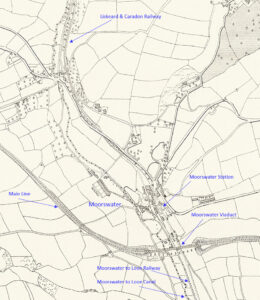
At Moorswater, the minerals were transferred to barges and floated down the canal, onto the East Looe River and taken to the quayside at Looe. Moorswater was a short distance north of the Cornwall Railway Company’s main line Viaduct, and about 150 feet below it. It was a busy place and it was destined to become even busier.
With the canal in operation the southern section of the journey, from moor to quay, was as efficient as the times permitted but there was still the laborious task of hauling the stuff overland – from mine and quarry to Moorswater.
The canal served its purpose for about 30 years but demands for a quicker method sealed its fate and although parts of it remained open, it was replaced by a railway in 1860.
The Liskeard and Caradon Railway
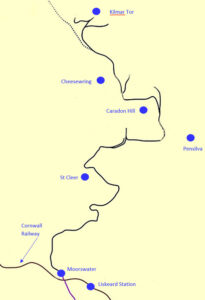
As the quantity of minerals being mined and quarried to the north of Liskeard increased, there was a need to find a better method of transporting the goods to the canal.
The canal had worked well but it was impossible to extend it northwards because of the gradients: another way had to be found. Thoughts turned to the construction of a railway up to the mines and to the Cheesewring Quarry where the granite output was increasing. It was acknowledged that the gradients and terrain presented huge obstacles but in spite of that, in 1842, the construction of a standard-gauge mineral railway network was proposed.
The Liskeard and Caradon Railway Company was formed to construct and maintain the necessary infrastructure by which the mines and quarries could use their wagons to transport their goods to Moorswater. To overcome the steep gradients, a circuitous route southward was to be constructed. Loaded wagons, propelled by gravity and controlled by a brakeman, would carry the goods to Moorswater from where horses would haul the empty wagons back up the line.
Approval to build the line was received in June 1843 and work began on clearing the route and preparing the track bed from Moorswater to Tokenbury Corner, near Pensilva. The workforce must have been considerable as the area took on the appearance of a huge building site. Initially, the T-section rails were set in chairs and fixed to granite blocks but later these were changed to wooden sleepers.
The cost of obtaining land from the Duchy of Cornwall seems to have been severely underestimated and the company’s financial resources began to be stretched. Loans had to be quickly arranged so that the work could continue.
The section from Moorswater to Caradon opened in November 1844 with a rope-worked system to cope with the incline from Gonamena to the Cheesewring, a granite quarry on Stowe’s Hill on the eastern flank of Bodmin Moor. Later, in March 1846, a line was opened from Caradon to the quarries.
Gradually, the railway’s tentacles stretched out deep onto the moors, either as a railway or tramways, and a line up to Kilmar Tor was opened in 1858 by the Cheesewring Granite Company Limited but operated by the Liskeard and Caradon Railway Company.
Fluctuations in mineral prices meant that profits for the mines and quarries were squeezed at times and the knock-on effect was that the Liskeard and Caradon Railway was feeling the pitch. Despite the shortage of funds, however, it found it necessary to extend lines to other mines so as to open up new markets.
Notwithstanding that the mineral railway did not permit the carriage of passengers, many excursions took place as this 1850 newspaper report shows. “Three hundred of the members of the Liskeard Temperance and their friends took a trip on Tuesday last by the Liskeard and Caradon Railway to Cheesewring where they spent a delightful day; the novelty attracted some thousands of persons to the spot and on the arrival of the train at Cheesewring, the hill appeared nearly covered with spectators… The train, consisting of seven carriages, returned to Moorswater soon after eight without the slightest accident or anything to mar the day which will be remembered by those who participated in it …” 1 The West Briton Advertiser Friday June 28 1850 There are other reports of people riding free in open goods wagons but being charged for their hats, coats and parcels to avoid the ‘goods only’ rule. This also seems to have applied on the Moorswater to Looe goods line when it opened in 1860.
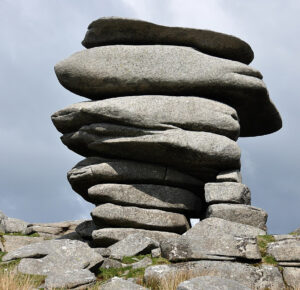 The Cheesewring
Clinker states that the railway was worked by horses until March 1862 when locomotive power was introduced. It seems, however, that gravity was still used for the downward journeys in many instances. Many of the engines used on the line were named after local places such as Liskeard, Cheesewring, and Kilmar.
The network had been transporting minerals for over 70 years but in 1917, a newspaper report announced that the section of railway between Moorswater and Caradon was being removed. It added, “This is an old mineral railway which has carried a lot of heavy traffic in times past. I believe it is the only section of line in Cornwall which has been taken up in order that the material may be used at the Front [the war effort].” 2
The decision to legally abandon the lines came in 1931. 3 (C R Clinker)
The Moorswater to Looe Goods Line
The rail and canal set-up worked reasonably well for about 20 years but the transfer from wagon to barge was time-consuming and inconvenient and the carrying capacity of the canal was proving to be inadequate for the increasing amount of minerals produced. In 1858, serious consideration was being given to the construction of a mineral railway from Moorswater to Looe and this newspaper report heralded the solution. “Amongst the applications reported to the House of Commons for new railway bills in the present session, is one for authorizing the construction of a railway from Moorswater to Looe, and traffic arrangements with the Liskeard and Caradon Railway. We understand that the projectors of both lines of railway dined together at Webb’s Hotel, Liskeard, on Monday last, and transacted some preliminary business.” 4
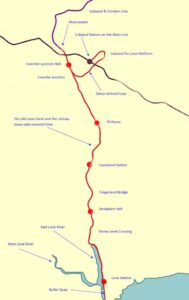
The line was to run more or less parallel to the old canal and in some places, built directly on its route. Iinitially it would have only three stations, at Moorswater, Causeland and Looe.
Work was soon under way and in December 1860, the Liskeard and Looe Union Canal Company opened its eight and three-quarter mile, single track, mineral line between Moorswater and Looe. It provided a direct connection with the Liskeard and Caradon Railway north of Moorswater. The Liskeard and Looe line was owned by the canal company, but it was the wagons of the Liskeard and Caradon Railway which used it under a lease for which there was an annual payment of £1,650. With the new line in place, the time-consuming transfer of goods from rail to barge at Moorswater was eliminated.
The introduction of the line was greeted with considerable pleasure as this 1860 report indicates: “On the occasion of the opening of the above named Railway to Looe on the 27th of December instant, there will he a grand Independent Volunteer Demonstration, a public tea and a ball at Looe, under distinguished patronage, in aid of the fund of the Looe Artillery Volunteers.” 5 Cornish Times – Saturday 22 December 1860
The locomotive and wagons travelled south from Moorswater, though Causeland and Terras Pill Bridge which carries road traffic over the East Looe River. The bridge dates from about 1825 and is a short distance south of the old canal’s first lock which acted as a tidal barrier. The railway was built on the bank separating the river and canal and a level crossing was installed for the Liskeard and Looe Railway line.
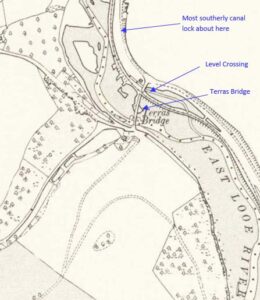
Perhaps it was to here that my uncle, my brother and I travelled to in a motor boat in the 1950s, I really can’t remember, but I do know that we could reach out and touch the banks on both sides. All we needed was Montmorency to match Jerome K Jerome’s adventure.
As Looe’s 1850s road bridge comes into sight, the engine driver prepares to apply the brakes to come to a halt on Buller Quay. It must have then been a busy place with many Looe folk earning a living from the combined benefits of rail and sea.
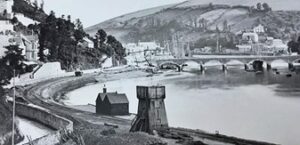 The approach to Looe before the 1879 station was built, when the railway ran through to Buller Quay: here, the two rivers have combined to become the Looe River which heads off under the road bridge to divide the twin towns.
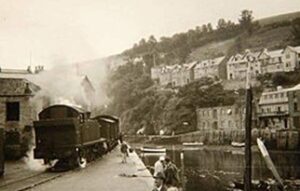 An engine and wagons on Buller Quay
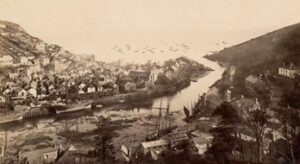 Buller Quay (Photo: courtesy Lyndon Allen)
Although people travelled the line unnofficially, as with the line up to the moors, there was considerable demand for a formal passenger service and in 1879 moves were underway to make this possible.
Opening of the Moorswater to Looe Railway Passenger Service
In 1879 the Liskeard and Caradon Railway Company made an application to the Board of Trade for a license to work the Liskeard and Looe Railway as a light passenger railway. 6 West Briton and Cornwall Advertiser – Thursday 12 June 1879
The use of the line for passengers involved many changes to the infrastructure including a new station at Moorswater and it was the operaters, the Liskeard and Caradon Railway Company, which undertook these.
On the 11th of September 1879, Moorswater Station and the line to Looe opened, and the official service was launched.
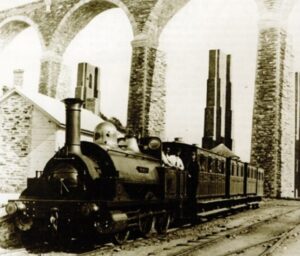 Moorswater Station below the Main Line Viaduct
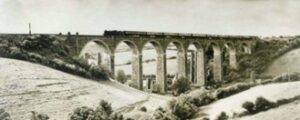 Moorswater Viaduct post-1881 (Photo: George Ellis)
By the 1880s, the Liskeard and Caradon Railway was in financial trouble and in October 1886 it entered into receivership. Its fortunes had changed considerably, not helped by its total reliance on the mining and quarrying activities on Bodmin Moor. Whilst it continued to trade under receivership, its situation was becoming increasingly hopeless.
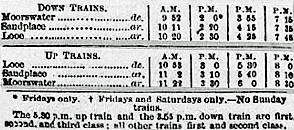 The 1883 Liskeard & Looe Railway Timetable 7
Moorswater was not the most convenient location for passengers to and from Liskeard and in 1896, a Halt was built a short way down the line – Coombe Halt (later Coombe Junction Halt). From there, passengers could make their way on foot to Liskeard, albeit it was a steep climb.
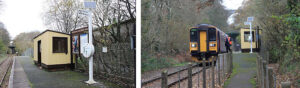 Modern photographs of Coombe Halt looking back up the line towards Moorswater (Photo: Wiki)
The next Halt southwards was at St Keyne, often referred to as St Keyne Wishing Well Halt. It opened in September 1902 to serve the St Keyne area. Here, the river is to the west of the line and the canal is to the east with Landreast Bridge crossing river, canal and the railway line to provide access to Lametton Mill.
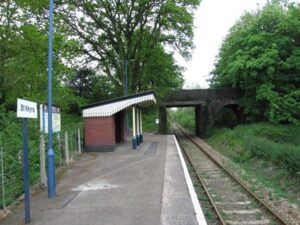 A modern photo of St Keyne Halt (Photo: Wiki)
The next port of call is Causeland Station, about five miles from Liskeard. It opened for goods in 1860 and in 1879, for passengers. Here, the river is to the east of the railway line and the canal is to the west. This switching from side to side is a common feature as we travel down the line.
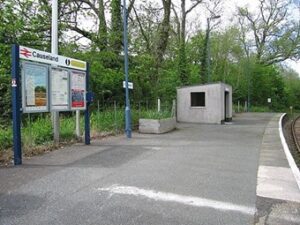 A modern photo of Causeland Station (Photo: Wiki)
A note of interest in a 1910 newspaper was that Causeland Station was claimed to be England’s smallest railway station. It went on to say, “Passengers in the earlier days of the railway were allowed to ride in the open trucks, and it was a common thing for some twenty of the latter to be attached to the rear three coaches (the only coaches possessed by the Caradon Railway, who were then working the line) for the convenience of school parties through the beautiful Looe valley and on to the famous moors and Cheesewring Rocks… In 1901, the Liskeard and Looe Company took over operating the line from the Caradon Railway Company…” 8
Sandplace Station is next down the line, about six-and-a-half miles from Liskeard and not far below Tregarland Bridge. It opened in December 1881 and is the last stopping place before Looe. At the same time, Causeland Station closed but there seems to have been a change of heart as it was re-opened just seven years later. During the early 1900s, sidings were added at Sandplace and they operated for about 50 years.
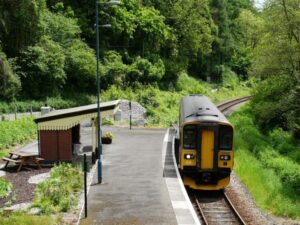 A modern photograph of Sandplace Station (Photo: Wiki)
In 1895, the Liskeard and Looe Union Canal Company morphed into the Liskeard and Looe Railway Company.
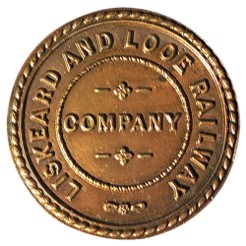 The company seal of the Liskeard and Looe Railway, photographed at the Steam Museum in Swindon. (Photo: Wikimedia Commons / Geof Sheppard)
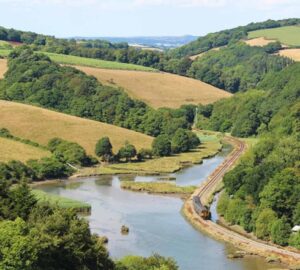 A modern image of the line south of Terras – a diesel unit runs alongside the East Looe River. There are many twists and turns for both river and railway before Looe is reached.
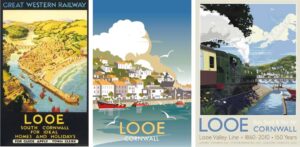 At last our train approaches Looe and across the river we can see Trenant Wood at the entrance to the West Looe River which is easily navigated to Watergate, a river trip I enjoyed in my younger days. Opposite the mouth of the river is Looe Station and the following images show it as the pristine building it once was.
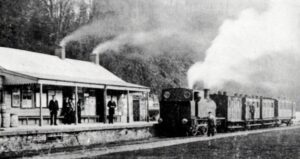
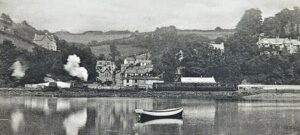 Looe Station and Shutta 1907 (Photo: Wikimedia Commons / Mark Crombie)
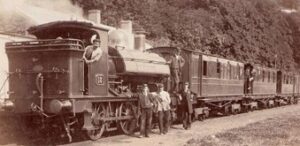 GWR 4-4-0ST number 13 at Looe about 1905 (Wikimedia Commons)
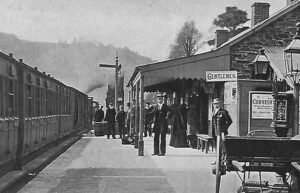
Looe had been the goods terminus since 1860 and in 1879, a passenger station opened there. The sidings and buildings were a little further down the line, towards the road bridge over Looe River, and the line to Buller Quay continued along the quays on the east of the river where goods were transferred to waiting ships.
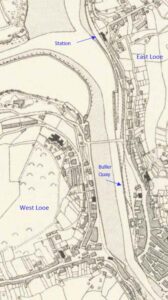 The line from Looe Station down to Buller Quay
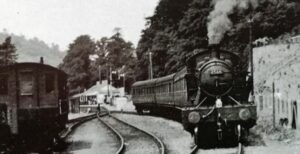 A train leaving Looe Station for Buller Quay which operated from 1860 to 1916
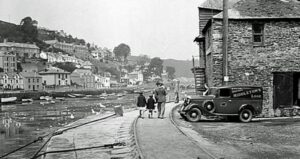 1930s – Middleton’s Corner on Looe’s Buller Quay with the tracks still in place
The Liskeard to Looe Loop Link
Because of the considerable drop from Liskeard to the Looe line, a direct connection to Liskeard Station had been but a dream but a design put forward had made it a possibility. That it was steep could not be denied but its construction was considered to be essential as the connection would metaphorically be the ‘icing on the cake’. It was to join the line about half a mile south of Moorswater – just below Coombe Halt – at Coombe Junction.
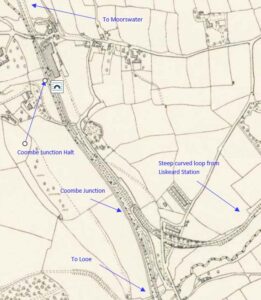 Coombe Junction
Work began in 1898. The construction of this link was a major undertaking and was not without its problems as a newspaper report of an accident shows. “As a consequence of the recent heavy rains, a landslip has occurred in one of the cuttings on the Looe Extension Railway works, near Liskeard. The work has been pushed rapidly forward by the contractor, Mr J C Lang. A deep cutting is now being driven through the hillside forming one side of the Liskeard Valley, and facing the Bolitho Fields, through which the new line will run. A gang of about 20 men were engaged there late on Friday afternoon, when quite 100 tons of solid earth came away. Fortunately the ganger (Henry Ede) was on the alert, and, noticing indications in the wall of earth forming the side of the cutting, shouted a warning to the men, who had just time to scramble out of harm’s way when the tremendous mass of earth came away with a rumble and crash, half filling the cutting for a distance of twenty-five yards. The wagons standing on the temporary rails were completely buried.” 9
Following the recovery from this incident, work continued but there are recorded comments about spiraling costs. “As soon as the connection – now on the point of completion – is accomplished, the Liskeard and Looe Railway Company take over their line again, and also the rolling stock of the Liskeard and Caradon Company at a valuation. Thus, what was primarily the Looe Canal Company has now become merged with the Liskeard and Looe Railway Company in respect of the new line. The Liskeard and Caradon Railway Company, the existing parties, sink their rolling stock with the re-formed company as payment of five years’ rent. The new line will be a distinct boon.” 10
In 1900, this report referred to the loop link to the Looe line, some 150 feet below, at Coombe Junction, a short distance down the line from Coombe Halt. “The new Looe railway line, which has been directly connected with the Great Western Railway station at Liskeard, will be opened as soon as the Board of Trade Inspector has furnished the necessary but formal approval. Quite a pretentious and commodious station has been erected at the back of the Station-road, Liskeard, and from this junction, passengers will cross a level piece of ground of about twenty yards leading on to the eastern end of the up platform of the Great Western Railway Company’s station.” 11 The new platform – the ‘Liskeard for Looe Platform’ – was at right angles to the main line and was extended in 1924 and again in 1937.
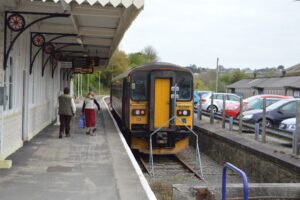 The Liskeard for Looe Platform
In May 1901 the line opened; there was then a direct passenger service from Liskeard to Looe. The steep and tightly curved loop presented the passengers with a slightly hairy downward journey as the train, with brakes screeching, headed for Coombe Junction. In case of brake failure, the points at the junction are always kept open so that a runaway train could simply head back up towards Moorswater. The return upward journey to Liskeard involved a tough climb but after some puffing and wheezing, the little steam engine finally arrived at the platform.
The construction of this loop led to the closure of the passenger service at Moorswater Station but Coombe Halt remained open and was accessed by trains reversing the short distance northwards from Coombe Junction.
Passengers bound for Looe via Coombe Junction had the novel experience of watching the locomotive run around to the south end of the train and the guard swop ends. Once done, the train headed for Looe running alongside the old Liskeard and Looe Union Canal and then the East Looe River.
I well remember introducing my own children to it and failing to tell them that because of the steep decline from Liskeard Station, the train changed direction at Coombe Junction. Having chosen to sit facing forward towards the engine, they suddenly found themselves looking towards the back of the train.
Much later, on the 15th of May 1951, a newspaper reflected on the celebrations when the Liskeard to Coombe Junction loop had been completed 50 years previously. “The two-mile, spiral loop line between Liskeard GWR Station and Coombe was opened for the first time. This anniversary, the Golden Jubilee of this event was celebrated on Tuesday – it recalled that it formed the first link between the old Liskeard to Looe railway and the main line to Paddington and the North and hastened its absorption into the GWR. Before this was opened, passenger trains from Moorswater sidings to Looe – begun on September 11th 1879 – took intending trippers down to the sea in coaches painted dark reddish-brown, lit by oil…” 12
Accidents
The history of our rail network is littered with reports of accidents both during the construction stage and when the lines were in use but those found in connection with this line appear to have been less serious than elsewhere.
Under the heading of “Breakdown on the Looe Railway,” this 1898 report covered a fairly trivial if rather inconvenient mishap. “A slight interruption to traffic occurred on Monday on the Looe Railway, owing to a mishap to the engine of the first down train. Just outside Sandplace Station, the pin of one of the wheel-springs broke, and the body of the engine dropped between the framework. The driver (John Pearce) at once pulled up, and a telegram for a relief engine was despatched. The few passengers walked the two miles into Looe. The 11.00am train from Looe did not run, but the afternoon trains did, the line being cleared when the 2.30pm train reached Sandplace. The trifling injury to the engine was quickly repaired by James Williams, foreman fitter, who brought the engine back to Moorswater under steam at 5.30pm.” 13
A potentially serious incident occurred at the railway crossing at the end of Looe road bridge in 1898 when a horse and trap were passing just as the train was coming down from the station. The horse, startled by the whistle of the engine, backed towards the rails and the trap was caught by the engine and dragged along for some yards. The trap was smashed but the driver, Mrs Gillbard, escaped without serious injury. 14
Because of the steep incline on the Liskeard link line there was always the possibility of a mishap involving runaway rolling stock and in 1906 it did happen. Six empty carriages had been taken up to Liskeard but a problem during uncoupling from the locomotive saw the carriages pushed back onto the branch where they ran away down the steep gradient. At Coombe, a collision was avoided by the signalman at Liskeard warning his colleague at Coombe Junction and a passenger train from Looe was stopped at the junction signals. The carriages were estimated to have passed through the junction travelling over 60 mph and they ran through to Moorswater, where they collided with other carriages in the shed. 15 (Wikipedia) A newspaper report of the accident stated: “Six coaches ran away down the incline on the Liskeard and Looe Railway on Friday evening and collided with four others in a carriage shed in the Moorswater Valley. The coaches were greatly damaged, but fortunately, they were empty.” 16 Western Echo – Saturday 23 June 1906
Another incident on the same section of line involved Mr W Vincent, the driver of a Liskeard and Looe Railway train. As the train approached Liskeard, he fell off the engine as it was passing under Lodge-hill Bridge. A newspaper report said, “It is supposed he was looking out from the cab, and that his head came in contact with the side of the bridge. He was conveyed to the Cottage Hospital suffering from concussion of the brain.” 17
The GWR Years
In 1909, the Great Western Railway (GWR) purchased the troubled Liskeard and Caradon Railway Company from the receivers. It appears also, that the Liskeard and Looe Railway Company was experiencing financial difficulties due, in part, to the cost of building the Liskeard loop line. Its situation did not improve and a few years later, on the 1st of January 1923, the GWR took it over. 18
An article in the ‘Cornish Guardian’ on Friday the 3rd of September 1926, exalts the merits of Looe as a holiday location and applauds its rapidly growing popularity. No doubt, this had contributed to the increase in passenger numbers on the railway but there was also mention of the growth in goods traffic.
In 1934, an article about the Liskeard and Caradon Lines in the GWR Magazine caught the attention of the Cornish Guardian. It quotes the author, Mr D V Levien. “The district served by the Liskeard and Looe Railway which was opened for goods trains in 1860, and for passengers in 1879, is interesting from the point of view of its history as well as that of the Liskeard and Looe Union Canal authorised in June 1825, a part of the bed of which was filled in to form the site of the railway. Linked with it is the defunct Liskeard and Caradon mineral line, which was constructed between Moorswater and the Caradon tin mines in 1844 and extended to the Cheesewring quarries, north of Liskeard, some two years later. Here are to be seen an amazing pile of giant stones the top layers of which are over thirty feet in circumference while those beneath are but half their girth.
From Cheesewring to the seaport town of Looe, a distance of sixteen miles, the ruling gradient was 1 in 60 and this allowed the trucks loaded with stone to travel down from the quarries to the quay by force of gravity. In 1901 the Liskeard and Looe Co. took over the working of both lines, and in May of that year was completed the famous horseshoe loop, some two miles and nine chains long, which connects Coombe Junction, near Moorswater with the Great Western Railway Station at Liskeard. The line north of Moorswater was closed in January 1917 – old rails being valuable scrap metal much needed at the time.
An inspection of the district originally served by these old canal and railway companies reveals interesting glimpses of the derelict site of early railway tracks and the canal bed, where not filled in and used for permanent way purposes, running cheek by jowl with the river, tow path, the public road, and the railway. St Keyne is a case in point. Here, the usually dried-up canal course, covered by a relic in the shape of the original canal arch in brick, and a modern railway overbridge, are in close proximity. St Keyne – immortalised by Southey in his poem, ‘The Well of St Keyne,’ lies in a wooded dell in lovely Looe Valley, en route between Coombe Junction and Causeland. At the level crossing just outside Looe is another picturesque reminder of the past, for here the ancient canal lock at the point where the canal originally ran into the East Looe River stands unemployed, abutting upon the railway track – a reminder of the good old days of peaceful travel and a contented outlook. The track of the railway at Looe is extended beyond the station and runs along the quay. Although seldom used nowadays, it is easy to picture the bygone activity when the windjammers of past years sailed up the river to take in cargoes of stone from the Cheesewring quarries, and other stores. The horseshoe loop connecting Liskeard Station and Coombe Junction is in itself of much interest, while here and there to the north of Coombe Junction the site of the old Liskeard and Caradon Railway is still to be traced, although the line has been closed for the past seventeen years. Remains of the old stone-sleepered track formerly carrying Vignoles rails, may be seen in the vicinity of St Cleer.” 19
The period of GWR ownership came to an end on the 1st January 1948 when the countrywide network was taken into public ownership by British Railways under the overall management of the British Transport Commission, later the British Railways Board.
Closure and Reprieve
In 1963, goods services were withdrawn and the fate of the line seemed sealed when Robert Beeching, chairman of British Railways, and pro-road transport minister Ernest Marples, announced its closure.
The Western Region of British Railways hereby give notice in accordance with Section 56(7) of the
Transport Act 1962, that they propose to discontinue on and from Monday, 3rd October 1966, all
railway passenger services between Liskeard and Looe and from the following stations and halts:
Coombe Junction Halt, St Keyne Halt, Causeland Halt, Sandplace Halt and Looe
There was some hope that it could be saved however, and the ‘Cornish Guardian’ of the 12th March 1964 outlined some economies which could influence the decision. “New economy moves under the Beeching Plan put into operation on the Looe branch line on Monday are expected to result in a saving of over £2,000 a year. The branch signal box has been closed resulting in a staff saving. New signalling arrangements, which have been substituted, will also mean lower running costs. The post of Station Master Looe has been done away with and in future the station will be supervised from Liskeard. The closure of the line to passenger traffic is now thought unlikely, especially as it is intended to serve a holiday centre for South Wales miners and their families planned for the Millendreath Valley, near Looe.”
Whether or not these factors influenced those at the top we do not know but a concerted effort to retain the line was mounted by local authorities and other interested people. 20 The clamour for a reprieve was suddenly, and perhaps unexpectantly, helped by the democratic system however, as a change of government saw Barbara Castle appointed Transport Minister. She reprieved the line just two weeks before it was due to close so it is thanks to her that the wonderful Liskeard to Looe Railway line still operates.
There seems to have been disappointment in the British Railways boardroom at the reprieve. 21 and before long, the attractive Looe Station was demolished and replaced by a rather mundane shelter with a short platform.
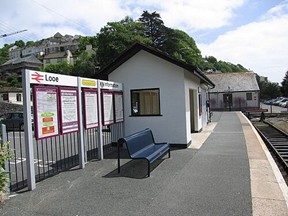 The original station buildings were demolished and replaced by a shelter and end-of-line buffers (Photo: Wiki)
The goods yard beyond the station was then dismantled and the site sold to be used as a car park, a filling station and a police station. The line was shortened to finish at the station and the signal box was removed and the line controlled by a token system. 22
A Personal Reflection
I have thoroughly enjoyed assembling this article which for me, is a topic of supreme delight as I recall the thrill of a steam train experience made so many years ago with my family. My memory prevents me being specific about the first time but the ride beside the meandering East Looe River has been one of the joys of my life.
The age of steam has passed and now diesel units travel alongside the old canal, through St Keyne Station, Causeland, Sandplace Halt and finally into Looe Station. Not the grand building it once was but still there to provide today’s children with an experience which has delighted youngsters for well over a century.
Perhaps I’m influenced by nostalgia but for me, it’s the most picturesque line anywhere.
As to Looe itself, I could reminisce at length (and I have) about its quirky streets, its road bridge, its Banjo Pier, its river ferries and its enchantingly named ‘Pennyland’. It is the place of my childhood, where I grew up and where I ‘fished’ for crabs from its quaysides. It is the place which I often refer to as my spiritual home. Looe, wonderful Looe.
We’ll leave the last word to Bernard Moore who penned this emotive poem in 1919.
Travelling
“Peckham Rye, Loughborough, Elephant, St Paul’s,”
Every morning the porter bawls.
The train grinds out…and I gaze on lots
Of sad back gardens and chimney pots,
Factory stacks and smoky haze
Showering smuts on the close-packed ways.
And the train jolts on and twists and crawls
“Peckham Rye, Loughborough, Elephant, St Paul’s.”
But, trapped and prisoned I may be,
I lift a latch and my thoughts go free,
And once again I am running down
On a winding track from a Cornish town,
And I dream of the names of the station through
“Moorswater, Causeland, Sandplace, Looe.”
An ancient engine with puff nigh gone
Drags a couple of coaches on
Close where a stream runs all the way
Muttering music night and day;
There isn’t a porter about at all
To spoil the peace with a raucous bawl,
But a kind old guard to see me through,
Give me a ticket and take it, too.
The line twists down through patches sweet
Of soft green pasture and waving wheat,
And the stream spreads out to a river wide
Where ships creep up at the turn of tide,
Till a tangle of spars on a blue sky spun
Gives me the sign of the journey done,
And I stand contented on the quay
And hear the surging song of the sea.
So runs the dreamlike journey through,
“Moorswater, Causeland, Sandplace, Looe”
But every morning the porter bawls,
“Peckham Rye, Loughborough, Elephant, St Paul’s.”
Addendum
Perhaps a little-known addition to the railway story is that during the 1930s, the GWR proposed a new seven-mile rail route avoiding Liskeard. Work began in 1937 but halted due to the Second World War and how much was accomplished is not clear.
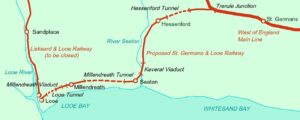
Sources and Further Reading:
https://www.cornwallrailwaysociety.org.uk/looe-branch-including-moorswater.html
https://www.everylaststation.co.uk/looe-valley
‘What to look for on the Liskeard to Looe branch line,’ an article by Carol Vivian in the Cornwall Association of Local Historians journal,
‘The Magic of the Liskeard to Looe Railway,’ a 1994 booklet by Colin Henry Bastin.
Various pages on Wikipeadia
End Notes:
- The West Briton Advertiser Friday June 28 1850
- Newquay Express and Cornwall County Chronicle Friday 02 March 1917
- The book ‘The Railways of Cornwall 1809-1963’ by C R Clinker
- Cornish Times – Saturday 13 February 1858
- Cornish Times – Saturday 22 December 1860
- West Briton and Cornwall Advertiser – Thursday 12 June 1879
- Cornish Telegraph – Saturday 29 September 1883
- Royal Cornwall Gazette – Thursday 13 October 1910
- Royal Cornwall Gazette – Thursday 20 October 1898
- Royal Cornwall Gazette – Thursday 9 August 1900
- Royal Cornwall Gazette – Thursday 09 August 1900
- Cornish Guardian – Thursday 17 May 1951
- Royal Cornwall Gazette – Thursday 29 December 1898
- Royal Cornwall Gazette – Thursday 29 September 1898
- (Wikipedia)
- Western Echo – Saturday 23 June 1906
- Royal Cornwall Gazette – Thursday 12 July 1906
- The book ‘The Railways of Cornwall 1809-1963’ by C R Clinker
- Cornish Guardian – Thursday 12 July 1934
- Cornish Guardian – Thursday 29 April 1965
- ‘The Magic of the Liskeard to Looe Railway,’ a 1994 booklet by Colin Henry Bastin.
- (https://en.wikipedia.org/wiki/Token_(railway_signalling)#Token_only)

Tony Mansell is the author of several books on aspects of Cornish history. In 2011 he was made a Bardh Kernow (Cornish Bard) for his writing and research, taking the name Skrifer Istori. He has a wide interest in Cornish history, is a researcher with the Cornish National Music Archive and co-editor of Cornish Story.