
The Royal Institution of Cornwall
By Susan Coney
This article is a brief summary of the history of the Royal Institution of Cornwall (RIC). More comprehensive information can be found in the Royal Institution of Cornwall’s Journals 2018 and 2019. Copies of these Journals can be found in the Courtney Library at the Cornwall Museum, River Street, Truro.
On Thursday 5 February 1818, a meeting was held at the County Library Truro, which was probably situated in the lower part of Pydar Street, to discuss a proposal to set up a Society for the advancement of ‘science’. At this meeting the society was named the Cornwall Philosophical Institution. The meeting was attended by four members of the Vivian family including Mr John Vivian and chaired by his son Mr John Henry Vivian. It is thought that Mr John Vivian’s other sons, Thomas Vivian (who died in 1821 aged 22), and Lieutenant General (then Major) Richard Hussey Vivian may have attended also.
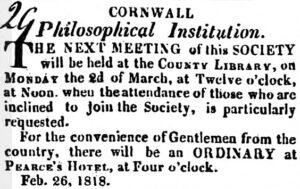
A notice appeared in the Royal Cornwall Gazette on the 26th of February 1818 inviting interested people to join the Society at a meeting on 2nd March 1818 at the County Library at 12.00. This was to be followed by an ‘ordinary’ at 4.00 pm at the Pearce’s Hotel (The Royal Hotel).
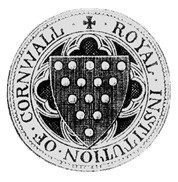
Soon after, the Society was named the Cornwall Literary and Philosophical Institution. In 1821 the Institution was granted a charter from George IV and became the:
Royal Institution of Cornwall
The Institution was one of the earliest of seven similar societies established in England and Wales.
The first president of the RIC was Lord Exmouth, Edward Pellow whose family came from Flushing. The aim of the Society was to ‘encourage the pursuit of science’. This aim was to be met by providing a museum and act as an archive of accumulated information. It would provide laboratories and a lecture rooms.
The introductory lecture was given by Brydges Willyams Esq. the Vice President, published in full in the Royal Cornwall Gazette on 18th October 1818
This meeting was held in the Town/Market Hall Truro. This Town/Market Hall was opened in 1809 to replace the old Market Hall which was at the end of Middle Row at the junction of St Nicholas Street and King Street. This ‘new’ Town Hall was on the site of the current City Hall (Hall For Cornwall) but was a much smaller building.
The Institution rented rooms in this Town Hall where they held a series of lectures and possibly where they displayed their donated museum items.
By 1821, the Institution was asked to move out of the rooms in the Town Hall. It was clear that the Institution needed larger premises to display their museum items. Various premises were rented around the town, but no permanent premises could be found. The RIC committee considered purchasing land on which they could build but this was not successful.
In 1828, the Institution purchased part of the premises lately owned by John Vivian Esq., who had died in 1826, in Union Place.
Two of the rooms became the Museum, the larger of the two were fitted out with a new set of cases to display the collection of birds and other objects of natural history and table cases for the display of the mineralogical collection and a collection of shells. Other objects of interest were displayed in the smaller room.
Over time, various books and manuscripts were donated to the RIC covering subjects such as antiquities, geology, and natural history, with a growing number of items relating to Cornwall.
By 1831, more room was required and the premises were expanded to provide a lecture room, a reading room and laboratories.
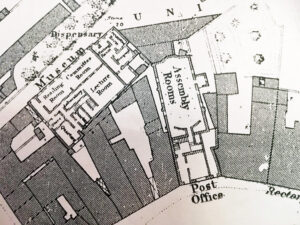
1873 Survey map of Truro (RIC building in Union Place)
The RIC continued to focus on its primary role of providing educational lectures and facilities. The museum collections grew such that the need for more space was obvious. In 1911 this was remarked upon by the Prince of Wales recollecting his visit with the Duke of York (later Kings Edward VIII and George VI), when they visited the museum as naval cadets.
In 1887, Sylvanus Trevail put forward a plan for a new building to mark the Golden Jubilee of Queen Victoria. The building would have faced Pydar Street next to Trevail’s Post Office which was built in 1886. This proposal was not accepted due to cost.

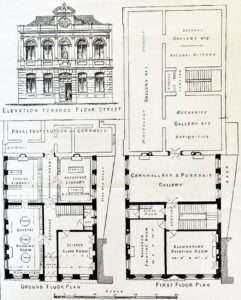
RIC building Plan January 1887
In 1908, The Cornubian and Redruth Times (15 October 1908) reported that the former Mining School building in River Street, Truro, had been acquired by the Royal Institution of Cornwall.
The River Street building, designed by Philip Sambell, was built in 1845 as the Truro Savings Bank. In 1897 it became the Henderson’s Mining School.
Extensive alteration and extension were built but due to WW1 and the lack of builders the ‘new’ Museum was not officially opened until June 1919.
The moving of the collections was overseen by the then curator George Penrose. He also did much of the moving himself.
In 1985, the RIC purchased the Baptist Chapel next door to the Museum building. The Baptist Chapel was built in 1850 to the design of Philip Sambell.
Collections
From the inception of the Royal Institution of Cornwall, people, not just members, donated numerous historical items to the Institution.
Some of the first specimens that were donated to the museum were not only examples of ‘rocks’; there was also ‘a scorpion and tarantula preserved in spirits’, ‘the jaw of a dolphin’, ‘the fossil horns of a stag found forty feet (down) in Carnon stream works’, ‘a lamb with two bodies and eight legs’ and ‘a monstrous chicken’. Many birds found in Cornwall (shot and stuffed of course) and hundreds of shells were displayed
One of the most notable collections is the MINERAL COLLECTION. ‘It was the acquisition of the Rashleigh collection in 1902 that gave international importance to the collection in terms of historical value, quality and rarity’, (quote from the RIC Journal in 2018).
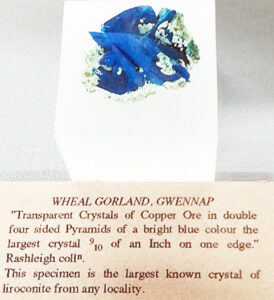
The museum of the RIC houses a vast collection what are best described in general as ARTEFACTS. Some artefacts are in display in cabinets, but the stores contain many more. These artefacts, small and large, include ART works both from the past and more modern artists e.g. Bryan Pearce, collections of Natural History e.g. Egyptian items, collection of porcelain, historical garments, etc. Many of the items are from around the world as well as from Cornwall.
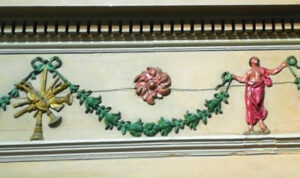
Part of the frieze from the former Assembly Rooms in High Cross Truro
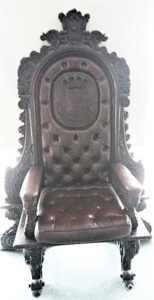
The Royal Institution of Cornwall President’s Chair
Another vast collection is the PHOTOGRAPIC archive. It consists of photographic plates and prints from the 19th and early 20th centuries recording Cornish life of places, events and people. These photographs were taken by both professional and amateur photographers. One of the amateur photographers was Major Authur William Gill who also took films and gave illustrated lectures at the RIC and across Cornwall. Some of the photographs have been scanned and are available to view online on the Cornwall Museum website. The electronic database containing details of all items in the collections was created from paper archives by Margaret Morgan and maintained by her throughout her time as a volunteer at the Museum.
The Courtney Library
The Royal Institution of Cornwall’s vast collection of books, manuscripts, magazines, and maps had built up over many years. Until 1973 it was housed on the ground floor of the museum building in River Street and before that in the Union Place building. In 1973 a library was constructed on the first floor of the River Street building. It was named the Courtney Library in commemoration of a bequest by Richard Acutt Courtney to fund the provision of the new Library. The Courtney Library was managed by Angela Broome, a long-term employee of the RIC.
Expeditions
In 1868, it was decided that the RIC should arrange archaeological excursions to visit places of interest in the county. The first in 1868 was to the Cheesewring. These excursions were originally by horse and carriage then later by charabanc, train, coach and car.
Initially, it was the male members of the RIC who attended these excursions, but ladies attended too soon afterwards.
Cornwall Museum and Art Gallery
In 2024, as part of the program of repair and reorganisation, the Museum of the Royal Institution of Cornwall was renamed Cornwall Museum and Art Gallery, ‘to better reflect the programme, objects, artefacts and history that keep our past close by and tell the story of Cornwall’. It continues to be run by the Royal Institution of Cornwall Charity 1150749.
Galleries
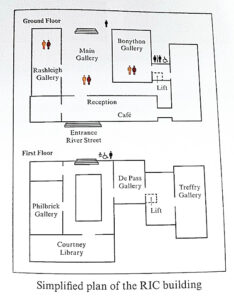
Some of the galleries are named after the significant benefactors of the Museum as can be seen on this plan. These names are above the doors to the galleries. However, these gallery names are not often used now.
Rashleigh Gallery – named in honour of Philip Rashleigh, Cornwall’s most famous Mineral Collector. He was not a benefactor of the RIC as such, but the majority of his Mineral Collection is displayed in this gallery.
Bonython Gallery – named in honour of Sir John Langdon Boython KCMG who had Cornish ancestry. He went to Australia aged six when his parents emigrated. He visited Cornwall on several occasions, timing his visits with RIC excursions. He was the first Australian Bard of the Cornish Gorsedh. He gifted large sums of money to the RIC.
De Pass Gallery – commemorate Alfred De Pass who contributed financially and gave many material gifts to the RIC.
Philbrick Gallery – named in honour of Miss Myrtle Evelyn Philbrick who came to Cornwall to teach at the County Grammar School for Girls, Truro, in the 1930s. She retired early becoming a market gardener. She with her friend Miss Bowing set up the Garden Centre at Carnon Downs. Miss Philbrick was an historian and collector including an extensive collection of postal covers which at her request, was sold after her death and the proceeds of the sale she bequeath to the RIC. In 1989 she gave a significant sum of money to the RIC to refurbish the previously named the Opie picture gallery which was renamed in her honour.
Treffry Gallery – commemorates David Treffry. The Treffry ancestral home is at Place Fowey. He gave generous gifts to the RIC to buy items e.g. John Opie’s painting, ‘A Gentleman and a Miner,’ and later enabled the completion of the Baptist Church conversion, hence the name of the gallery.
Details of some other significant benefactors are included in the Royal Institution of Cornwall Journal 2018, a copy of which can be seen in the Courtney Library.
Recent quote: ‘we want all people to know that the Museum is for everyone not just for rich old men’.
Comment: However, if it wasn’t for those ‘rich old men’ there would not be a museum for us all to admire and enjoy.
Susan Alecia Coney (nee Phillips)
Although I was never very interested in history at school, it is now a big part of my life. I enjoy both the research and writing about it. Initially, it was about my family and their involvement in the community but this sparked a more general interest in Cornish history, of its people and places. I have been involved in a number of projects relating to Truro and have enjoyed this opportunity to record the results for future generations.
