St Keverne Parish
By Terry Moyle
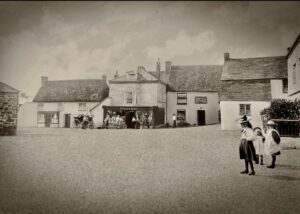
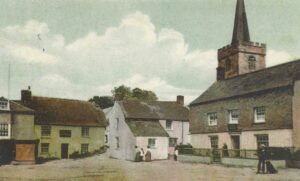 St Keverne circa 1900
St. Keverne is the largest parish in West Cornwall, is in the Hundred of Kerrier and is part of the area known as Meneage (from the Cornish managh – monk). As early as the Sixteenth Century the parish, because of its great size, was divided into four unequal districts called Turns. Turn Bean (Torn Byghan – Little Turn) includes the church town and the coast from Porthoustock to Coverack, Turn Tregarne (Torn Tregarn – tre + karn – farmstead and crag), on the north east with the coast from Porthoustock to Penare and Lestowder, Turn Traboe (Torn Treworabo – tre + a personal name) on the north west from Treleague to Dry Tree and Turn Trelan (Torn Trelann – tre + lann – farmstead + enclosure, generally religious) on the south west from Coverack to Kennack.
The last two turns were the largest and all four met at the Church town. The word Turn is not found anywhere else in Cornwall and is probably derived from the Latin “quaterni” meaning four each or four together. The turns were used in many records as, for example, in the 1524 Cornwall Subsidies in the reign of Henry VIII, the Cornwall Muster Roll of 1569, the Protestation returns of 1642, the Poll and Hearth Taxes 1660-1664 and the Parish Valuation of 1838.
Historically the residents of the parish would have been Cornish speakers. The westward retreat of the Cornish language as a community language was both gradual and irregular. It probably died out as early as 1200 along much of the area bordering Devon but in the far west there were Cornish speakers into the Nineteenth Century although it was not, by then, a community language. I wonder how my 8th great grandfather, Rev. Miles Exelby, Vicar of St. Keverne 1626-1641 and coming from England, would have got on with a congregation of mostly Cornish speakers.
Richard Symons, a Royalist soldier stationed at Pendennis Castle in the Civil War wrote in his diary for 1644 that East Cornwall was speaking good English and all beyond Truro spoke the Cornish language. Cornish was spoken on Goonhilly (Lizard Peninsula) and at Pendennis but at Land’s End people speak no English. Probably St. Keverne and neighbouring parishes lost Cornish as the day-to-day language between 1700 and 1750.
In St. Keverne parish 37 place names contain the word TRE(V) – farmstead, homestead, settlement). Charles Henderson wrote that the older of these contain personal names like Tregellast, Treglohan and Tregonan while others like Trevean, Trenance and Trenoweth are slightly later.
St. Keverne was an important religious centre in Celtic times and was named after a Celtic Saint – Lan(n) = enclosure(religious) with the name of the saint Aghevran. Hence Lannaghevran in the Cornish language.
In 1842 when the parish was surveyed for the Tithe Commissioners 5,751 acres were classified as arable land, 4,170 acres as downs, moor and waste and 13 acres as woodland. Descriptions of the parish are also found in the Trades and Post Office Directories from the mid Nineteenth Century to 1939.
An interesting article in Cornish Studies Resources by Bernard Deacon (2021/2022) is titled “St. Keverne: from rebellion to respectability”. In the late 1400s and early 1500s the parish of St. Keverne was at the heart of Cornwall’s several “commotions”. Men from the parish rose against the taxation of Henry VII in 1497 led by the village blacksmith, Michael Joseph (Mighal Josep an Gov) who was joined at Bodmin by the lawyer, Thomas Flamank, with his supporters. This rebel army marched to London, only to be defeated by the King’s forces at Blackheath. I am proud of these two rebel leaders – Mighal Josep because of his link to my home village and Thomas Flamank because he is my 9th great grandfather.
This is not the end of the story – several men from St. Keverne were involved in the explosion of anger over the introduction of English into church services. This anger led to the murder of archdeacon William Body in Helston in 1548 and the uprising known as the Prayer Book Rebellion of 1549. One of the reasons for the decline of the Cornish language was that there was no Bible in Cornish until 2011, unlike in Wales where a Welsh Bible was available from 1588.
However, by the mid-1800s Bernard Deacon says that things had quietened down considerably and most people in this large rural parish concentrated on farming and not on politics. 30% of men were farmers and another 40% were farm labourers while the remaining 30% were fishermen or craftsmen working in rural trades. He quotes two examples – the story of a John Williams from Chyreen Farm above Porthoustock Cove who left the farming to his brothers and went to London and became a clerk, later becoming a bank inspector. John Williams and his wife Mary moved closer to the city – in 1881 they employed a servant which became two servants by 1891 and had moved out to the new suburb of Ealing. Victorian bank clerks were deemed to be the “aristocracy of the clerical profession” although by 1911 John Williams was a buyer in the woollen trade. Bernard Deacon also includes the story of a Susan Brooks who went from a farm labouring family to running a large farm. She married into the Nicholls family of Treglossick and following the death of her father-in-law, Sampson Nicholls, and later her husband, John, she continued to run the farm.
The population of St. Keverne Parish 1801-2021
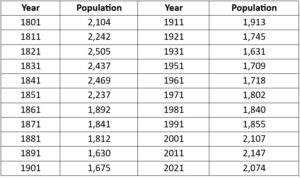
In 2021 for St. Keverne Churchtown (the built-up area including Laddenvean) the figures were:
- Population structure – 464 males and 517 females
- Age groups – 159 (0-17 years), 511 (18-64 years) 311 (65+ years)
- Age distribution – 83 (80+ years), 321 (60-79 years), 249 (40-59 years), 157 (20-39 years), 92 (10-19 years) and 78 (0-9 years).
- Other – 972 born in the UK (97%)
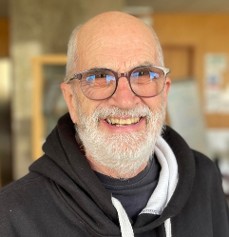
Terry Moyle
Retired teacher, Bard of the Gorsedh Kernow, local and family historian, author of 12 books on aspects of St. Keverne parish and speaker and teacher of the Cornish Language.
