
Confessions of a Horologist
By Alan Johns

Alan Johns
Looking back over my long career my mind slips easily to the many trials and tribulations of a horologist.
I will begin my story in 1960, the year in which I met Olive, my future wife.
The following year, on the 21st of August, I began my apprenticeship with J Pearson & Son of Truro, a long-established company of jewellers and watchmakers. I was then 16 years-old.
The shop occupied the entire ground floor of 17 Boscawen Street with a small yard at the rear facing St Mary’s Street. It was a prime trading site and the footfall was considerable, especially on Wednesday market day.
There were five watch/clock and jewellery repairers in the first-floor workshop facing St Mary’s Street, opposite the Cathedral. Each had their own particular skills such as watch/clock repairing, enamelling, jewellery repairs and other skills. I spent time with each of them, learning the various aspects of a watchmaker/jeweller.
There was always time for a bit of humour and in my early days I was sent on silly errands such as to Mallets, the Ironmongers, for a rubber hammer or for some glass nails. On another occasion my new colleagues ‘borrowed’ my watch. It was dismantled and I was told to put it back together again.
Whilst in the clock repair area I had to observe an elderly Welsh gentleman as he repaired a cuckoo clock. He was a lovely man, way past retirement but he worked three days a week to supplement his income. He used to breeze into the workshop in the mornings with a cheery Bulla Da or that’s what it sounded like. It was probably Bora dah which I took to mean Good Morning in Welsh.
I watched patiently for three days while he wrestled with this large, wooden, highly ornate cuckoo clock. Sometimes the cuckoo door wouldn’t open, sometimes the cuckoo wouldn’t appear and sometimes it gave the wrong number of cuckoos. Every time he corrected a fault, two more would appear. I could see how exasperated he was getting by the red line around his neck. Eventually he gave a shout of despair, opened the window high above St Mary’s Street and with a shout of ‘Fly you bugger,’ he threw it out. The clock was smashed to smithereens on the road below and I had the task of sweeping up the bits. It was beyond repair and we had to supply the customer with a replacement.
I was given the task of sharpening a piece of peg wood (2) with which we were to clean the pivot holes of clock plates. I would return the peg wood to the repairer only for him to say, “Not clean enough.” This happened time after time and at the end of the day my fingers were so raw that it taught me a good lesson. It’s got to be ‘zact,’ not near enough.
My time in the workshop was well-spent and I thoroughly enjoyed the banter and the friendship.
I began my British Horological Institute training in September 1962 and in the preliminary examination, in June 1963, I was awarded the Arthur Tremayne Prize, and a £25.00 tool award, for being the top apprentice of the year.
As part of my apprenticeship, I had to attend courses to gain my qualifications. One examination involved making a part for a watch balance wheel – I had to make everything including a very fine screw. That screw took me three days to make and included blueing and polishing it to a high degree. At last I had completed it and was just giving it a final polish when it flipped out of my grasp. Despite our combined efforts, we never found it. Panic set in as the finished piece had to be in London by the following Wednesday – I had two days to make another. I worked late into the nights and managed to finish it.
The workshop manager was a Pole who had come to England after the war, he was our principal watch repairer and could turn steel on a lathe to the thickness of a hair. He was a brilliant watchmaker but a hard task master if I got something wrong. He told me a little of his life in Poland. During the war he was interned by the Nazis and placed in a forced-labour camp working on instruments for Messerschmitt planes. Sometimes a colleague would set one of the altitude gauges incorrectly to thwart the Nazis. If caught, they were shot and hung up in the workshop as a deterrent to others. Sadly, most of his family died in the ghettos.
After a year of training I was given the job of visiting customers – going out in our Austin minivan to collect or adjust the timekeeping of clocks we had sold.
One such visit was to an elderly lady in Kenwyn to wind and adjust her clocks. Invariably, after a couple of days, she would be on the phone complaining that the clocks were not chiming together. This is almost impossible to achieve but I had a plan and the next time I went there I said, “If they all strike at the same time all you will hear is a racket. Shall I set them so they strike at slightly different times so you can hear the beauty of each clock.” She thought it a good idea and the problem was solved.
I had to visit the Convent of the Epiphany every week (now the Alverton Manor Hotel) to wind and adjust their clocks. The turret clock in the tower took about 30 minutes to wind and check the accuracy. On one occasion I breezed into the refractory, as usual I greeted the cleaners with a loud good morning only to find the room full of clergymen, nuns, and the Bishop of Truro, all silent and deep in prayer. I turned, red faced and crept out.
When the clocks went forward an hour it was no problem, I just had to move the hands forward – at midnight – but when they went back it was a different kettle of fish as you couldn’t move the hands backwards. I had to go there at night, climb the dark spiral stone staircase and stop the pendulum at midnight precisely then wait an hour and start it going again at 1.00am. For a teenager, this was very spooky, there were bats flying around my head and if I looked down, I occasionally saw a black hooded figure shuffling along, the nearest thing to a ghost that you can imagine. As the minutes ticked by, I imagined all sorts of things – every sound made me jump: the wind howled through the tower and large oak doors creaked down below. It was not my favourite task.
On another occasion I had to go up the tower with the foreman clock repairer to service the turret clock. The clock room was very small with a platform for one person, consequently the only place for me was to sit astride a large bell with a 30 feet drop underneath. Attached to the bell was a long rope which one of the nuns pulled when it was time for prayers which was quite a frequent occurrence. Yes, the nun pulled the rope while I was astride the bell. It gave a dull thud.
“What’s wrong with the bell,” she shouted.
“Stop pulling,” was my desperate reply as I swung to and fro like the hunchback of Notre Dame expecting any minute to fall to the floor below. Luckily, she stopped but moaned about everyone being late for prayers.
I generally enjoyed my visits to the convent and made some good friends there. The turret clock that we lovingly looked after was a good one and I often wonder what happened to it. I have since asked a member of the hotel staff what became of it, but he didn’t even know that the clock existed. I do hope it’s not been allowed to rust away.
We also had the contract to service the fine clocks on St Michael’s Mount. We had to do this every three months and on one occasion a kitchen maid came to us with what appeared to be a rusty box of clock parts she had found under the sink. We took it back to the workshop and imagine our surprise when under the dirt we saw the name Thomas Mudge – one of the finest English 18th century clockmakers. To cut a long story short, we made parts and restored it to its former glory and it was put on show at The Mount. The last time I was there it was working well.
Another timepiece on St Michael’s Mount which I worked on in 2005 was a very rare quarter-striking lantern clock by Richard Grennall (Greenhill) of Ashford. It dated from the mid-17th century and was 16½ inches tall, it had a sister-clock in Stockholm National Museum – the clock on St Michael’s Mount featured bellringers dressed as Cavaliers, the sister-clock in Stockholm Museum as Roundheads, Richard Grennall was obviously not fussy where his money came from. I had to refurbish the clock and the project attracted much interest and Michael Pearson, a Kent antique horologist, wanted to ensure that its integrity wasn’t jeopardized. I had no intention of doing so and he left quite happy. He needed photos of the clock for his new proposed book on Kent Lantern Clockmakers. He was delighted to be able to take photos of the clock ‘stripped down’ as I was in the process of the refurbishment. Unfortunately, the book has not materialised.
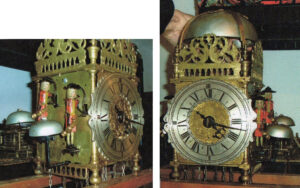
The Grennell Clock
Winding and servicing clocks was once a regular need and I was following in a long line of men who undertook such work. Ronald E Tonkin comments on this in his book, Traders of Bygone Truro: “In 1831, clockmaker H Venn was scurrying up clock towers and dashing into drawing-rooms to wind timepieces ‘by the year’. He was based at 9 Duke Street.”
About 1961, Pearson’s moved their Boscawen Street Shop to the corner of Lemon St and Lemon Quay, the workshop moved to Charles Street. In 1963 I began working for Bowden and Sons, a high-class jeweller in Plymouth who had agreed to take over my apprenticeship. I was then a ‘Trura boy’ over the Tamar.
One of my jobs was to travel around Plymouth, collecting, adjusting and delivering clocks. Every Monday I had to go to the Duke of Cornwall Hotel to wind their clocks and those of Mrs Dingle, the owner of the large department store who lived in a large house on the Hoe. She often asked if I would like a cup of tea but as she was suffering from dementia, sometimes the tea arrived and sometimes it didn’t, and on some occasions, I received a cup of sugary water. Another memorable event was installing a favourite grandfather clock into a brand-new bungalow. The clock was taller than the ceiling, however there was she would not allow the base to be shortened, so she had a hole cut into the floor to lower the clock into the hole – Success!
Olive and I were married on the 5th of September 1964, just a couple of months before I completed my apprenticeship.
In 1965, and now married, I took a job in Plymouth Dockyard working on high-grade ship chronometers. During my first week I was given a box of about 40 watches belonging to the officers on the Ark Royal aircraft carrier: these had to be repaired and serviced before the ship sailed. I was keen to impress so I got my head down and set to work. After just four days I had completed them and I returned them to a surprised manager. A little later the union convenor approached me and asked to have a word. “Those watches you repaired in four days; we have an agreed time of two weeks to do them so can you please slow down a bit.” I asked him what I was supposed to do with all the spare time and he told me have a look around and see what the other watchmakers do. The other five watchmakers were quite capable of doing the repairs in four days but would spend the extra time on watches for friends, family and God knows who. They each had their own private repair businesses running in dockyard time. Some even passed business cards to the lower ranks on the Ark Royal.
It was whilst I was working in the dockyard that I completed my final apprenticeship examination.
I greatly benefited from the time I spent in HM Dockyard Devonport as whilst I was working there I completed my final apprenticeship examination including the practical section, having the pleasure of working on all the very best tools and plenty of time to complete things, whereas in my previous years study, it was always at home or the workshop in my own free time.
In October 1966, I had the honour of being made the youngest Fellow of the British Horological Institute. Further qualifications followed in quartz work and gemmology.
J Pearson & Son, where I had begun my apprenticeship, now in Boscawen Street, the lure of returning to Cornwall was such that I rejoined them as assistant manager. Unfortunately, the move was short-lived as after just two years, in 1968, Mr Pearson decided to sell the business.
We were living in Perranporth and not then wanting to leave the Duchy, we decided to build a workshop in our garden so that I could work from there, but a vacancy for a watchmaker suddenly arose at Gudridge and Son, 3 St Piran’s Road, Perranporth. It was the beginning of my life working in Perranporth.
I was there for a couple of years and in late 1970, I moved to Exeter to manage a multiple jewellers in the high street. During my first few days I had a visit from the area manager from Bristol. He instructed me to check the shop window alarms to make sure that they were all working – we had four medium sized windows and one very large one. We set the alarm and then went to each windows thumping them one at a time. Each of the smaller windows operated as they should but when we came to the large window, he thumped it and nothing happened. He thumped it again – nothing. “You have a go,” he said. I gave it a half-hearted thump and he said, “Don’t pussyfoot around, this is toughened bandit glass, give it a good thump.” So, I did and it cracked from top to bottom. He stood there in a state of shock. We discovered later that the previous manager had had trouble with the alarm on this window and had disconnected it.
After a while I was sent an assistant manager. The chap was the spitting image of Michael Crawford in ‘Some mothers do ‘Ave ‘Em’’ – in every way! One Friday, at close of business, I gave him the black night wallet with the day’s cash to deposit in the bank. Twenty minutes later he was back, banging on the shop door. I was worried that he may have been mugged but he explained that on the way home he had bought a frozen chicken at the supermarket. It was in a plastic carrier bag, similar to the one holding the night wallet. He said, “I opened the bank night safe and banked the chicken instead of the night wallet.” On the following Monday morning he had to go to the bank to retrieve the chicken.
One Christmas, during the miners’ strike, we had periods of no electricity and head office in their wisdom, instructed me to put butane gas lamps in the windows to avoid any loss of sales. Late one afternoon, a gentlemen entered and queued up to be served. After a minute or so I asked if I could help him. He said, “I don’t want to buy anything, I just wanted to tell you that the curtains in the shop window are on fire.” Amazingly, he had queued up to tell me!
I was very conscious that customers who were dawn to a particular ring tended to convince themselves that it fitted and were sometimes guilty of forcing it over the knuckle. To avoid this situation, I instructed our staff, particularly temporary Christmas staff, that they should place the ring onto the finger themselves. Unfortunately, one eager customer jumped the gun and before our assistant could help, the ring was in place. It was clearly too tight and now the problem was how to remove it. It had happened before and we always had a bowl of cold water available to deal with the situation. Unfortunately, what we didn’t realise, the cleaner had replaced the cold water with boiling water. The first I knew of the problem was when a piercing scream filled the shop. We eventually managed to calm the lady and remove the ring but it was a few anxious days wondering if we were to be sued.
Jewellers are often the target of both planned and unplanned crimes and ours was clearly of the latter variety. Our burglar was clearly ‘one over the eight’ and, with brick in hand, the shop window with lots of shiny objects was clearly at his mercy. As luck would have it, exactly at the moment the brick hit the glass, a passing police car came to a halt, bundled him inside it and headed for the nearest police station.
My career took me to Ernest Jones in Exeter where I remained for a couple of years and in 1977, I returned to Cornwall to work at Gudridge & Son again, this time as manager and with the prospect of buying the business. So back to the bench!
I recall one grandfather clock I had to repair for a retired lady doctor In Newquay. I collected the movement and took it back to my workshop. After several weeks I returned with it to Newquay and she informed me that she had polished the case ready for me to insert the movement. I placed my hand on the case and it felt as if it was covered in syrup and I asked her what polish she had used. She replied that she had used an old recipe of her mother’s. “I used double cream,” she exclaimed, “it brings out the colour of the wood really well.” I fitted the movement but what the clock would have smelled like after two or three weeks I hate to think.
On one occasion I wasn’t feeling well and had to make an appointment to see my doctor. He seemed preoccupied on his computer and told me to go home, take a couple of aspirins and see how I was in the morning. I was not impressed. The next day he arrived in the shop with a faulty wristwatch but I was not in there. He left a note saying that he would call back a little later to see what could be done. I was presented with it on my return and in a frivolous mood, my suggestion was to put it in a glass of water with a couple of aspirins and see how it was working in the morning! He took it in good part.
A home visit was to a retired vicar in ‘Stippy-Stappy,’ St Agnes. I knocked on the door and heard a distant voice telling me to enter and make my way upstairs. I found the clock on the landing and my customer in bed with a lectern in front of him. I asked him if he was unwell, but he assured me that he was in good health, but Thursdays were his ‘reading days’. Another visit was to an elderly lady in Wheal Quoit, St Agnes. Having fixed her clock, I was asked to look at something else in the bathroom. Not knowing what to expect, I found her husband in the bath. “Now,” she said, “have you any idea what those spots are?”
One customer, a farmer as I found out, came into the shop wanting to buy a new ring. He said, “I’ve lost the other one,” to which his wife replied, “it’s not lost, we know where it is.” Then he told us it was lost whilst calving, so still inside the cow. I suggested that it would be cheaper to follow the cow around the field, but he was determined to buy a new one.
Many of the Perranporth locals popped in for a chat and to pass on the latest news. On one such occasion a well-known Perranporth born-and-bred lady came in, in a quite agitated state. I asked what was the problem and she complained that the New West View flats were for local people but one had been allocated to Granny Higgins. The old lady was in her nineties and had moved to Perranporth from Scorrier when she was 12 years old. So, no hope for this Truro boy and even less for Olive – ‘her from upcountry’ as an aunt of mine used to call her.
David Penhaligon, our Member of Parliament, was killed in a car crash in December 1986 and the news travelled rapidly throughout Cornwall. I remember a distressing moment when a lady came into our shop to share the news. Another lady there hadn’t heard and she turned out to be a close friend of the family. She was distraught and inconsolable.
I had been working on a very large clock which had an exceptionally loud chime. It was ready for collection, but the owner delayed their return for a while. So, it stood working and chiming in the shop. When it was eventually collected, the butchers from across the road complained that they had been relying on it, they were late leaving work!
In 1984 a huge opportunity opened up for me – a visit to Japan and Switzerland to study their watchmaking techniques and future developments.
Going to see what makes them tick
“A Truro born watchmaker is to make a trip halfway round the world to study the latest techniques in the manufacture of quartz timepieces in Japan after being chosen from among 3,000 people for a Churchill Travelling Fellowship. Alan Johns, who lives in Perranporth, a watchmaker at Gudridge and Son, will spend five weeks researching the subject in Japan and then tour watchmakers in Switzerland for three weeks. The entire cost of the visits is being met by the foundation.” (2)
The plan to buy the business worked out and in 1987, Olive and I became the proud proprietors of Gudridge & Son (Watchmakers and Jewellers) of Perranporth.
The year of 1994 was stressful as it was then that we undertook major building work on the Perranporth shop – more major than we had realised!
In 1995, Truro beckoned and Olive and I opened a second jeweller’s shop in Tippett’s Backlet.
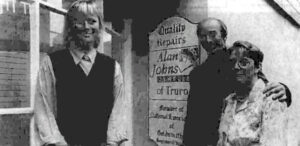
Alison Johns with Alan and Olive Johns in front of the new shop in Tippetts Backlet (3)
Jewellery Family Return to City
“Westcountry Television presenter Alison Johns will be keeping it in the family when she officially opens Truro’s newest jewellers on Saturday – the owner of Alan Johns jewellers in Tippets Backlet is her uncle.
Alan is returning to his roots. He was born in Truro, and attended Fairmantle Street and Redruth Grammar School before serving as an apprentice to J Pearson and Son, Jewellers in Truro.
The Johns family has strong ties with the city. Alison also went to school there and Olive, Alan’s wife, is musical director of the Praisemakers choir.
For the last 18 years, Alan and Olive have been based at Gudridge and Son, Jewellers in Perranporth, which they will continue to run after the opening of the new shop. In fact, Alison had her first work experience there, with a summer job in 1976.
A skilled watchmaker, Alan won the princely sum of £25 when he was awarded the Arthur Tremayne prize for the best apprentice of the year. He was thrilled – £25 was a whole month’s wages. He went on to be made a Fellow of the British Horological Institute, the youngest person at that time to be awarded the honour.
In 1984, Alan won another major award when he became a Churchill Fellow and went to Japan and Switzerland to study watchmaking. As a result, Alan has since been the service agent for all Japanese Orient watches brought back to the UK. Alan Johns Jewellers will now be selling Orient Racer watches, the first and only outlet in Great Britain to do so. Alan has decided to showcase them because of their superb quality and design. They will also be stocking a fine range of quality jewellery and giftware.
Its workshop is well equipped to carry out watch and jewellery repairs to a very high standard and it’s also registered with the National Association of Goldsmiths to carry out valuations.
Truro’s newest business looks forward to being of service to the people of the city and to the surrounding area.” (4)
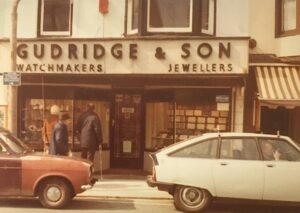
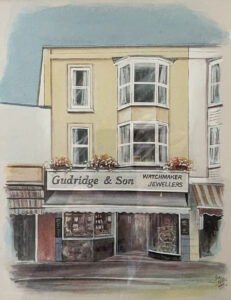
Our new shop in Tippett’s Backlet
This was a busy time for us as we were running two shops – something had to change. In 1998 we made the decision to close the Perranporth shop.
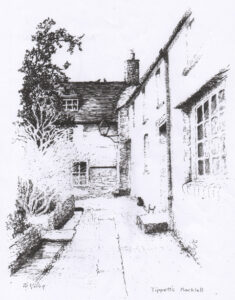
For those of you not familiar with the opes and alleyways of Truro, this sketch by Jo Millen shows the Backlett just around the corner from our shop, where it ajoins the Leats
A couple came into my shop and from their demeanour, I could tell that they were clearly very much in love. He told me that they were about to be engaged and he wanted a ring for his ‘Bride to be’. The ring was chosen, paid for and their details entered in my file. Sending them a note of congratulations seemed like a nice touch, but a few days later I received a phone call. The lady said that she appreciated the gesture but she was his wife and she was awaiting his return! We never sent congratulations to engaged couples again!
Another little gesture was to have a bowl of sweets on the counter. Two ladies came into the shop and I looked at the younger and asked if she and her mother would like to choose one each. The other lady looked at me and said, “I’m her sister not her mother!”
A couple from Roche came into my shop having seen a very expensive and flashy watch in the window. It was priced at £700 [then expensive] and without the slightest quibble, he bought it. It had many functions and despite my offer to explain what all the knobs did, he declined any help. His wife said that he had been on a cruise and had been sitting at the Captain’s table and had noticed that the other men there had watches with ‘knobs on’. That was why he wanted it. Sadly, he died a short while later and his wife brought the watch in for a valuation. She told me that recently her cat had also died and that she missed the cat greatly!
A local young farmer asked me to make him a bespoke engagement ring for a young lady to whom he was about to propose. He designed exactly what he wanted and shortly after, he returned to collect it. A few days later, I spotted them at a concert in Truro Methodist Chapel. He signalled to me with a thumbs up and I went over to congratulate them and to check that the ring fitted. He said, “Oh, I haven’t asked her yet!” I’m pleased to say that he eventually built-up courage, and that she accepted.
Another young lady brought in an attractive engagement ring with a big white stone which she wanted to sell. She explained that she was breaking up with her fiancée but as she had given him the money for the ring initially, she intended keeping it. Unfortunately for her, the stone was cubic zirconia, a synthetic man-made material and not the diamond she had been led to believe.
During my career I worked on a great variety of timepieces, some famous, others less so, and this one in particular remains in my memory both as a beautiful clock and as a piece of history. It depicted the Charge of the Light Brigade during the Battle of Balaclava in the Crimean War and had been presented to the last surviving member of the disastrous charge.
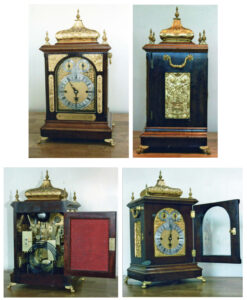
“Presented by the officers of the 8th Hussars to Capt. J A Hefferon, Qr. Mr. 8th Hussars and last surviving officer in the service who was present at The Balaclava Charge, on his retirement after 40 years in the Regiment in recognition of his services during that period and of the high esteem in which he was held. 6th December 1891.”
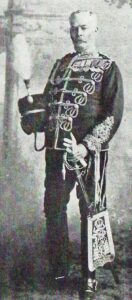
Captain J A Hefferon
We closed the Truro shop in 2013 and after fifty years working in the miniature world of a horologist, I hung up my loupe. (5)
It has been a good career and I enjoyed every minute of it. Well, nearly every minute! Some of my friends say that I’ve spent a lifetime winding up clocks – and them!
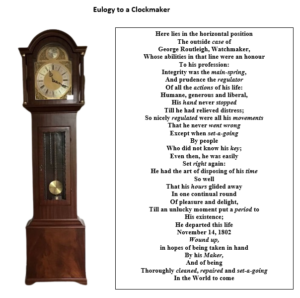
I’ll finish with this piece written over 200 years ago. It sums up my career.
End notes:
- A peg wood is a cleaning tool used in watchmaking to clean pivot and other small holes. It is made from a specially selected orangewood that has been dried and sheds very little. It consists of a thin piece or dowel of wood that the user shapes to a point. The standard length is 150 mm and the thickness varies from 2 to 6 mm. They are also used to clean watch case backs and watch case rims, to dry watch hands and clean between bracelet links which might gather grease and dust when worn over a long period. The point is twirled around the hole to be cleaned to remove dirt. A new point is cut and the operation is repeated until the peg wood is clean when removed from the hole.
- The West Briton of the 6th February 1984
- West Briton and Cornwall Advertiser – Thursday 19 October 1995
- West Briton and Cornwall Advertiser Thursday the 19th October 1995
- A loupe is a simple, small magnification device used to see small details more closely. It is designed to be held or worn close to the eye.
