
By Jo Lewis & Tony Mansell
This is not a history of the Baptist Church per se, nor is there any attempt to stray into doctrinal matters, it is simply a record of the chapels and of their place in the religious built environment.
Perhaps though, it would be helpful to say that the Baptist movement was one of the earliest non-conformist churches having been formed in the very early 17th century. Its members were classed as dissenters – those not conforming to the state church.
A society was established in Falmouth in 1670 but within about 30 years the movement had largely died out and from the 1740s the Baptists in Cornwall faced considerable competition from the growing Methodist movement. There seems to be no evidence however, that they attracted the hostility that followed the Wesley brothers. Could this have been because the Anglican Clergy considered them to be less of a threat?
By 1765, a Baptist Chapel had been founded in Falmouth and a few years later, in Penryn.
The Reverend Robert Redding, a Baptist minister who had come to Cornwall from Worcestershire, took charge in Falmouth in November 1772, the same year in which he married Joanna Hornblower, the eldest daughter of Ann and Jonathan Hornblower of Chacewater.
Chacewater
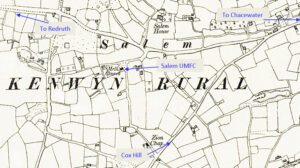 The location of Salem Chapel (1907 map).
The 1907 map shows a United Methodist Church whose congregation had been worshipping there since the 1880s. Prior to that it was the home of the Primitive Methodists (indicated on old-maps.co.uk) which does seem rather strange as there was already a Primitive Methodist chapel in Chacewater but maybe this small community considered itself separate to the village. Before the Prims however, it had been a Baptist Chapel, built by that sect in 1758.
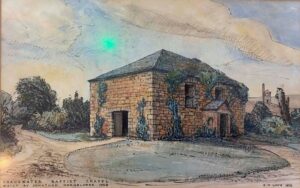 Painting of Chacewater Baptist Chapel by E G Long, held by the City Life Church in Truro (Baptist) (Photo submitted by Barry West)
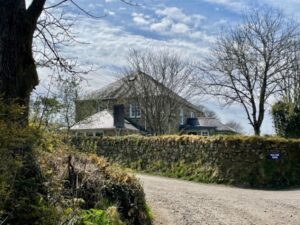 The building owner in 2021 confirmed that it was once a Wesleyan chapel and for much of the late 20th century was an agriculture store before being converted into a family home. (Photo: Jo Lewis)
The Cornwall Heritage Gateway has this to say about the building: “Baptist chapel now farm building. Circa 1830. Killas rubble with elvan quoins, jamb stones and voussoirs. Hipped corrugated iron roof originally scantle slate. Rectangular plan with wide entrance to east. Later entrance and porch to middle of north wall. Wide doorway to east side with flat arch fallen. 2-window openings to north, south and west sides each with flat arches. North side has gable ended brick porch and blocked. Later entrance to far right. Interior gutted but retains king post roof structure. This is the first Baptist chapel to be built in Cornwall.”
The Hornblower family were strongly connected to the Baptist Movement in Chacewater, particularly Jonathan Hornblower, who is credited with building the chapel.
Jonathan moved to Cornwall in 1745 and in 1761, “He pitched his tent here.” He succeeded his father as a mining engineer and married a local girl, Ann Carter.
Jonathan was religious and according to his grandson, although his parents had been members of the Baptist Chapel, his religious views at that time, and those of his wife, are not known.
Jonathan’s father, Joseph Hornblower, had been in Cornwall since 1725 when he moved down to erect a Newcomen engine at Wheal Rose. He had lived in Salem, Chacewater, since 1748.
Jonathan Hornblower is credited with founding the Baptist church in Chacewater in 1758 (1) and it seems likely that the congregation met in the open air “On the Downs.” (The date seems slightly early considering Jonthan’s arrival in Chacewater. Either that or the arrival date is incorrect)
In 1764, Jonathan became acquainted with William Pollard, a young man who belonged to a religious society in the Parish of St Agnes and this led to Jonathan and his family to begin meeting with a group of like-minded believers for conversation, hymns and prayer. The members of the group were from different strands of religion however, and when a Mr Heath, a Baptist minister from Plymouth, visited and preached in 1767, the Hornblowers saw the need for a Baptist meetinghouse. Construction began in early 1768 and Mr Heath later stated that it was built “almost entirely by our worthy and zealous brother, Mr Jonathan Hornblower.”
The building was licensed as a Baptist meeting house in April 1768 and the first service using the pulpit was on the 22nd of October.
On Sunday, 29th May 1769, Mr Lewis from Exeter performed the first baptisms at Chacewater, for Jonathan and Ann Hornblower and two others. The baptismal ceremony took place at a nearby river and was witnessed by a large group, many who later joined the local Baptist church, where it was reported that from three to five hundred met for worship.
There is a reference to the Church being formed and constituted on the 10th of September 1769 with the Reverend J Hodge Morcom as its first ordained minister. (2)
Seven days later, on the 17th of September, Thomas Croggan was baptized, possibly the same person mentioned later in Truro.
In 1774, it seems that the Society was searching for a new pastor.
In 1789, the Reverend Robert Redding was about to leave Falmouth and Charles Turner, Mr T B Rouse and Mr Sholl knew of the Chacewater Church and were determined that it should not become destitute. They agreed with the Reverend Redding that he would preach at Truro in the morning and evening, and at Chacewater in the afternoon. (3)
Robert Redding died in 1807 but it seems certain that the Baptist community in Chacewater continued for another 40 years or more.
There is mention A handwritten history of the Baptists Church in Chacewater (Future Reading) of individual exclusions and William Rowe, in 1837, was “charged with frequenting low Beer Houses and drinking with Worldly Company.” The Baptists decided to be “separated from him.” (4)
In January 1838, the Baptists at Salem were released from a debt and the “Chapel [was] in the hands of the Church and Congregation.” (5)
The Sunday school commenced, or re-commenced, in June 1838 when it had 38 children and six teachers. The chapel congregation is said to have “considerably increased” by this time. (6)
Things were clearly active elsewhere in the vicinity as there is mention of services at Skinners Bottom albeit the congregation was decreasing in number. Wheal Rose also gets a mention where a room was being used for preaching. (7)
On the 26th of June 1838, there is a first suggestion of money problems. The possible sale of the chapel had already been mentioned and it was now said that £50 was required “to make our place of worship fit for the congregation, being destitute of Baptistry Vestry or comfortable seats.” The Pastor had not received his full pay and “The attention of the Church being called to the state of the funds.” All members were appraised of the need to raise funds. (8)
As to when the Chacewater Baptist Chapel closed, or moved to elsewhere, we have two pieces of information which may throw some light on the situation.
Firstly, the Website My Primitive Methodists states that the building’s original occupiers are difficult to determine but the weight of evidence suggests that it may well have been a Baptist chapel before being taken over by a Methodist denomination – or two. The chapel, marked as a Primitive Methodist Chapel on 1880 maps, later became a United Methodist Free Church. (9)
Secondly, Pigot’s Directory includes Chacewater Baptist Chapel in 1844 but by 1873 it is no longer listed. This suggests that the Chacewater Salem Primitive Methodists occupied the building from sometime after the mid-1840s until the 1880s when the UMFC moved there. I am afraid that will have to do until we can establish a firm Baptist closure date.
As to the later use of the building, it seems to have ceased its religious life in the early 1900s and local history suggests it became a farm building before being re-roofed in the 1980s and converted to a dwelling.
Truro
Kenwyn Street Chapel
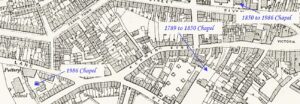 The location of Truro’s Baptist Chapels
Several members of the Baptist Church lived in Truro, some of whom were also members at Chacewater and others were in communion with the Independent Church at Bethesda. The formation of the Truro Baptist Church is described in the opening minute in the first Church Minute Book. The Presbyterian Meeting House, in Kenwyn Street, was built in 1708 and being vacant in the late 1780s, was taken on trial at an annual rent of six guineas for a term of three, ten or sixteen years. The period was extended and actually turned out to be 60 years. It opened as a Baptist Chapel on the 11th of October 1789. The Baptist Minister at Falmouth, the Reverend Robert Redding, was about to leave and it was agreed that he would preach at Truro in the morning and evening, and at Chacewater in the afternoon. (10)
The series of books by the Truro Buildings Research Group locates the chapel on the south side of Kenwyn Street, “on a site reached through a court which is now the William IV beer garden.”
The Baptist Manse was also located in Kenwyn Street. (11)
By December 1790, the congregation had grown considerably and it was decided to enlarge the meeting house – to double its original size. It was re-opened on 15th May, 1791. A little later, a gallery and an indoor baptistry was added. (12)
The Baptist Church had strict rules about behaviour and in 1800, William Siley was excluded for theft and drunkenness. A year later, Thomas Croggan (was this the same Thomas Croggan from Chacewater?) was excluded for ‘illicit commerce’ with his servant but was restored in 1805, and in that year a Mrs Clemens was suspended for quarrelling and fighting with her husband.
Early in 1807, Robert Redding was taken ill and he died on 26th March, at the age of 54, having been pastor at both Truro and Chacewater. He was buried at Kenwyn Churchyard, next to where Ann Hornblower was buried. The attendance at the funeral was one of the largest ever known there. The Reverend Richard Polwhele preached the funeral sermon and has left it on record that the funeral was “one of the most impressive occasions he had known.” (13)
The Baptist Church practices adult baptism, also known as believer’s baptism. It is the practice of baptizing individuals who have reached an age where they can make a conscious decision to follow Jesus Christ. There is an earlier mention of baptisms in a river and for Truro, it seems that the Mill Pool was the chosen location.
River Street Chapel
In June 1847, the church decided that it needed a new chapel. A site was found in River Street, part of what was then called ‘Matthew’s tenement’, immediately to the east of the Savings Bank (now the Royal Cornwall Museum). An agreement by the trustees of the Baptist Church with Edmund Turner and John Ferris was drawn up whereby the Church agreed to purchase the plot for £400, to be paid within three years, with permission to build a chapel thereon before the consideration was paid. Philip Sambell Junior, one of the deacons, was the architect and in September 1848, tenders were received and a Mr Prior was contracted to build the new chapel. The foundation stone was laid on 2nd November, 1848, and the new building was ready by January, 1850. (14)
The Cornwall Heritage Gateway has this to say about the building: “A former Baptist chapel constructed between 1848 and 1850, in a classical style to a design by Philip Sambell. They moved to this building upon its completion in 1850. Since 1986 it has been used by the Royal Institute of Cornwall. The building is described as having a granite ashlar front, and Delabole slate roof with pediments at the front. It is a two-storey building, with a rectangular aisleless plan, formerly with gallery on 3 sides now divided into 2 floors, former schoolroom at rear added in 1867.”
The opening service was held on the 14th February 1850 and Truro Baptists settled into their new home.
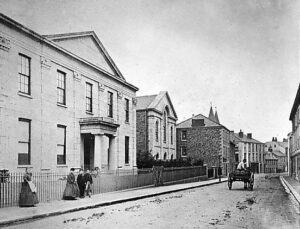
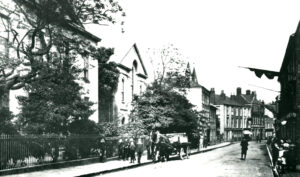 These two photographs show the Baptist Chapel to the right of the Royal Cornwall Museum with the pinnacles of Bethesda Chapel appearing above the rooftops
In 1858, the Baptist Association appears to have consisted of churches at Falmouth, Helston, Penzance, Redruth, St Austell, Truro, Grampound and Hayle, but by 1878, there was no longer a church at Grampound, but Newquay and Hayle had been added. (15)
In July 1865, alternative plans and estimates for increasing the accommodation in the chapel were considered, but in September, the church decided that the demand for school accommodation was more urgent than a gallery for the chapel. (16)
The schoolroom was added in 1867 and six years later, a gallery was in place. The architect was the same Mr Philip Sambell. (17)
This 1874 newspaper report outlines the extent of the work carried out. “Yesterday (Thursday) afternoon, the Baptist Chapel, River-street, was re-opened, after being closed for nearly three months, for the erection of galleries and a new organ. Those who visited the chapel yesterday for the first time since the alterations have been in progress, were doubtless much surprised at the metamorphosis which has taken place. The present lightness and elegance of the interior of the building, are such a striking contrast to the heavy and somewhat cheerless appearance, which it presented before, that anyone familiar only with its past aspect, and unaware of the improvements which have been recently effected, might well be excused for imagining that he had strolled inadvertently into the wrong place. It was at one time thought that the expense of the alterations would not exceed £300, but as the work proceeded it was found necessary to add considerably to the original design, and the result has been that more than half as much again has been expended. As regards the principal object of the alterations (increased accommodation), everything appears to have been most carefully designed in order that the whole of the congregation may be able to see and hear the minister without the slightest obstruction. The pulpit is in the form of a raised platform, and circular in shape. The front is divided by carved pilasters into panels, which are filled in with ornamental ironwork of an elegant and tasteful design, painted light, and picked out with gold, and the railing of polished Spanish mahogany, which gives to it an exceedingly pretty and agreeable appearance. On either side of the platform and leading to it, there is a circular flight of stairs, the balustrades of which are of iron to match the front of the platform, and similarly painted and gilded, with rails of polished mahogany. At the south end of the chapel, and immediately facing the platform, a gallery is provided for the accommodation of an increasing congregation. The seats in this gallery appear to have been designed expressly for ease and comfort; they have reclining backs, are stained and varnished and are thoroughly in accordance with modern tastes. At the north end of the chapel, a smaller gallery is erected, supported by four handsome marble pillars with caps, carved in the ionic style; this gallery is provided for the accommodation of the new organ and chair. Connected with the galleries, is a feature which attracts attention immediately on entering the chapel, instead of the heavy and sometimes unsightly wooden fronts that one is accustomed to see in nearly all places of worship, which boast of galleries, a very light and agreeable effect is produced by an elegant iron scroll, front of unique and chaste design, which is painted nearly the same colour as the platform front, and adds very materially to the beauty of the interior of the chapel. The organ, which is a new one, was built by the firm of Brewer and Co, Castle Street, Truro, and reflects great credit upon the makers. It has a handsome gothic front, the pipes of which are elaborately and tastefully decorated, and consists of a great organ and a pedal organ with the following stops. Open diapason, stop diapason bass, stop diapason treble, principal, fifteenth, flute, dulciana, bourdon, and pedals to great. The tone as well as the appearance of the organ, is highly admired by all who have been privileged to hear it. The cost is 140 guineas. The whole of the interior of the chapel has been re-painted by Mr J E Philp, of King-street, Truro, who has accomplished his work in a comparatively short space of time, and in a very efficient manner. Great credit is also due to Messrs Colston and Brewer, the builders, and to the Messrs Clemens, who did the masonry…” (18)
There is a reference to there being two Baptist Chapels in the Truro Parish with 440 sittings. (19)
During the 1890s it was felt that the Baptist and Congregationalist movements should work closer together, perhaps to unify, and “Closer relations between the two movements were being explored.” (20)
In 1912, a new Baptist Manse at Truro was opened. “The formal opening of a new Manse presented to the Baptists of Truro by Mrs J Cockin, took place on Friday. The house, which one of several recently built in The Crescent, commands an excellent view of Truro and the picturesque surroundings of the city. It provided with all up-to-date conveniences and contained eight rooms. Hymns were sung and prayer was offered by Mr H T Pearson. Then the house was accepted on behalf of the church by the pastor (the Reverend Seager); and on the motion of Mr J Treseder. seconded by Mr W Walters, a hearty vote of thanks was accorded Mrs Cockrin for her generous gift. Refreshments were subsequently handed round.” (21)
The 1920 annual meeting of the Cornwall Baptist Association was held at Truro with the Reverend M L Murphy of Falmouth presiding. It was considered that an amalgamation of the Truro Baptist and Congregational Churches was “necessary owing to economic conditions.” Mr H T Pearson, a deacon at Truro Baptist Church, spoke in favour of the proposed amalgamation and said that the proposal had come simultaneously from each side. A similar suggestion had been made several years previously but had not materialised. Several meetings had been held and the members of the Baptist Church were willing that the amalgamation should take place. It was suggested that the Baptist Church should be discarded for worshipping purposes, and that the congregations should unite for worship in the Congregational Church, the better of the two premises. The deacons were instructed to progress the matter and to arrange the necessary terms of agreement. The Truro Congregational Church was without a pastor and it was hoped that the Reverend T R Lewis, pastor of the Baptist Church, would be invited to accept the pastorate for four years. Mr Pearson added that some of them felt they were giving up a good deal in leaving the place where some of them had worshipped from childhood. Their members would form a major part of the congregation and he did not think they were asking too much for their terms to be complied with… (22)
It is unclear if the proposed amalgamation took place but if it did, the congregation moved back to the Baptist Chapel when Bethesda closed in the early 1930s.
In 1984, Truro Baptists decided that the maintenance cost of their chapel was becoming greater than they could afford: they proposed selling it and moving elsewhere. The Royal Institution of Cornwall declared its interest in purchasing it for use as an annexe to the Museum.
In 1986, the church building was sold and became a part of the Royal Cornwall Museum.
Chapel Hill Chapel
During early 1985, the Baptist Church identified the Truro (Lake’s) Pottery site in Chapel Hill as a suitable location for a new chapel. Planning permission was granted and building work progressed during 1985 and early 1986.
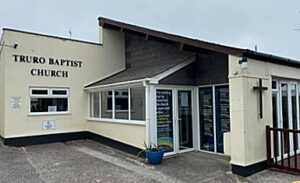 (Photo: courtesy Barry West)
In 1986, the Truro Baptists reached a new milestone in their 200-year history on Easter Sunday when they held their first services at their new home on Chapel-hill. (23)
In circa 2021, Truro Baptist Church became the City Life Church but remained a member of the Baptist Union and the South West Baptist Association. (24)
Footnotes:
- Cornishman – Thursday 1st October 1891
- Ashley Rowe – Kresen Kernow ARC/T/286
- gov.uk (https://discovery.nationalarchives.gov.uk/details/r/53fb9d17-ce0d-408f-94c9-b9b1dda81884) Kresen Kernow (https://kresenkernow.org/SOAP/detail/fc409964-6ce1-4f9b-8f0a-1f43bc2ff2da/)
- A handwritten history of the Baptists Church in Chacewater Kresen Kernow reference X581/3.
- ibid
- ibid
- ibid
- ibid
- https://www.myprimitivemethodists.org.uk/content/chapels/cornwall/chacewater-salem-primitive-methodist-chapel
- gov.uk (https://discovery.nationalarchives.gov.uk/details/r/53fb9d17-ce0d-408f-94c9-b9b1dda81884) Kresen Kernow (https://kresenkernow.org/SOAP/detail/fc409964-6ce1-4f9b-8f0a-1f43bc2ff2da/)
- Ashley Rowe – Kresen Kernow ARC/T/286
- gov.uk (https://discovery.nationalarchives.gov.uk/details/r/53fb9d17-ce0d-408f-94c9-b9b1dda81884) Kresen Kernow (https://kresenkernow.org/SOAP/detail/fc409964-6ce1-4f9b-8f0a-1f43bc2ff2da/)
- ibid
- ibid
- Kresen Kernow (https://kresenkernow.org/SOAP/detail/fc409964-6ce1-4f9b-8f0a-1f43bc2ff2da/)
- ibid
- ibid
- Royal Cornwall Gazette of Saturday the 17th January 1874
- Imperial Gazetteer of England & Wales [Wilson, John M]. A. Fullarton & Co. N. d. c. [1870-72]
- Royal Cornwall Gazette of Thursday the 19th July 1894.
- West Briton and Cornwall Advertiser of Monday the 15th July 1912.
- West Briton and Cornwall Advertiser of Thursday the 6th May 1920
- West Briton and Cornwall Advertiser of the 24th March 1986
- Kresen Kernow
Further Reading:
A handwritten history of the Baptists Church in Chacewater is held at Kresen Kernow. It is simply titled Church Book (Chacewater) and has the library record X581/3 and its opening paragraph reads: “Some account of introducing the Gospel, laying the foundation of, and future progress of the Baptist Church at Chacewater.” It contains a detailed history of the Baptist Church there, its meeting, ministers and individual baptisms, admissions and exclusions.
An incomplete record of Baptisms at Chacewater Baptist Chapel is held at Kresen Kernow with the library record X1301/B/9/110/15.
About Jonathan Ann Carter Hornblower. (https://penwood.famroots.org/jonathan_ann_carter_hornblower.htm)
Kresen Kernow holds a document entitled Steps of Faith. It is a short history of 200 years of the Truro Baptist Church, written by George Beards and published by the church. It includes details of the closure and sale of the church in River Street in 1985, which had been built by the congregation in 1850, and the purchase of the former Lake’s pottery in Chapel Hill and construction of a new church building on that site.
Kresen Kernow holds a considerable number of other documents relating to individual Baptist churches and the movement in general.
Bethesda Independent/Congregationalist Chapel, Truro. https://cornishstory.com/2023/03/29/bethesda/
 Jo Lewis is a researcher-compiler for The History Files (https://www.historyfiles.co.uk/), an activity which led her to volunteer for Cornish Story’s Mapping Methodism. Her contribution to that project has been invaluable and it is no exaggeration to say that without her involvement, it would not have reached the same level of success.
 Tony Mansell is a Cornish historian with a diverse interest in Cornwall’s past and present. He is a Cornish Bard (Skrifer Istori), a researcher with the Cornish National Music Archive and Co-editor of Cornish Story.
My Mum’s family attended the Truro Baptist Chapel in River Street all their lives and my Aunt (one of Mum’s twin sisters) continued to worship in the new Baptist Chapel in Chapel Hill until she died in 2005.
My Aunt, Mum’s eldest sister, was married there in 1920 and my Grandfather’s funeral service was held there in 1940.
I have photos if you would like to see them including a group photo of some of the congregation (date approx. 1910) and a photo of the original ceiling rose before it was painted over by the museum.