
The Dondu: The Demon Huntsman and his Dandy Dogs
Categories Articles, Folklore, Myths & Legends0 CommentsBy Robert Burroughs
Another story in the Drollercoaster series
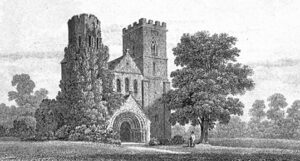
St Germanus Priory Church at old Lanaled; East Wivelshire, 1824
From F W L Stockdale: Excursions in the County of Cornwall;
(pub’ Simpkin & Marshall, London, 1824)
In the church of St Germanus at ancient Lanaled, there survives a carved Misericorde seat showing a Huntsman and his Dandy Dogs. This is the terrifying story of the Dondu; the Demon Huntsman and the Wild Hunt he leads. He gathers in the ‘tythe’ of lost souls from Nomansland and the graveyard walks of old Wivelshire and in a ‘Danse Macabre’ drives them past Sheviock Church and down to the Dandy Hole on the Lynher River opposite the mound and Isle of Erth. There the Naffanog; the ‘Great Goldworm’ is supposed to lie sleeping; for every pile of good earth must have a worm within.
If you are unlucky enough to meet the Dondu driving his old, rickety ‘rattle wagon’ along the Budlegh Bounder and Horsepool Lane at Alantide; that is any night between Halloween and Bonfire Day:
Hold up your collar and look away,
Before your hair turns silver and grey,
Before you become the huntsman’s prey.
Once upon a time, many years ago a young beggar boy came to the old Priory Church of St Germanus at Lanaled.
“Please take me in Father Abbot. I am hungry and thirsty.” He said, “And if you help me, I promise to serve you as faithfully as I can.”
He had no family of his own and asked the Abbot to take him as a novice for the priesthood, so that he could gain a living. The Abbot looked long and hard into the young boy’s face and thought long and hard about him:
“It is God you must promise to serve, not me. The life of a good priest is a hard one, my son! And once you have taken your vows you will be bound to them forever in the eyes of God. So, you must prove yourself strong and true. This is the test for you. First, you must work in our garden, then in our kitchen and finally in our fields, only after you have completed honest toil and shown you can obey our rules, may you start your studies. You must obey our rules without question.”
The Abbot smiled and added: “To be saved you must follow the seven sacred virtues and avoid the seven deadly sins. Steer clear of the Devil and all his tricks. Do you think you can?”
The boy promised he would try, and the Abbot agreed to take him. And at first all went well. The boy worked hard in the garden. He worked even harder in the kitchen. He turned the salmon on its griddle in the hearth, but he burnt his thumb. He sucked the thumb; the salmon tasted so good he was tempted to pinch a crispy flake off the fillet, but he did not. The cook was pleased and said: “You may sneak a cake, if you feel really hungry.”
I would have been tempted, wouldn’t you?
But the boy remembered the Abbot’s instruction and said: “No, I may not.”
“Good for you! You’ve passed your first test,” said the cook and laughed. “If the Devil offers you a ‘roast’ in his kitchen, Or, the Dondu offers you a ride in his cart, You’d be a fool to accept.”
“Who is the Dondu?” asked the puzzled boy.
“No-one you want to meet my lad, unless you fancy being hung, drawn and quartered like a buck rabbit, or spatch-cocked like a silly hen.”
The cook looked away and would say no more but muttered the old rhyme:
“He herds the beasts by Priors Brake.
And foolish souls he’s quick to take,
And ferry o’er ‘Halsafren Lake’.
Avoid his forests dark and deep,
In them we neither sow nor reap.
For none must work, nor play, nor sleep beneath his ‘erce’ tree.”
At last the Abbot was satisfied and set the boy one last task to do all on his own, to clear a small patch of woodland by the river. He added: “You may go as far as the parish boundary, but do not go down the old lane towards the river, nor into the old forest beyond the Aled brook. You must work on your own! Speak to no-one! When you have cleared the field of every weed and briar you must come and tell me. God wants no ‘tares’ in his wheat at harvest time.”
The young lad worked hard clearing the field by the wood. The sun burned down, but try as he might, it seemed as if he would never reach as far as ‘Budlegh Bound’ and Polmarch’. This was in the next parish, where the lane ran down to the river, through the dark tangle of the old forest. The lane had deep ruts, where heavy wagons had passed, but there were trees, both young and ancient, growing between the tracks. The boy knew it must be a fairy road, where the Wild Hunt crosses, and the dead may walk.
A breeze shook the bright green leaves of the trees and he thought he heard a whisper on the wind, as it carried across the track:
“Come, come into the glades, come, come into the gloaming!”
The forest looked cool and deep. He wanted to rest. And so, at last, he crossed the lane, lay under an old oak and despite his promise to the Abbot, was soon fast asleep.
He woke with a start; it was late. A bold jenny wren flew away from his head. A blackbird stood before him, looking up from its anvil, littered with the shells of poor snails. The ‘deryndu’ tilted his head and with his sharp eye gazed at him, then pecked away in the moss. He shivered, he shuddered; a ‘darkness’ passed through him. A stag with a young hind, stripping the tender shoots of a hazel stand, was suddenly startled.
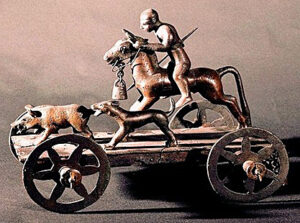
Moccos, the Wild Boar pursued by a Hunter; Celt-Iberian cult object.
The British variant is the Hunt of Twrch Trwyth/Triath the enchanted Wild Boar across Cornwall by Culhwch in the Romance of Culhwch and Olwen, The Mabinogion, 11th C.
For in the shadow of the oldest oak there stood,
A strange figure of a man, hidden beneath a leafy hood,
Dressed in a ribbed and twisted gown, from top to toe,
Of darkest green and russet and brown,
As if it was of moss and bark and ivy woven,
With holly and nightshade and wands of rowan Intertwined.
And girding his waist about, a hag-worm belt was twisted, with a clasp like the ram’s head of that old, golden slow-worm; the An-Nafannoc of Kernow, the guardian of its buried treasure. While in his hand he clasped a pikestaff of twisted yew. The stranger’s features were strong and bold, his nose cruel and curved like a raven. His lips were thick and fleshy, but his smile was cold. His eyes were clear and blue and bold, but his skin was earthy brown. His brow was brave and beetled, his face all swarthy and furry. His hair was black as coal and curly, matted with beech mast and other leaves, both red and gold and green and russet. The Dondu, for it was he, took off his cloak with a flourish and said: “You will need a hand to clear the rest of that before nightfall, my young friend. Let me help you.”
“The Abbot said I must clear it all on my own, so that there are no weeds or briars to choke the crop.” Stammered the frightened lad, for he saw the stranger had horns that curled out of his head like all cloven beasts have.
“What the Abbot doesn’t know won’t upset him.” The stranger laughed. “Why did he set you an impossible task? Don’t tell him.”
He lent on his pikestaff: “How will he know who ‘yured’ his earth, and hewed this staff from his graveyard too?”
The boy thought about this, and in his heart a seed of resentment was sown. Why should he tell?
The stranger worked beside him, like a whirlwind, and the little field was cleared and raked in no time. The boy felt guilty, but also rather proud; now he would be able to show the Abbot all the work he had done in a single day. Then the stranger turned to him: “I’ve done a good deed for you, now you must do the same for me.”
The boy’s heart sank. He shivered.
The stranger laughed again:
“Don’t worry, it’s not a trick. I won’t ask you to commit a mortal sin, nor some sorry task like weeding. Your sins you can keep to yourself, though they will indeed return to haunt you. Just come with me further into the forest. I have a fine salmon cooking on my spit, and you must be hungry by now, but you must decide for yourself.”
And so, the lad broke his word again and went deeper into the woods. He sat down by the fire and looked at the salmon, it was a fine fish, as fine as those in the Priory fishpond.
The boy frowned: “Where did you get it?”
The stranger just smiled and said: “Well I’m not like the Abbot; A meek Fisher of Men, I’m the Wild Hunter of fowl, fish and game. I’m Lord of the forest, the waste and the moor. I hunt where I want. As for Laws I don’t care, My law is the hunt, my skills in the snare! And I’ve caught a fine fish today. Why wouldn’t you want to live just like me?”
Now, what do you think he meant by that?
“Eat up! It’s no crime. And don’t say anything to the Abbot, just tell him how hard you’ve worked clearing his field.” The Dondu commanded! “Why should the church and the lords have it all?”
The boy felt afraid, but he sat down by the stranger’s fire and ate the fish and it tasted good. He felt pleased with himself. When he had finished, he sucked his thumb and felt a sharp pain where he had burnt it before in the kitchen. The sun had set, and the crescent moon was now rising high over the dark twisted oaks.
‘There is wisdom and foresight to be found in a thumb nipped by the devil’s door’: the old proverb says! The boy’s conscience was pricked. “I must go back now.” He pleaded.
The stranger smiled, not a kind smile, but a cruel one: “Well, we’ll meet again another fateful day. That’s when your debt to me you must repay, my fine lad.”
And he disappeared, silently into the deep, dark wood.
The next day the Abbot was surprised to find that the boy had cleared the field so well. The boy was too ashamed to confess what had happened. When he was asked if he had been helped, he blushed at first, then smiled and proudly said: “Honestly, on my Honour, Brother Abbot! Neither Man nor Beast, nor any other Monk has helped me.”
I don’t think this was strictly true, do you? But he convinced himself that, at most and at least, it was not an outright lie. So, the Abbot agreed that he could start his studies as a priest. And the boy tried as best he could to forget the dark stranger from the forest but fear of being pursued by his helper still haunted his dreams. He studied longer and more deeply than the other novices, they were lazy and came from wealthy families. He would be the first into the library and the last to leave and yet he would still plead: “Father Abbot, are there no other books that I can read?”
While other monks sneaked off to hunt and fish and visit local taverns, he used all his spare time to pray and learn more about the lives of the saints.
He would say: “Dear Father Abbot, guide me in my prayers, that I may be better than all the others.”
The Abbot was pleased with his progress but replied: “Don’t worry so about your brothers, my son! Yes, you have done well it’s true, but beware the sin of Pride! You should always do your best, but do not fret so much; no scheming to be better than all the rest.”
Eventually he took his vows and the Abbot promised to find him a place in a local parish, but at the back of his mind he still felt troubled by a small, hard grain of doubt about his novice. At first the young man was a good priest and the parish prospered. He became wealthy too and noble friends gathered around him and praised him for his generosity. Above all he loved to feast and hunt, and so he purchased fine horses and hounds, to pursue his passion. “Now, at last I can please myself.” He thought.
Finally, the old Abbot died, and everyone agreed the young priest should become the head of the Priory. Slowly but surely the new Prior lost his way. He ignored the seven saving virtues and succumbed instead to the seven deadly sins. The parishes no longer prospered. The Prior guarded his woods and wastes jealously, so that only he and his friends could hunt there. He neglected the Church; he neglected the monks and he cared not at all for the humble or the meek. He drove the beggars from his door and the poor from the alms houses. His lawyers seized the land of those in his debt. He forgot that he had once been no better than a poor orphan. He became proud, boastful, and a bully; he raised the rents and the tithes on all the church lands so that he could pay for feasting and hunting with his new friends. He even swindled, connived and conspired with thieves and robbers to get his hands on the last few pennies of honest folk. But at last he had to pay the debt he owed from many years before.
It was Good Friday’s Eve. The eve of the holiest day of the year; when hunting was strictly forbidden. When every priest should attend to his flock and pray to the Saviour, But not the Prior of Lanaled. He was up at dawn for the hunt alone. Instead of hymns and psalms he sang a rude hunting song and called out to the master of his pack of hounds:
“Hey, Johnny Le Bonney out seeking a lover?
Hey, Ho, Johnny Rumbello
Here’s to the black stag and his fair white doe.
By Pinder’s Pound he found sweet Sally Clover?
Hey, Ho, Johnny Rumbello,
Now tell me sweet Sally will you be my fair, lover?
Oh Never, No, Never, My Johnny Rumbello!
But he kissed her once, then twice and thrice
And tumbled her three times over!
With a Hey and Ho, Johnny Rumbello,
Here’s to the Black Prince and his fair White Doe.
“Beware his ‘bound old folks do say!
For Angels and Demons pass this way!”
He roused all his hunting friends. They ate a hearty breakfast and the Prior ate twice as much as the greediest. He called for ale and wine and drank a jug of both. Then the master of the hunt blew on his horn to summon horses and hounds.
And in the distance, far away like an echo, a horn replied; “Who dares to hunt my lands this day?” The angry Prior cried: “If I find the rogue, I’ll make him pay with his very own soul, I swear!” And with a Tally Ho from the Master of the Hunt, the Prior, his pack of hounds and his hunting friends were off!
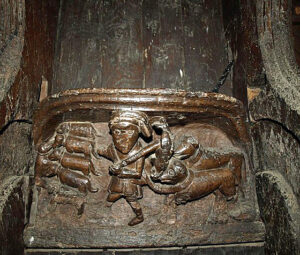
Dando and his Hounds: The Misericorde, St Germans Priory Church
Off went the hunt, over hedges and ditches,
through woods and wastes and the moorland sitches.
Frightening children, who fled back to their beds.
Terrifying folk, who covered their heads in their churches and chapels.
Filling the countryside with cries and alarms.
Scattering the animals that fled from their farms.
But despite the Hue and Cry, not a single deer broke cover. Not even a fox, nor mad March hare was found by the hunters anywhere. So, angry and hungry and tired, with their coats all muddied and bloodied from thorns on the brambles and briars, the huntsmen that very evening skulked back through the ford at Drossel-Crew towards Erth Island, just across from the Priors Brake.
The Prior was at their head. A full moon had risen, it cast a pale light, and like a dark pool behind each huntsman a dark shadow followed. The shadows seemed to slink and slide, and ripple and slither and silently glide, as if they were trying to catch them.
Meanwhile in the wood a lone figure stood, moonlight glinting on antler and bone. Part hidden by his hood the Dondu was waiting, with his ‘pikestaff’ for fleeing, wayward souls and his hunting horn at the ready.
Before him a sumptuous feast was spread on a clearing in the glade. The huntsmen, like wild beasts, fell on it, gorging themselves with food and wine, grunting and belching like gluttonous swine, led by the Prior himself.
“Why I’d ride to Hell and back for wine this fine, if there is no more to be had on Erth!” The Prior declared and laughed. But he showed no gratitude.
For when they had their fill, the Prior stood up and demanded:
“Are you the thief who has culled all my deer?
You villain; don’t think you have nothing to fear.
Don’t think a fine feast means ‘forgive and forget’.
I’ve a lesson to teach you. You’ll wish we’d not met!”
“Not so!” said the Dondu “It’s for you I’ve been sent.
I’m here to collect a lifetime’s bad rent.”
And raising his head he now threw back his hood:
“You owe me of old for your feast in my wood.”
The Prior turned pale with fright; he remembered when he had eaten the salmon and first lied to the Abbot. His pride and cruelty ebbed away. Now he was the one who had everything to fear.
The Dondu declared:
“For every treat there’s a price to pay,
And you’ll provide sport for me this day.
Here is the story you may not live to tell;
Though you’ve dined well on Erth,
You’ll make a fine roast’ in Hell,
Unless you escape my Wild–Hunt.”
And he blew a mighty blast on his Hunting Horn; it echoed like some great stag ‘belling’ across the river. There was a moaning and a creaking and a cracking and a groaning. The forest branches bent and then broke. His monstrous Wild-Hunt awoke; great hounds with fearsome, fiery eyes; gruesome beasts and ghastly creatures that began creeping and crawling, then leaping and mauling each other hungrily, as they slipped and slid out of the shadows, between the trees towards the huntsmen.
At last the horrid parade of the ghostly dead were all assembled; lords and ladies, bishops and beggars, some already no more than skeletons, sniffing the clean night air, gazing about through sightless eyes; some beckoning with their bony fingers. While the Dondu’s own mighty hellish hounds crouched waiting for his Tally Ho.
The Prior and his friends did not wait a second more but ran off through the forest with the Wild Hunt and the Dondu’s demon hounds in pursuit. All night they were hunted until at last only the Prior and his hounds were left and with a terrible scream of despair, he tried to leap the river Lynher back to Erth, but fell instead into the bottomless Dandy Hole, followed by the hounds, the Dondu and his Wild Hunt.
The prior and his hunting friends were never seen again. But the Dondu sometimes is; riding a black stag with his baying hounds from Nomansland towards Polmarch, or driving his rickety old wagon, he can still be heard, rattling along from Horsepool and Georges Lane down to the Dandy Hole. The wood is still called Prior’s Brake.
So! Remember!
Those who escape the Devil’s pond,
May still be trapped in the House of the Dond,
And hunted until Judgement Day.
No matter where they hide away!
Christ first died then Harrowed Hell.
The Dondu’s flock is more forlorn,
And are forever tattered and torn,
Until St Winnol tolls his bell.
Some say the carved head on Sheviock Church tower is the Prior; looking fearfully westward towards Nomansland, waiting for the Dondu’s wagon and his never-ending punishment, but it is much later than the more archaic elements of the tale.
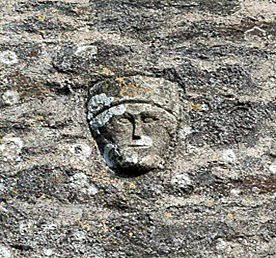 The carved limestone head in the tower-spire
Footnote:
The tale itself is certainly as old, and probably much older than the medieval figure of the Huntsman on the Misericorde Seat, which is still to be seen in St Germans Priory Church. It is also clearly one of the sources adapted for the later Tregeagle Legends found on Bodmin Moor and further west.
The wild huntsman known as the Dondu, is also associated locally with Budleigh Bound (and Georges Lane) and Horsepool or Marchpool Lane that runs to Poole Farm and beyond to the marshy ground at Tredrossel and Polmarch, where the lobster-pot withies grow, and the lane emerges above the cliffs past Trewrickle Farm. Unless you have taken the other turning for St Winnols, Tredrossel and Tredis and eventually on to the even more spooky country of sinister Nomansland and Perdredda Round, from where the Scathnoz may sail. At Triffle Farm above Downderry (Donderrig?) aerial photography has recently revealed an ancient ‘Cursus’ at the furthermost point of the Dondu’s wild drive.
The old way starts or ends, depending on your point of view, on the banks of the Lynher River, just opposite the equally sinister Dandy Hole and the isle and mound of Erth. The Dondu is associated with wild beasts, storms and the old ‘rattle wagon’ that collects the dead and carries them to the river below Erth along the same route. The association of the priest with Erth Barton, Prior’s Brake at Sheviock and Lanaled (St Germans Priory) is common to most local versions.
The ancient legend of the Dondu would seem to be a conflation of a number of themes, combining Classical, Celtic and Christian motifs. Fear of the lingering dead (particularly in the forty days immediately after death) and the appeasement of dead ancestors have very ancient origins and are found across most cultures, as historians and anthropologists can testify. In the world of Classical paganism processional images of the dead being led to the underworld often featured Hercules and sometimes also involved Mercury\Hermes as Psychopompos. The assimilation of some of this pagan material by Christianity involved a clear distinction between the virtuous and the sinful dead, and those who were later confined in Purgatory, (once it had been discovered by theologians anxious to appease the fears of the wealthier classes). Originally these were herded to Hell in a monstrous procession, still often led by a wild Herculean figure. For medieval versions see the Peterborough Chronicle and the account by Orderic Vitalis from Normandy. The Celts had their own version of the Wild Hunt often led by a ‘Wild Man’ or ‘Green Man’ a figure associated with the Horned God, Cernunnos (see below). While Ogmios/Ogma/Ogmagog (the Celtic Mercury/Hermes according to the Romans) the god of speech and eloquence, hence the mythical creator the old Ogham alphabet, played a role similar to a Psychopompos. He is sometimes depicted rather like a pied piper with golden chains from his mouth leading away a group of enchanted followers. The Celtic otherworld, however retained a number of quite distinctive features; as a Land of Eternal Youthfulness (Tir na’n Og), which lived on in the various legends of Faery Hunts, led by Gwinhael, Finn, the Erle King or King Herla.
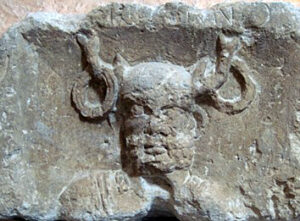
Cernunnos: Carnonos: Celtic Horned God, Pillar of the Boatmen, Paris
Cernunnos is associated with animals of the forest as well as the Underworld, but also with abundance and the image of a Cornucopia (Not as one local ‘wit’ speculated Lord of the Cornish Pasty) The representation above was recovered from the Seine beneath Notre Dame and is known as the Pillar of the Boatmen, unusually it is inscribed with the god’s name, but spelt as Carnonos. Two torcs are entwined on the horns but there is no sign of the accompanying serpent or ram-headed slow worm the god holds on the Gundestrup Cauldron.
These wild figures are all probably European ancestors of the ambivalent figure of Harlequin from much later and a residual element in the sinister anarchic behaviour of Mr Punch, Court Jesters, the Russian ‘Yurodivii’ and the Slavic ‘Skomorokhii’ A figure very similar to the Dondu is found in Welsh legend and folklore (See Dr Anne Ross).
Another famous Celtic Wild Hunt, but of a giant Boar involves King Arthur in the Romance of Culhwch and Olwen, where the boar’s bristly back conceals the cult objects; scissors, a comb and a razor, all needed to cut Olwen’s long hair, before she can leave her father’s house and marry Culhwch. The figure here, however, overlaps rather more with the Magic Herdsman and the unruly Wildman of the Woods, as well as Hender of Lanhydrock, Herne and Cerne the Hunter, found in British folklore and in the various medieval ‘romans’, where Merlin himself is described as such a figure, as is Sweeney/Suibhne, the mad bird king of DalRiada. Donn is of course in Gaelic folklore the Lord of the Dead and the Underworld. The house of Dond is more obscure and is only referred to in one other source of which I am aware, the ancient Irish Destruction of Da Derga Hostel, which involves the sons of Dond Desa. Descendants of the Irish, Deisi however, are reputed to have settled on the north coast of old Dumnonia; as attested by those ogham inscriptions in Cornwall and even in south Devon that are partly in Gaelic. The Cornish Dondu, similar to the Gaelic may simply mean the ‘dark brown one’ of the forest and the otherworld, both seem to be associated with storms and power over beasts, particularly beasts with cloven hooves, who like the devil cannot be shod with iron shoes, not even by Tam-an-Gof. This story was combined at a later date with a widespread medieval legend where a sinful monk (like the prior) or later a rascally lawyer swindles the living, but after death is repeatedly called back to provide evidence or judgement in later disputes. He is pursued by demons and given an infinite number of ridiculous and impossible tasks to fulfil as a penance. Clearly it is the prototype that was adapted for the more famous Tregeagle stories from further west. An essay on the historical Justice Tregeagle is provided by W H Rouse and a short biography, which also deals with the legend is A Spooner; ‘John Tregeagle of Trevorder’. Tregeagle was also famously the persecutor of Anne Jeffries, the Cornish prophetess and companion of the fairy folk (see Hunt and Bottrell for the legend) and another equally ‘difficult’ woman, the Quaker Prophetess; Anne Trapnel, both imprisoned by Tregeagle for a while in ‘Lanson’ Jail.
The famous depiction of Dando, the huntsman carrying a crossbow, followed by two mature hounds may still be seen in St Germans Church. In front of the huntsman there appear to be five smaller hounds or pups, which are suckling from a bitch.
Furneaux describes the Misericorde carving thus:
“There is a chair built into the wall of the chancel with a misericord of a hunter carrying a crossbow over his shoulder with game slung on it and preceded and followed by his hounds. Locally it is called the ‘Dando and his dogs’ (dating uncertain).
For those who never learnt their catechism like ‘good Catholics’ used to, the Medieval Sins and Virtues are outlined below:
The Prior’s Errors
- In the medieval Church the Prior would have known the seven deadly sins were:
Anger, Gluttony, Greed, Envy, Lust, Pride and Sloth.
- While the opposing seven saving virtues you should practise were:
Forgiveness, Temperance, Generosity, Prudence, Chastity,
Humility and Diligence.
-
-
-
- Faith, Hope and Charity were needed for Salvation
- Despair was the ‘mortal sin’ for which there was no forgiveness
-
-
The Priory Church and the House and grounds of the Port Eliot Estate on the banks of the Tiddy and Lynher rivers are based in part on the re-cycled ruins of the old monastery/priory and are well worth a visit and (for those with deeper pockets there is sometimes the annual Literary Festival; see the website for details of how to book).
Older residents and retired Hippies, who may be found lounging in local hedges examining the ‘weed’, still remember the even more famous Elephant Fairs of the 1970s, presided over by Peregrine and Jacquetta Eliot.
You should also visit the recently restored Church of Our Lady at Sheviock, for the Courtney and Dawney effigies, and perhaps take a walk around Budleigh Bounder and Polmarch and Prior’s Brake, the locations mentioned in the Dondu’s tale.
Some additional Reading
Anne Ross, Pagan Celtic Britain: Studies in Iconography and Tradition, University of Chicago Press, 2005 edition
For the Misericorde seat: J Furneaux; ‘A Paper on St Germans Priory Church, Cornwall’ in Exeter Diocesan Society Transactions, iii, (1899), pp82-89.
For the legend of the Deisi see:
P Rance: ‘The Attacotti, Deisi and Magnus Maximus: The case for Irish Federates in late Roman Britain.” In Brittania, Vol 32, 2001, pp243-70
For Tregeagle see:
A L Rouse, The Little Land of Cornwall, Alan Sutton, Gloucester, 1986
B C Spooner, John Tregeagle of Trevorder: Man and Ghost, 1935
P Marshall, “Anne Jeffries and the Fairies; Folk Belief and the War on Scepticism in later Stuart England” in A Mc Shane &G Walker (eds) The Extraordinary and the Everyday in Early Modern England, Palgrave/Macmillan, 2010
P Marshall, Invisible Worlds: Death, Religion and the Supernatural in England, 1500-1700, SPCK, 2017
Hilary Hinds (ed) Anne Trapnell, The Quaker Prophetess. Her Report and Plea: A Narrative of her journey from London to Cornwall of 1654, Iter Press, Toronto, 2016
For Barbary Corsairs and coastal communities:
Jo Esra, “Eer will be noe Fishing: 17TH Century Barbary Piracy and the Westcountry Fisheries” in Troze, (Journal of the National Maritime Museum Cornwall), March 2016, Vol 7, N1, pp 1-20
Walks
Port Eliot House and Grounds is not a National Trust property, so check their web site.
There are a number of Circular walks around St Germans, both along the river and above the village and around the lanes of Sheviock village. There are also nice pubs and teashops, or you can go as far as the famous and famously eccentric Rod and Line Inn at Tideford, from where the Tiddy flows down to the Lynher river and the Dandy Hole.
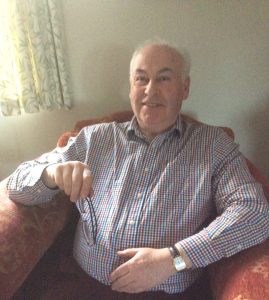
Robert Burroughs was born and grew up in southeast Cornwall. He returned to Cornwall some twenty years ago after an academic career in European Studies and History. His interest in European folklore inspired him to return to his roots and collect examples of local folklore, including his own family’s legends, japes and jokes. Other tales and anecdotes come from oral history projects sponsored by the Cornish Audio-Visual Archive and the Institute of Cornish Studies. They may provide some insight into the Ertach Kernow or Cornish Heritage of ‘Cornwall’s Forgotten Corner’: The Drolls of old Wivelshire.
