
A second portrait of St Ives by the late Mary Quick (1929-2021) who was born and raised there. It was probably written circa 2015. We are grateful to her family for allowing it to be published here.
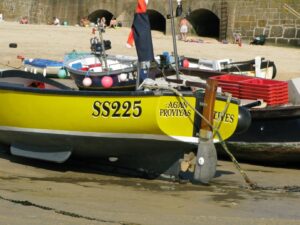
For many years, St Ives has been recognised as a popular resort, famous for its white sand and clear sea, bringing thousands of tourists from home and abroad. Some are attracted by the beautiful scenery as shown in films such as Poldark, while others appreciate the local culture, including a large artists’ colony. In summer, the streets are crowded with visitors, while parking is almost impossible, meaning that traffic circles continually hoping for a space. Christmas and New Year are also busy times with visitors coming from far and wide, but for a shorter duration. To cater for so many people, extra restaurants have been established as well as snack bars and pasty shops with fish and chips ever popular.
It has been noticed though, that perhaps too many newly opened premises are expensive, and seem to disappear overnight, but with others quickly taking their places while not realising that the town is much quieter in winter when hard times beckon. However, those geared to the tourist trade often fail to take into account local needs for daily living, with the Co-operative Society’s stores being the only main sources for groceries (of which more later). Now, the town has lost the long-established Edinburgh Wool Company’s shop, a great source of reasonably priced clothing and novelty items. One wonders what will take its place in such a prominent location.
It has been said that at one time, residents of Downlong 1 had no need to go beyond the Market House for daily necessities as most could be found close to home, though there were more choices in Uplong. For example, there were fish shops in Tregenna Hill, Tregenna Place, Market House and later on, one nearby. A few years ago, Matthew Stevens’ fish shop in Back Road East was opened for a short time, but now there are no fish shops in Downlong. Perhaps local people previously made their own arrangements in what was once a fishing port.
Confectioners in Uplong 2 had their own bakeries; Curnow’s large shop and cafe in Tregenna place was serviced by one at the rear of the old Post Office; Thomas’s in Street-an-Pol was behind the shop, with Hamlyn’s in the Market Place, while Geen’s café was served at the rear of the premises, just inside Fore Street. However, working bake-houses were more numerous in Downlong and used daily by residents: Henry Trevorrow (Henny Puddy) by the Old Arch in the Digey, George Stoneman off Fore Street, now Ferrell’s; Raddy Thomas in St. Peter’s Street, Henry Trevorrow in Back Road East, and Jan Smith in Sea View Place (the oven was still in place in the early 1940s).
After the bakers had risen early to make bread, with yeast proved overnight, local shops were welcome to use the ovens to bake their own bread. When the oven was slightly cooler, many bakers made pasties for sale and locals were able to bring all kinds of meals to be cooked including roasts and cakes, for a small sum. This was a great relief to households in warm weather as it meant not having to use the slab (Cornish Range 3). Saucepans and frying pans could still be used though as the local Gas Company had made available a gas ring and two lights for a modest sum.
For some of the older grocery shops in the town, it came as a shock when the Co-operative Society opened its large premises in Royal Square. It paid a yearly ‘divi’ (dividend) when a special membership number was quoted at the time of purchase. It is no surprise that some elderly people, having been sent to the store on an errand as children, can still recall the family’s number! They were also fascinated while watching orders with money from the counter travelling by a cup on wire to the office further along and slightly higher; change was delivered by the same method. At first, the store was well patronised, as not only did it sell groceries but curtain materials and other household goods on its first floor. Later though, while retaining many loyal customers, elderly people in particular realised that often they had difficulty in carrying their purchases home: but the store remains popular and the Co–op now also maintains two other branches in the town, which both holiday visitors and locals find very convenient; now though, no ‘divi’ is offered. The smaller shops that existed in Downlong and provided a living for many families have long gone, though Johns’ and Ferrell’s, (both perhaps among the oldest in town) continue to trade. Tourism offers employment in different ways, and fortunately the summer season has extended, while residents and second home owners often employ local tradesmen.
Although crowded streets and unending traffic is a price to be paid, there is no doubt that without the tourist trade, unemployment would increase and more of our young people would have to find jobs elsewhere to the detriment of the town. In these uncertain times, perhaps it is more prudent to holiday at home, to the benefit of the town and those employed in its popularity.
Endnotes:
- Downalong is the oldest part of St Ives – a pretty tangle of narrow streets and tiny courtyards clustered around the harbour. It’s the most picturesque and atmospheric part of the town, characterised by traditional fisherman’s cottages, imaginative street names, and points of historical interest.
- Upalong is the upper part of town where most residents now live.
- The Cornish Range was known locally as a ‘Slab’ (this being another name for a hotplate).
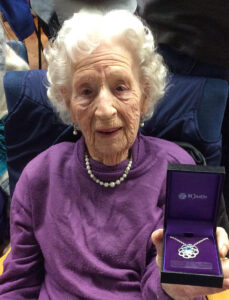
Mary Quick was born and raised in Downalong, St Ives, and much of her life revolved around recording and writing about St Ives. She was a Cornish Bard (Owmelder) and longstanding member of the Old Cornwall Society.