
By Pete Benbo
This account of ‘Electrifying Cornwall’ began as a presentation given to various organisations. It seems to have been appreciated and I was persuaded to develop it into an article – well, two actually. Because of its size, this first part relates to the provision of electricity to Cornwall, and the second part relates to the Camborne/Redruth passenger and mineral tramway. I hope you enjoy my efforts.
Electricity, something we all now take for granted, you turn on a switch, a light comes on or the kettle boils, hopefully not from the same switch.
But what is electricity?
Standard procedure nowadays seem to be if you want to know something you check the Internet so I googled the question – What is electricity?
It came up with a lot of lengthy information but what I wanted was a short, one-line explanation, so I found and settled for this:
“Electricity is a form of energy resulting from the existence and movement of negatively charged electrons.”
So now we know and the next time you switch on something you will have started a movement of negatively charged electrons.
Perhaps those of you who were born in or before the 1940s may not have had electricity and if you did, then it’s possible it was only downstairs.
.
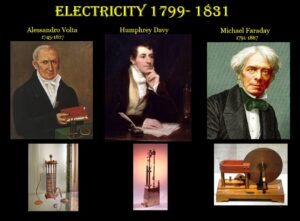
Electricity, however, had been experimented with many years ago and it was in 1799 that Alessandro Volta, a chemist and physicist, found that a piece of cloth soaked in brine and placed between discs of copper and zinc created an electrical charge, this discovery credits him as the inventor of the electric battery.
Then in 1802, a Cornish chemist and physicist, our very own Humphrey Davy, discovered that by connecting a series of batteries together to create enough voltage, and then connecting them to two carbon rods, a current could jump from one to the other giving a bright steady arc light.
Moving forward another 29 years and Davy’s assistant, Michael Faraday, invented the Faraday Disc which led on to the development of the dynamo which enabled electricity to be produced instantly and easily transmitted through a cable.
One of the early uses for electricity was street lighting and eventually, domestic lighting which must have improved conditions for everyone.
This new power made water wheels, windmills and atmospheric steam engines outdated, and factories began using this new power to increase their output.
During the 1800s, communications advanced considerably thanks to electricity – no more flag waving or drum beating to send messages.
The first street in the UK to have electric lighting was Mosley Street, Newcastle upon Tyne, installed in 1879 by Joseph Swan using his incandescent lamps. The same year, Blackpool used electric arc lights to illuminate its promenade.
Blackpool was the first town with an electric tram system – in 1882 – using a conduit connection (scalectric), but they soon found they had a problem with sand and salt water getting into the conduit. It was decided to construct an overhead electrical supply system to the trams and while this was being erected, the trams continued to be drawn by horses.
The first UK public generating station was at Godalming, in 1881, where a dynamo was driven by a water wheel, and the electric generated was used for street lighting. Apparently though, as more street lights were added, the waterwheel was inadequate and a portable steam engine was brought in to increase the output.
In 1882, the Edison Electric Light Station at Holborn Viaduct, London, opened. It had a coal-fired steam driven generator and the electricity produced was used for street, commercial and domestic lighting.
By the 1890s, the government of the time realised they were completely out of touch as to what was going on electrically so they consulted Edmondson Electrical, 1 the largest electrical wholesaler at that time.
The government asked Edmondson to recommend areas of the country which could benefit most from having a generating station which could power a light railway. The company’s response was to set up a subsidiary – The Urban Electric Supply Company 1898 – to address this request.
So now, let’s go south and take a look at Cornwall were there were some significant electrical events taking place including in Truro where, in 1850, there was a demonstration of electric arc lights.
The first lighthouse on The Lizard was built in 1619 and had twin towers with the light provided by a coal furnace. The current structure dates from 1761 and continued to provide the light using coal. In 1812, however, coal power was replaced by oil lamps with reflectors to enhance the light.
The ‘West Briton’ of the 24th January 1878 reported that the oil lamps in the Lizard Lighthouse had been replaced by ‘brilliant electric arc lamps’ and that a fog horn was also being used. The light inside the lantern was then the most powerful light in the world, with an intensity of 12.2 million candelas. 2 It was said that it was so bright that it caused several poor pilchard seasons. The twin towers were in operation until 1903 when they were replaced by a single flashing light from one tower. 3
In 1879, there was a two-day exhibition demonstrating Edison’s speaking telephone 4 and electric light.
On the evening of 13th January 1879, a rugby match at Redruth Rugby Football Club is thought to have been the first to have been played anywhere in the world to have been lit by electricity. The generator and lighting equipment was provided by C W Provis & Co of Manchester (Mr Provis, in his youth, had lived in Redruth). He had also floodlit the first Association Football Game – at Brammell Lane – three months before. The company also provided lighting for many functions up and down the country for which their fee was 20 guineas plus a third of the gate money. It seems that a Redruth boy had done well.
St Austell was the first town in Cornwall with electric street lighting. The ‘West Briton’ of the 20th May 1886 reported that Mr Veal of St Austell had installed a generator in his warehouse in order to supply the town with electric street lighting. Cables were laid in the streets and when all the installation work was completed, a large crowd gathered to witness the switching on ceremony.
However, there are some who claim that Mevagissey was the first town with a street light – outside a workshop down by the harbour were boat engines were repaired. The generator was driven by pilchard oil.
On the 14th November 1892, the draper’s shop owned by Broad and Co on the junction of Fore Street and Penryn Street in Redruth demonstrated electric arc light. The Arcade leading from Fore Street to Penryn Street was also lit in the same way.
By the late 1800s and early 1900s some of the large estates had their own generating plants installed;
Lanhydrock had a generator installed in 1894 and was only connected to the mains in 1948.
In 1894, Mullion Cove Hotel had a generator, probably installed by Veal & Co of St Austell as five years later, Mr Veal installed a light on the West Pier taking the electrical supply from the hotel.
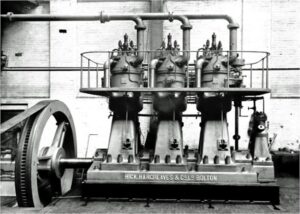
There was a generating station at Mount wise, Newquay, in 1906, using two diesel engines and in the
same year, a generating station at Beacon Hill, Falmouth, was powered by two steam engines and a diesel generator.
Some of the other towns with generating stations were Bodmin, Bude, Callington, Launceston, Liskeard, Looe, Padstow, Penryn, Polperro, Polruan and Rock.
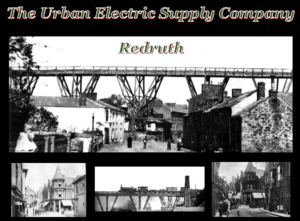
The 1898 Urban Electric Supply Company (UESC) had successfully set up power companies with light railways and they were now considering similar projects in Cornwall. Their office was in Redruth and their research led them to consider tramways between Camborne and Redruth, and from Penzance to Newlyn but the latter fell through when the extent of property demolition became clear.
The Camborne to Redruth proposal went ahead however, but that is the subject of a separate article and I continue here with the question of electricity provision in Cornwall.
The main shareholder for Dolcoath Mine was the Basset family while for Wheal Vor, it had been the Cornish Copper Company of Hayle, but that was before it was taken over in 1861 by Harvey’s of Hayle – steam engine manufacturers.
Meetings were held between the directors of Dolcoath Mine and Harvey’s of Hayle which resulted in the Cornwall Electric Syndicate being formed and registered as a company. Duchy Developments Association led the proposed development to build a power station at Hayle on land made available by Harvey and Co. (Harvey and Co, foundry ceased in 1903 but the company continued to operate as a builders’ merchant.)
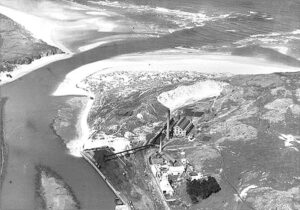
Hayle Power Station
Nothing was forthcoming from Duchy Developments Association and in 1910, control of the project was passed to the UESC at Carn Brea who then became The Cornwall Electric Power Co. It was they who built the power station at Hayle. An overhead line was erected joining the Hayle Generating Station to Carn Brea and by 1923, Carn Brea ceased generating and sent their generators to Hayle.
In 1926, the National Grid was created by the Central Electricity Board linking 122 generating stations across the country. During the period 1928 to 1933, 100,000 men were involved in erecting 26,000 pylons and 4,000 miles of cable.
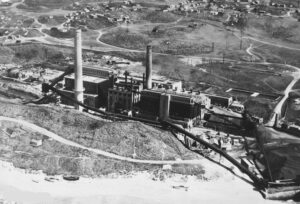
Hayle Power Station expanded over the years and in 1933, became a part of the National Grid.
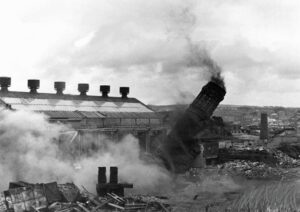
Hayle Power Station operated for a further 40 years and was finally decommissioned in 1973.
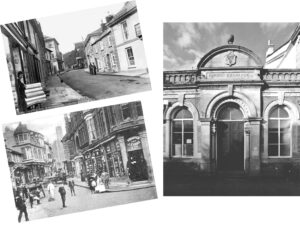
In 1902, the same year as the trams began operating, electric power and street lighting began to be installed in Redruth. The first three street lights in Redruth were at West End, at Lower Fore Street with a third at the Mining Exchange in Alma Place. It was planned that a further 179 street lights were to be installed in the Camborne/Redruth area.
Supply of electric to domestic consumers was very slow at first and by 1920, only 6% of homes had an electricity supply. At first, it was very expensive and 60 hours of usage to power a 100-watt bulb cost an average man’s weekly wage. However, by 1939, 65% of homes had an electricity supply.
Clearly, the generating companies wanted to increase usage and circa 1947, after nationalisation, a scheme to increase the number of homes using electricity offered free installation of two lights and a plug.
By the 1950s, most towns had a South Western Electricity Board (SWEB) shop where the public could pay their bill and also admire electrical items for the home. By then, half of the domestic consumer homes had an electric socket and it may be a surprise that the most favoured domestic aid was an electric iron.
Grid voltage had been set at 132,000 volts but in 1949, it increased to 275,000 and in 1965 it became known as the super grid and voltage had increased to 400,000.
Turning now to new methods of providing electricity, I’ll start with that produced by using natural sources.
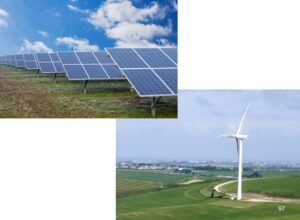
Solar Panels and Wind Turbines.
We have all seen the growth in solar panels and wind turbines and apparently in Cornwall, there are occasions when we produce more power than we use and the surplus is fed into the National Grid.
In 2026, Cornwall has over 400 wind turbines and more than 50 solar farms – one in Launceston covers 130 acres.
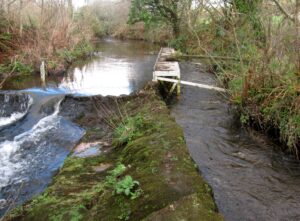
Another form of generating electric is by using the movement of water in a river and as far as I can find, we have three hydro generating projects in Cornwall: two in the St Austell / St Blazey area and one at Trelubbas, Helston. For the Trelubbas project, a disused mining leat from the River Cober, just upstream from Coverack Bridge, is being used to drive a hydro generator.
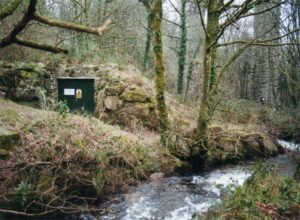
The water from the leat is diverted into a large pipe connected to the generating station down the valley, near Lowertown Viaduct. The building in which the generators are housed has an appearance of being built from local stone making it blend well with its surroundings.
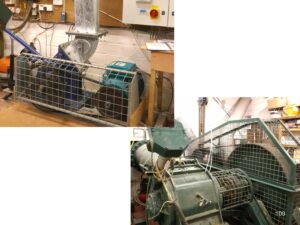
Inside the building, the water drives the turbine generators, the larger of which is 200 kva ** and the smaller, 36 kva.
Restrictions apply to the amount of water that can be taken from the Cober and when the river is low, as in summer time, limits may be imposed and then only enough water can be taken to drive the small generator, and not even that on some days.
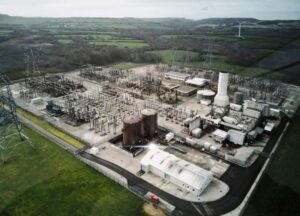
At Indian Queens, an Open Cycle Gas Turbine Power Station has the capability to provide up to 140MW of electrical power during peak periods. It has a battery Energy Storage System with a storage capacity of 47.5 MW and this supports the UK’s transition to low carbon energy systems.
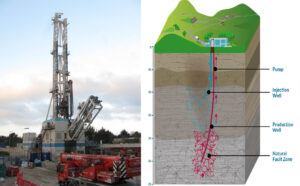
Another method of generation has been constructed at United Downs, Carharrack, by Geothermal Engineering Ltd. The method there is to produce steam from hot rocks three miles underground where the temperature is 195 degrees C. The steam produced is piped to the surface to drive a turbine which in turn, drives a generator. As of February 2026, three megawatts of electricity is being generated and fed into the National Grid. It is also expected that 100 tons of lithium will be recovered per year. Following on from the success at United Downs, two more sites are being developed – one at Penhallow and the third at Manhay, in the of parish of Wendron.
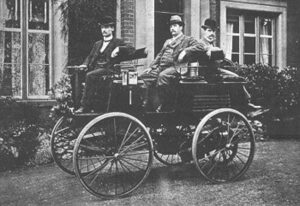
As electric vehicles are to replace petrol and diesel vehicles, any form of generation must be welcomed. However, There is nothing new about having an electric car; the first one was built in 1832 and the one above was the first produced by Thomas Parker in 1884, the same firm that made the tram motors. In fact, electric cars were very popular up to the early 1900s to 1910 but improved refining of crude oil made petrol cheaper and easier to obtain at roadside filling stations and this resulted in the decline in electric cars.
Although electricity is thought to have been generated in 1850, at Truro, it was 50 years later that the trams and the generating station at Carn Brea arrived.
The Urban Electric Power Company started to generate considerable amount of electricity. This was followed by a name change to the Cornwall Electric Power Company 1903 which became the main supplier of Electric in Cornwall. In 1947, the Cornwall Electric Power Co. was nationalised and became known as The South Western Electricity Board. In 1990, it was privatised and re-named SWEB Energy. The company was eventually sold to an American company who split off the supply provision to the French company, EDF.
In 2022 the distribution passed to the National Grid.
Sources
It is my understanding that all the photographs used in this article are in the public domain but if that is not the case then they will be credited or withdrawn.
End notes
- Edmondson Electrical was established in Ireland by Joshua Edmondson, a blacksmith, in 1801. The company expanded significantly in the 19th and early 20th centuries becoming the United Kingdom’s UKs leading electrical wholesaler and by 1880 it had an office in London.
-
kVA (kilovolt-ampere) measures apparent power in electrical systems. It represents the total amount of power flowing through a circuit. One kVA equals 1,000 volt-amperes.
-
The candela (symbol: cd) is the base unit of luminous intensity in the International System of Units (SI). It measures the brightness of light emitted in a specific direction as perceived by the human eye. A common wax candle emits roughly one candela.
-
Thomas Edison is credited with inventing the first incandescent light bulb in 1879. Joseph Swan produced light bulbs which led to patent disputes between Swan and Edison, but Humphrey Davy created the first light from Electricity in 1802 being the Arc light.
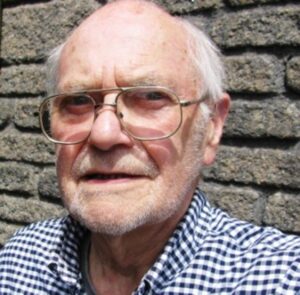
William Peter Benbow born 26th May 1937
For most of my early years I lived on a farm in Lanner but farm life didn’t interest me. I preferred playing about with batteries, wire and radio valves.
My last day at school was Friday the 23rd May 1952, and a couple of weeks later I was on my bike to Chacewater to start work with an electrician with an expectancy of becoming an electrical apprentice. Within a year I quit as he didn’t want an apprentice, he just wanted a boy for cheap labour.
Luckily, a family member knew of a garage in Penryn who required an apprentice, so I applied and was accepted as an auto electrician apprentice with T H Nicholls of Penryn.
Having served the apprenticeship, National Service papers arrived. So for the next two years (1958-1960) military service was completed in the Royal Engineers.
On demob I returned to work for T H Nicholls at his Redruth garage. Shortly after starting there, I applied and was accepted as a mechanical fitter at the South Western Electricity Board transport dept in Pool, Redruth. I remained there for 35 years (1961 to 1996) finally accepting early retirement from the company, which was by then, Western Power.
During the years with SWEB several older workmen
During the years with SWEB several older workmen would tell about the good old days of Cornwall Electric Power with the Camborne Redruth Tram system. Some old timers even passed on some of their postcard pictures of the trams they had. At the time I didn’t realise that later, when retired, I would be using the pictures and some of their information to create a talk about Cornwall and its electricity.