
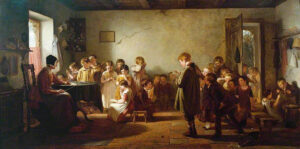
 A Dame School (Thomas George Webster 1800-1886)
By Tony Mansell
Prior to the Elementary Education Act of 1870, 1 the state took no responsibility for schooling and those who wanted their children to receive lessons had to rely on charity or private arrangements.
There appears to have been many small schools offering such a service in Cornish communities as this 1864 report indicates:
“Perranporth, St Agnes, Baldhu, Chacewater and Mithian, a population of about 16,000, was served by eight schools teaching 650 pupils. There were clearly many thousands of children receiving no education and in all probability, many were working on the land or down the mines. An entry in the 1871 census records that the Hawke children of Wheal Rose, aged four to twelve, were ‘Home not to school’.” 2
Many of these small schools were run by females, hence they were referred to as dame schools. These were commonplace in the 19th century but some sources state that they could have existed in one form or another as early as the 16th century. We can, however, say with more certainty that their demise began in the 1870s with the introduction of state education. Some may have lingered on but they would have been increasingly regulated to ensure that their pupils were receiving an acceptable level of education. Increasingly, schools found to be below the specified standards of tuition were closed.
Dame schools were independent of each other and usually operated from the teacher’s home. For a few pennies a week, the dame would provide her charges with a basic education, teaching the ‘three Rs’ (reading, writing and arithmetic) and probably, religion. The standard of education varied greatly and an 1838 study by the Statistical Society of London found that almost half of all pupils surveyed were only taught spelling, with a negligible number also taught mathematics and grammar. Although referred to as schools, day care seems to have been an important part of their offering, this enabled both parents to earn a wage or to run their business. Undoubtedly, some schools did provide a reasonable level of education and apart from academic lessons, girls may well have received some instruction in sewing and other household skills.
The pupils in these dame schools were mostly the children of the less well-off, perhaps the local tradesman and those not much above the poverty line. However, this report of a presentation in May 1966 suggests that was not always the case.
“From his research, the speaker listed a number of dame schools in the village which were attended by the children of the upper stratum – nice little boys and girls who were not allowed to mix with the poorly clad and sometimes boisterous offsprings of the working miners and labourers.” 3
For some, however, money was not plentiful and payment was sometimes ‘in-kind’ – a turnip or a few eggs – rather than coinage.
The Competition
An organisation offering basic education to the poorer elements of society was the so-called Ragged Schools. 4 These were started by Robert Raikes and the first opened in 1780 as part of the Sunday School movement. Raikes believed that the provision of education on a Sunday would divert the boys of the poor away from vice. Lay people provided the tuition which was offered free. Unfortunately, they were attributed the derogatory name of ‘Raikes’ Ragged Schools’ but they proved to be popular and attendance at these grew to over a million across the country. How many existed in Cornwall is not known but the Penzance Gazette of 1854 mentions such schools in Falmouth and Penzance.
Another provider was the National Society for Promoting Religious Education. 5 These National Schools were founded in 1811 with the provision based on the teachings of the Church of England. Its aim was to establish a National School in every parish of England and Wales which were usually next to the parish church, and named after it. From 1833, the state began to pay annual grants which were accompanied by inspections and increasing demands.
There was said to be “a severe shortage of trained teachers” in the early 19th century and the Anglican clergyman, Dr Andrew Bell, suggested that “some of the older pupils could be instructed so that they might teach the younger children”. This system of ‘pupil teachers’ was adopted and was still in use during the early days of state provision when young persons whose time at school included teaching duties under the supervision of the head-teacher.
In St Agnes the foundation stone of the Church School was set in place in January 1837 and the newspapers reported that the Town Band marched through the streets to mark the occasion. Mithian Church School opened on the 2nd February 1863 (it closed in 1880) and Mrs Joseph Boyd of Probus was engaged as schoolmistress at a salary of £35 per year. There, the initial intake was ten pupils but the numbers quickly grew to over 100 with an evening school attended by 36 scholars. In some cases, attendance was restricted to church members and Maurice Bizley, in his book Friendly Retreat, stated that children were dismissed for not attending church.
Another option was provided by the British and Foreign School Society 6 which was founded in the early 19th century to support free and non-denominational British Schools in England and Wales. These schools competed with the National Schools provided by the Church of England.
I have to admit to a confusion here in that the St Agnes school was referred to as a British school and yet it was “under the control of the local vicar”. Perhaps this was a local arrangement and an example of cooperation between the two societies.
Both the Church and British Schools were eventually absorbed into the state system, either as fully state-run schools or as faith schools funded by the state.
The Dame School for Many
Despite the alternatives, the choice for many was the local dame school, perhaps influenced by the additional provision of day care.
John Passmore Edwards, the Cornish philanthropist, attended a dame school in Blackwater, the village of his birth. Whereas it was usually women (dames) who ran these schools, in this case the tutor was James Blackney, a crippled ex-miner, who came to Blackwater in the 1840s. He taught geography, reading and writing for which he charged 2d or 3d per week depending on the pupil’s age. Edwards later referred to the limitations of the school but expressed his appreciation of James Blackney. John Passmore Edwards appears to have benefitted from his dame school attendance and in an effort to ‘give something back,’ he and John Symons, a former school friend, opened a similar free evening and Sunday school at Wheal Busy to teach uneducated boys of the area.
Alfred Solomon, an ancestor of mine, attended some form of schooling in Truro in the 1840s. Later, he became a Mormon Bishop and was described in an American report as having received a common school education. It is possible that he gained his education from a Dame School.
The Blackwater Women’s Institute book of 1951 mentions a dame at Wheal Busy who “wore a pook bonnet whilst teaching reading and sums to half a dozen boys and girls who sat on the stairs.” Her domestic duties were carried on simultaneously with her teaching.
Another dame was the local dentist and was said to have carried on this profession during lessons whilst her young pupils watched in horror.
A person who simply identifies himself as J T recorded his memories of attending a dame school in the Federation of Old Cornwall Societies’ Journal. He doesn’t say where the school was located but the fees were one or two pennies per week, depending on age, although payment in kind was also acceptable. “There was only one book, passed from hand to hand, and bigger children often taught the smaller ones their letters, the class standing around in half-circle with their hands behind their backs until their turn at the book.” The book may well have been a horn book, typically a sheet of vellum or paper on which letters, numbers or religious text was mounted on a frame with a handle – like a table tennis bat. J T continued. “The school mistress was also the handy woman of the village, eking out her living by knitting or patching and mending clothes for her neighbours and so at times would be too busy to teach. Punishments were sometimes necessary and I remember well the ‘custis’ and how in extreme cases, it was laid hard on both hands. If her ‘custis’ should be mislaid, or purposely hidden away, our dame had another instrument of torture ready, the flat wooden ‘busk’ out of an old pair of stays, or a switch, made of a bunch of ‘griglans’ (dried leather).”
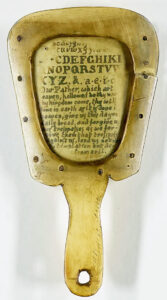 An 18th century Horn Book
Writing in the Federation of Old Cornwall Journal of 1936, C S Murrish recalled his days in a St Ives dame school in the 1890s. “Children were put to these schools at a very tender age in order to be minded while their mothers worked about the fish or otherwise occupied their time, and I suppose I was one of the last of them.” He wrote that the children sat on two low forms while the teacher sat in a chair near the fire, convenient for tending the kettle and the saucepans. The school fee was two pence per week and the normal attendance was about ten but this number increased on a good fishing day when the mothers were working. The teacher held up a book and when a child’s name was called, he or she had to stand and repeat after her the letter or number pointed out. Her big box-mangle was in the room and anyone misbehaving was threatened with being rolled in it. Any child who cried was put in the spence.
The newspapers of the time were full of letters about dame schools providing us with contemporary and sometimes contradictory opinions about the standard of education they provided.
1875: “Dame Schools – Your columns inform us week after week that there is a great spread of Board schools, and although they are costly at first, yet people are beginning to find out that when they are in working order one half of their annual maintenance may be got from the Education Department. Ratepayers also find that the bible may be read and explained, and prayers and hymns used in the
Board schools, so that they are not such terrible things as the supporters of the voluntary schools used to assert… But there is another thing Boards can do, and that is, shut up those wretched, unhealthy dame schools, which are taught by old women who know their A B C, or by young women who have failed as cooks or ladies’ maids. Children learn scarcely anything at such schools, and yet they flourish in some quarters, and are attended by the children of people who think they belong to the higher class – the aristocracy of our villages, who would not for anything see their children sitting near the child of the small farmer or labourer.” 7
1875: “Dame Schools – Cornish people know – and often to their sorrow – what direct, and indirect taxation means and to talk of Board schools having half their maintenance from anywhere but the public purse is mere trash… The Government grant, as it is called, is obtained on certain conditions; if the School Board should fail to secure an efficient teacher, or should the teacher fail to teach the young according to the Government plan, the grant will be withheld. If the grant is secured, where does the money come from? The public purse. How is this purse enabled to supply the demand? By direct and indirect taxation. But how can School Boards shut up Dame schools? Have not old women and young women a right to use any lawful means to earn a livelihood? If their schools are wretched and unhealthy the sooner they are shut up the better; but we cannot think it very gentlemanly to sneer at old and young women too, although some young women may have failed as cooks or ladies’ maids… The labours of these in infant schools, and in schools of those of riper years have hitherto been, and still are, valuable, or the schools would not flourish. The intimation seems to be that all teaching given by old and young women, who cannot work a sum in practice, unless in a Government school, is worthless, and all children who are not educated in Government schools live and die in extreme ignorance.” 8
1881: “Camborne Local Board – The Chairman said that Mr T King, Inspector of Schools, reprimanded the authorities for allowing overcrowding in dame schools, and the Inspector was ordered to visit these schools and to report them.” 9
“In the 19th century there were a lot of dame schools in Cornwall, a sort of private school run by women. One lady running such a school claimed she ‘didn’t knaw gramaar but she knawed georgraphe, rithmetic and the hole of the halfabet.’
A lesson started with her asking what A stood for. Eventually a child answered ‘Haape’.
‘Right,’ said the teacher. ‘Go hup top of class!’
In geography she asked, ‘What is Cornwall? Es ‘a a nation, a hiland or a furrin country?’
A boy replied that Cornwall was none of these but was stuck on to a furrin country from the top hand. He was awarded full marks.
Apparently, this type of inadequate teaching was more common than good teaching, so even the children who did attend school often did not learn much. Children of very poor families had no education at all.” 10
The beginning of the end for the dame schools was signalled by The 1870 Education Act, the first piece of legislation to deal specifically with the provision of education in England and Wales. It ruled that children aged between five and 13 should attend school but it did not make it free or compulsory. Private provision (including dame schools) could continue but locally elected ‘school boards’ were to be set up to build and manage state schools in areas “where they were needed.” 11
The State School in Place
The groundwork commenced immediately as this newspaper report shows:
“St Agnes School Board: The Board has taken a house-to-house census of the children from five to thirteen years of age, and ascertained the number of those attending school. A treasurer and clerk have been appointed, and it has been agreed that three schools shall be established; viz., for the town, Mount Hawke, and Trevellas and Mithian districts.” 12
In March 1872, the school in British Road, St Agnes ceased to be a church school under the control of the local vicar and became a ‘Board School’ under the Education Committee.
With the state having taken responsibility for education, voices began to be raised against the continued presence of dame schools and there were some who felt that the old order should be swept away. In the first log book of Blackwater School the headmaster wrote, “Most of the children coming from dame schools are very backward.”
It seems that Cornwall was not alone in having concerns about the standard of education being provided in dame schools as this 1874 letter from the Hull School Board shows. The Board there proposed, “an annual inspection and registration of all schools so that the question of efficiency should be decided by a competent Government official, instead of being left to the varying discretion of individual magistrates.” Local schools supported the proposal and the role of school inspector was introduced. This official visited schools and determined the children’s well-being, education, standard of fitness and religious provision. This was bundled together in an annual report which was available for scrutiny.
Education for under twelve-year-olds became compulsory in 1876. This met with resistance by some parents as it meant that children could no longer contribute to the family budget by working on the fields and in the mines. Indeed, it was a double-edged sword as there was a cost involved and it was not until the 1891 Education Act that school fees were abolished.
Truancy was widespread and some parents withheld their children as a protest against the compulsory nature of education or because they could not afford to give up income earned by their children. The situation only improved after the authorities started issuing summonses. Perhaps only as a local arrangement, children were permitted a limited period of time away from schools to help with essential work in the fields. This arrangement was still in place many years later.
The standard of teaching in dame schools clearly varied from school to school, and from dame to dame, and whilst in some, the tuition was poor and wholly inadequate, in others it provided a good foundation. Whilst accepting that parents benefited from the provision of day care offered by dame schools, they clearly felt that by sending their children to these schools, and paying for their attendance, they were doing what they thought best for their children. In many cases it must have been better than they had received and even those with concerns about the standard provided must have acknowledged that it was ‘better than nothing’.
Endnotes:
- The 1870 Education Act was the very first piece of legislation to deal specifically with the provision of education in England and Wales.
- West Briton of February 1864.
- Cornish Guardian of May 1966.
- Ragged schools were charitable organisations dedicated to the free education of destitute children in the 19th-centuries. They were intended for society’s most impoverished youngsters who were often excluded from Sunday School education because of their unkempt appearance and often challenging behaviour.
- The National Society (Church of England and Church in Wales) for the Promotion of Education, often just referred to as the National Society, and since 2016 also as The Church of England Education Office, is significant in the history of education in England and Wales.
- The British and Foreign School Society was founded in the early 19th century to support free and non-denominational British Schools in England and Wales. These schools competed with the National run by the National Society for Promoting Religious Education which had the support of the established Church of England, the local parishes, and Oxford and Cambridge universities.
- Royal Cornwall Gazette of October 1875
- Royal Cornwall Gazette of November 1875.
- Cornishman of 1881.
- Cornishman of 1881.
- The 1870 Education Act.
- Cornish Telegraph of July 1871.
- Royal Cornwall Gazette of December 1874.
 Tony Mansell
Tony Mansell is the author of several books on aspects of Cornish history. In 2011 he was made a Bardh Kernow (Cornish Bard) for his writing and research, taking the name of Skrifer Istori. He has a wide interest in Cornish history and is a researcher with the Cornish National Music Archive and a sub-editor with Cornish Story – an Institute of Cornish Studies initiative.
My great-great-great grand uncle, Nicholas Lelean, was captured by Napoleon and held prisoner for nine years. To help maintain herself and their children, his wife, Catherine, ran a dame school at their home in Mevagissey. She wasn’t very keen to do this, and described it in a letter to her husband, as being “a great trial to my mind”.
An amazing piece of history Maureen. Many thanks for sharing it.