
Coroners’ Inquests
By Bob Teague
My general approach to research into Truro pubs has been to try to show how pubs are so tightly woven into the fabric of the community, reflecting everyday life, people and events locally, nationally and even internationally. That is as true today as it ever was.
Truro’s pubs have, directly or indirectly, played a part in many people’s journey from birth, through the cradle to the grave. This article, largely based on reports from The Royal Cornwall Gazette and The West Briton, is about the end of life’s journey. Particularly, the tragic ends some people met and the examination of their deaths at Coroners’ Inquests, many of which were held in pubs. So, let’s look at a few inquests…
1. WESTERN INN – 1833 – inquest held on the body of a male infant found wrapped in cloth under the brambles of a hedge in the second meadow beyond Carvedras Smelting House. Verdict: wilful murder by person or persons unknown.
Comment: shows the smelting house was a prominent feature on the edge of town. As for the infant, who knows. Times were hard for many and an extra mouth to feed or a child born out of wedlock could push people to carry out unthinkable deeds. The Western Inn was situated where Mango’s bar is today, Little Castle Street.
2. WESTERN INN – 1837 – inquest held on James Davison (2 years), son of a private in the Inniskilling Dragoons quartered in Truro, who drank boiling water from a kettle.
Comment: at a time when Truro’s barracks (at the top of what is now Lemon Street and the Strangways Terrace area) housed soldiers from various regiments. The Inniskilling Dragoons was a cavalry regiment.
Young James’s death is, sadly, typical of many child deaths. Open fires and stoves caused injury and death to young, often unattended, children; especially through their clothes catching fire.
3. BEAR INN – 1845 – an inquest held into the body of a new-born child sent in a box from Penryn to Mr Barrett, shoemaker and Parish Clerk of St. Mary’s for burial.
Comment: who knows the story behind this delivery to Mr Barrett. The old Bear Inn was situated near, and to the north-east of, the former St. Mary’s church. It was demolished to make way for the cathedral.
4. GEORGE & DRAGON – 1847 – inquest held on Thomas Greenslade from Cullompton, a worker on the Cornwall Railway, who fell down a shaft at Buckshead, Truro, where a tunnel was being made. At his funeral, his coffin was carried by eight stout navvies in clean white frocks followed by about 200 labourers.
Comment: one of many itinerant navvies who lost their lives up and down the country building Britain’s expanding railway network. Buckshead tunnel is the first that trains pass through heading from Truro towards St. Austell. The George & Dragon was situated at the foot of Mitchell Hill.
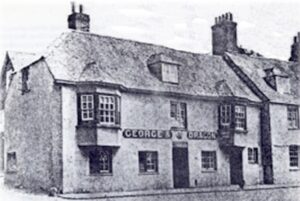
George & Dragon
5. GLOBE – 1847 – inquest held at the Globe Inn on the body of George Frederick Palin, manager of Messrs. Kent & Co’s. Arsenic Works at Bissoe Bridge, who shot himself in the privy at the end of his garden in Ferris Town.
Comment: the chimney of Mr Palin’s arsenic works still stands in the Bissoe Valley, near the cycle hire centre. The Globe was situated in Francis Street and is now the premises of Reed’s, a chemist shop.
6. UNION – 1849 – an inquest held on the body of a baby found thrown through the broken window of an old engine-house. It had suffered head wounds; murder suspected.
Comment: another tragic child death. The Union, latterly the Lord Nelson, was situated at the end of St. Austell Street, where it met Tregolls Road, and was demolished in the 1960s as part of road improvement works.
7. SWAN – 1850 – 18 September, inquest held at the Swan Inn on the body of Elizabeth Cock (20), a prostitute. Causes of death: syphilis; lung inflammation; enlarged heart; and exposure to cold, want and general destitution.
Comment: the causes of this death say it all. Prostitution was one of the darker sides to Truro life and some census records from the 1800s show ‘prostitute’ as someone’s occupation. Some of the more basic Truro pubs were well-known as places where ‘ladies of the night gathered’. The Swan, Kenwyn Street, was an imposing pub built in the early 1900s after a road widening scheme and was converted into flats.
8. DANIELL ARMS – 1852 – inquest held on the body of a new-born child of Mary Keverne who had secretly given birth to a girl at a relative’s house, but the baby died soon after birth. She wished to conceal the birth from her parents and had locked the child’s body in a box.
Comment: the stigma of giving birth out of wedlock was a powerful social factor and seems to lie behind this child death. The pub is still with us at the top of Lemon Street, now called the Thomas Daniell.
9. LAMB – 1852 – inquest on the body of James Carne (36), blacksmith, who fell off the back of a fish cart that was going too fast down Comprigney Hill. He and the fish seller, Mr Evans, who also fell off, had been drinking at the Falmouth Arms, Kenwyn Churchtown.
Comment: the clear dangers of driving a horse-drawn cart down a very steep hill whilst under the influence of alcohol. The Lamb, renamed the Duke of Cornwall around 1857, was in Pydar Street and closed in 1910.
10. UNION – 1854 – 12 May, an inquest was held on the body of a new-born male found wrapped in a piece of coarse sheeting in the smelting house dock near Moyle’s smelting house, opposite the Union. There were signs of violence about the child’s face. Verdict: wilful murder by person or persons unknown.
Comment: another example of an unwanted child meeting a tragic, early death.
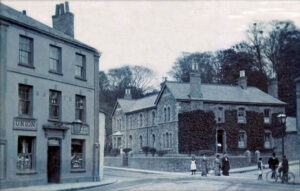
The Union Inn
11. UNION – 1856 – 29 March, inquest at the Union Hotel on a new-born female, found dead by a young boy in a pond near Kiggon Mill, Pencalenick, with a rope around its neck tied to a stone. A carter, Mr Snell, removed the child’s body and took it to the Union Hotel where the inquest was held. Verdict: wilful murder by person or persons unknown. At the Summer Assizes, the child’s mother, Ann Matthews, was given 12 months’ imprisonment with hard labour for concealing the child’s birth, James George the same sentence for being an accessory to the fact, and Richard Jose, who was found to have killed the child, was guilty of manslaughter rather than murder (thus escaping the death sentence) but was transported for life.
Comment: the perpetrators of another sad child death were brought to justice.
12. TURK’S HEAD – 1857 – inquest on the body of Thomas Hoarde (38), a clown with Moreland’s itinerant theatrical company who died after drinking three-pennyworth of gin in a bottle of ginger beer when he died instantly from a ‘visitation of God’. Mr Hoarde was an Odd Fellow and a procession of Oddfellows attended his funeral, preceded by Mr Emidy’s band playing the death march.
Comment: mobile theatre companies, groups of performers, fairs, wrestling contests and circuses provided a variety of entertainment for Truro and brought people into the town. ‘Visitation of God’ was a term used to describe an unexplained death, a useful catchall when medical science was far less advanced than it is today. The ‘Mr Emidy’ is almost certainly the musician Thomas Emidy, a son of the former slave, composer and musician Joseph Emidy from West Africa who settled in Truro. The Turk’s Head, formerly The Angel, was opposite the south door of St. Mary’s parish church. It was substantially rebuilt in 1879 and, in 1880, renamed the Cathedral Hotel with the arrival of the new cathedral. Demolished in 1960s as part of Truro’s development, the site is now part of the Mountain Warehouse shop.
13. UNION – 1859 – 2 May, to mark the arrival of the Cornwall Railway from Plymouth, a celebration arch was erected which extended from the Union Hotel across to the police station. Ironically, one of the last mail coaches, the North Mail, arriving in the dark, hit the arch while passing under which dislodged some luggage which, in turn, knocked off a passenger (William Lear from Devon) who was run over and died in the Hotel shortly after. The inquest into Mr Lear’s death was held at the Union on 3 May.
Comment: a tragi-comic event as Truro’s rail link to the rest of Britain, and the start of the demise of coach travel, was celebrated in Truro.
14. DUKE OF CORNWALL – 1861 inquest held into the death by suicide of Sergeant Richard Davey (24) of the Royal Miners Artillery Militia. He had shot himself through the head with his carbine in his room at the Militia’s stores in Pydar Street.
Comment: at a time when towns had their militia and regimental volunteer units as back up for Britain’s small standing army; similar to today’s territorial army reserves. The stores were “nearly opposite” the pub, giving an idea of the location of the pub (previously the Lamb – see above).
15. DUKE OF YORK – 1863 – inquest on the body of Henry Thomas, an oyster dredger from Pill Creek, who fell into the river adjacent to Newham Railway Station (West Cornwall Railway) after getting off an evening train from Penzance with a friend who survived. It was a dark and foggy night and it seems that the pair thought they had arrived at the Cornwall Railway’s Station (where Truro’s present station is situated) and walked straight off the quay into the river. The Town Council was urged to protect the river sides in the town as several drownings had occurred.
Comment: an incident during the brief period May 1859 to November 1863 when Truro had two passenger stations. At Newham (West Cornwall Railway line from Penzance) and the present-day station (originally the Cornwall Railway line from Plymouth) at the top of Richmond Hill. The Duke of York was in Fairmantle Street and closed in 1927. It was made into two dwellings, at No. 42.
16. GLOBE – 1864 – April, inquest held at the Globe into the explosion at the Bishop’s Wood Powder Mills which killed two young women; Ellen Reynolds (17) and Elizabeth Grose (23). They were both buried in Kenwyn Churchyard.
Comment: these young ladies lost their lives when the gunpowder mill in the heart of Idless Woods blew up.
17. BOSCAWEN INN – 1865 inquest held at the Boscawen Inn into the death of Thomas Allen, 60, a former pilot and casual porter on the quay at Malpas, but now in a filthy, wretched state. He often spent the night at the lime kiln at Poltisko to keep warm. The previous evening, Allen was seen on top of the lime kiln and, early in the morning, charred bones and a skull were found on the fire three feet from the top of the kiln. Verdict: accidental death.
Comment: an older man whom, it seems, was struggling to live after a working life on the local waterways. No support from the state at this time other than resorting to the workhouse. Lime kilns were common features of local communities. The Boscawen Inn, latterly the Admiral Boscawen, was on the corner of Malpas Road and Boscawen Bridge Road which led to Boscawen Bridge. Both the bridge and pub were demolished in the 1960s as part of road improvements on the east side of Truro.
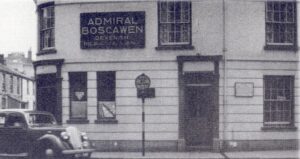
Admiral Boscawen Inn
18. WHITE HART – 1869 – November, inquest held concerning a nameless female baby, mother unknown, which was found dead and tied in brown paper in the Leats at the rear of Ferris Town.
Comment: yet another sad death of an unwanted infant. The White Hart is Truro’s oldest pub and is still open today.
19. CORNISH ARMS – 1882 inquest on the body of Marion Dennis, age 4, a child of delicate constitution. She had been given port wine as a stimulant. In the absence of her mother, she had drunk all her medicine and most of the port wine, leaving her in a stupor from which she never recovered. Verdict: death from alcoholic poisoning.
Comment: a child meeting an unusual, but tragic, end. The Cornish Arms (also sometimes known as the One & All or the Fifteen Balls) was at 29/30 Carclew Street, closing in 1931.
20. FORESTERS ARMS – 1883 – inquest into the death of Walter Wearne (16) of Castle Place, who had been ill for eight months after falling off a ladder whilst helping some masons. The case brought to light a disgraceful case of overcrowding. He was one of a family of nine that lived in two rooms, one above the other, and he slept on boards. The young man was unable to move due to paraplegia and slept in cold and dirt. The parents refused the nurses to move or wash him although he was in a dirty state. Verdict: death from natural causes; the house to be reported to the Sanitary Authority.
Comment: a reminder that, for all its economic and social importance, in Truro, like Victorian towns and cities generally, life was hard for the ‘have nots’ who made up most of the population. The poorer, labouring people often lived in low quality, insanitary conditions at a time of minimal health and social care. The Foresters Arms was a short-lived beer house on Union Street, around 1860 to 1885.
21. NAVY ARMS – 1883 – inquest at the Navy Arms into the death of John Hellens (40), sailor of Truro. He died after falling 50 feet from the topmast of the schooner Lizzie lying at Malpas. Mr Hellens left a widow and three children. The jurymen left their fee of 1s as a subscription for the widow. The ship’s part-owner, Mr Scoble, and her master, Mr Hicks, each added half a sovereign.
Comment: an incident when the Truro River was still a major artery for goods in and out of Truro even though the railway was well established by the 1880s. Many sailing vessels were locally owned and crewed, visiting British and European ports and beyond for their cargoes. With the gradual silting of the river, larger vessels moored at Malpas for their cargoes to be transferred to lighters for delivery into the heart of Truro. The Navy Arms was in Fairmantle Street from about 1830 until closure in 1993. The building was demolished in 2000 as part of a redevelopment scheme.
22. HOPE INN – 1888 – inquests held at the Hope Inn regarding the deaths of two illegitimate children who both died the previous day in the same house at the back of Bridport Place. First, Catherine Janie Nancarrow, aged 9, the child of Ellen Mary Rowe. Second, Maria Webber, aged 7 months, who was born in the workhouse, the child of Fanny Webber. Verdicts: death by natural causes.
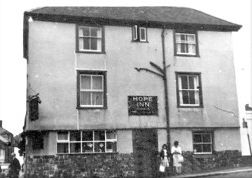
Hope Inn
Comment: evidence, if it’s needed, of the relatively high infant and child mortality prevalent in Victorian Britain, especially those from poor, disadvantaged backgrounds. The Hope Inn was at the bottom of Mitchell Hill, on the corner with St. Clement Street. It was closed and demolished in 1969 when that street was widened.
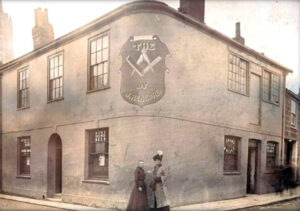
23. SQUARE & COMPASS – 1889 – 17 April, inquest at the Square & Compass into the death of Mr James Vigus of Old Bridge Street who collapsed and died at the Wesleyan Chapel. They had just finished singing the hymn with the line “Happy if with my latest breath I may but gasp His Name”.
Comment: the last hymn Mr Vigus sang proved to be appropriate! The Square & Compass was on the corner of St. Clement Street and Old Bridge Street. It is now the premises of a Chinese take-away.
Square & Compass
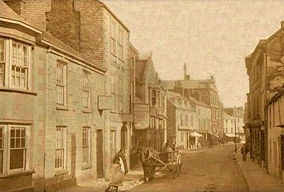
24. LONDON INN – 1893 – inquest into the death of Evelyn Kate Sugg (20), daughter of Charles Sugg (writer) and Kate Sugg of Coombes Lane. Peritonitis was the likely cause. One juryman asked if the deceased had laced herself so tightly that her ribs were drawn over each other, to which surgeon Haughton replied that, although tight-lacing could possibly cause peritonitis, it was unlikely in this case. Verdict: death from natural causes.
Comment: the dangers of fashion at a time when tiny waists were in vogue. The London Inn was in Pydar Street, roughly where Boots the chemist is. It closed and was demolished in 1967 as part of the street’s redevelopment.
London Inn
25. SQUARE & COMPASS – 1897 – 18 October, inquest at the Square & Compass into the death of the infant son of Minnie Richards, single, of Rosewin Row. Death was due to neglect. The NSPCC inspector had removed Minnie’s other child and two of her sister’s children to the workhouse due to neglect. Her infant son died from starvation, not helped by his having a tied tongue that was not brought to a doctor’s attention.
Comment: poverty and poor health care strike again.
 Bob Teague
Bob Teague was born in Truro and has lived there all his life. His admiration of beer and pubs, and local history were brought together in his research into Truro’s pubs.
Bob is a founder member of the Cornwall/Kernow Branch of CAMRA, The Campaign for Real Ale.
