
By Robert Burroughs
Three fishermen of Seythyn sailed o’er the Pleg-mor to cast their nets. Back and forth they tacked across the wind then turned for the final run home. They grasped the lines of their net to haul it in. They strained and heaved; they paused to breathe, then heaved again. Had they caught a heavy shoal of fish, or was it a playful young whale? Was it a monster out of the deep, that with one flap of its mighty tail could send both boat and crew forever beneath the waves? They grappled with the net. They gasped, they groaned, they cursed and moaned, at last the lines broke free.
But when they drew their net on board, for all that effort small reward, they had caught only a tree. A branch, then a bough, a trunk then roots emerged; a crab-apple tree, from beneath the sea, bearing its tiny golden fruit. Pulled up out of Morvale Deep, where Morfael the monster still lies asleep amidst the ruins of a city it helped o’erwhelm with waves so long ago.
“What kind of tree grows under the sea?” The puzzled young fisher boy asked, “and what kind of fruit might be borne from this root?”
The older fisher’ wondered.
But the oldest fisherman wisely said:
“Let us take nothing and break nothing from such a branch or bough,
Let Morvale Deep its secrets keep.
This is a morrigan’s wishing tree, from their orchard ‘neath the sea
And we must straightway cut it free,
And watch it safely return from whence it came.
Or we may raise up something worse, stir up old Seythyn’s curse.
And suffer once again the malice of Morvalwen toward all Seythyn’s men.”
They carefully removed from their net, the root, the trunk and each bough and branch, then slipped the tree back into the sea; each offering a brass farthing for their own good luck, to allay the curse and keep the mermaid’s revenge at bay. And they sailed home safely that evening, on a light sea with a fair wind and a bountiful final catch.
The oldest fisherman said to the youngest:
“If you had a looking glass that could peep beneath these waves into Morvale Deep, you might glimpse below us the city beneath the sea.
Where evil people never sleep but must forever dwell,
Trapped between heaven and hell,
Begging to be set free.”
And that is why on a silent night when a storm comes suddenly from the north-east, if you listen you may hear the toll of the Morvale bell from its tower beneath the sea. Then fishermen know well they must sail fast across that wind and make for a safe mooring at the nearest haven.
And the young fisher boy asked: “Who then was Morvalwen?”
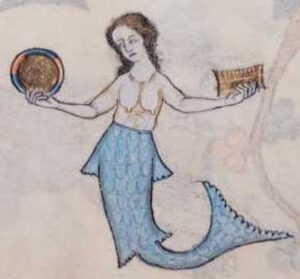
Morvalwen was a mermaid, who was caught while alone, sitting on a reef by the great Braun Stone, where the cormorants and gilliemoes bask in the evening sun, after a day of chasing fish. She would sit on her throne; a cadderware reef and sing as the evening sun set in the west. She had a golden comb for her wavy hair and a silver mirror of shining pearl forged in the depth of the ocean. It was there that she loved to wait and watch for the evening star, and swim in the luminous path across the bay cast by the passing silvery moon. Alonso Dawney was fishing nearby; the lady enchanted first his ear and then his eye, while singing on her blue elvan throne. With a skilful cast of his finest net, he caught her and hauled her into his ketch.
“Now what have I ‘ketched’? You’re a very odd fish to have fetched up here!” He exclaimed: “I don’t even have a serving dish that would fit the size of your tail.”
“Well how rude can a rude young fisherman be!
It’s clear you don’t need any lessons from me,
If this is how you treat a young lady.”
The mermaid angrily replied.
The mermaid was pretty and unafraid, quite unlike any modest village maid he had ever met or dallied with by the shore. She looked him straight in the eye.
“You must on this instant set me free.” She demanded: “Or I’ll call for my father and his anger will raise such a tempest in Morvale Deep, that the monster Morfael will awake from his sleep, destroying you and your flimsy boat with one flap of his mighty tail.”
Alonso laughed; he too was bold and unafraid and completely ‘bowled over’ by the lovely maid. He did not believe in monsters. He smiled and decided to ‘set his cap at her’, so he pushed his beret back over his brow and wondered just how he might win her love and keep her by his side forever.
The First Wish
He sat down on the transom of the ketch and pondered, and while wondering what to do next he suddenly remembered: ‘Mermaids are really not at all like ‘cold fishes’, but are passionate, and generous, and even grant the wishes, of those whom they choose to favour.
So, Alonso decided to try his luck, ‘nothing ventured is nothing gained’ he thought and smiling he said:
“First tell me your name and then I’ll see.
For a kiss and a wish, I will gladly set you free; that’s my promise.”
And the mer-maiden, still tangled within his net smiled too and boldly replied:
“Do you think you can catch me with ‘kiss or tell’?
Now that’s a game I know very well,
You must understand my favours can’t be coerced.
A wish that is forced is one that is cursed.
And remember I only grant three wishes.
So be careful what you wish for!”
“Firstly, my name is Morvalwen; I’m not from your tribe of mortal women my element is the ocean. And sadly, for you I can bring only grief and pain to those who seek to catch me and keep me a prisoner. Now before you get my kiss you too must tell me your name too.”
“If you still want a kiss? I promise to be tame,
And not drown you or drag you under the waves forever.
So, you had better release me! Right now!”
Alonso freed her and told her his name and she gave him a long and lingering kiss to be remembered by.
“Well Alonso your first wish you’ve already spent.
I may grant you two more wishes before I go,
But remember they’re only lent and won’t last forever.
You must know how to use them well.
Ask for anything more and your spell will be fatally shattered.”
The Second Wish
Alonso thought for a moment, and then he replied:
“Just as I promised, I have set you free, but now I wish you to be my bride. My real desire is for you to stay here with me, my dearest Morvalwen. I know your sort may live on land, even though they have to walk on webbed feet. There’s no need to fret! We’ll be properly wed and live like respectable folk. We can marry today and be blessed by Saint Winnol at his chapel above on the heath. We can live in my cottage quite happily, it’s cosy but clean and we can raise up a family. As for my third wish I think I’ll keep that in store for a stormy day.”
For although he was bold, he was a Cornish lad and prudent too.
But Morvalwen sadly shook her head:
“Life for me as a captive on land?” She replied: “Don’t bind me to it.
I cannot be stranded on earth, rock or sand for more than a day.
Don’t make me promise to take your hand and be your wife.
My home is the ocean and that is my life, open and free.
Why can’t you come there and live with me Alonso?
If your love is as strong and true as you say?”
“My love is honest and true, but alas unlike you, I would drown within minutes in the land beneath the waves.” He sadly replied.
So Morvalwen, having granted him three wishes, was forced to keep her word and live her life with no tail but two feet on dry land. But she warned Alonso that every day she would need to stay for some time back in the ocean, or she would simply waste away. And every night he must bind her feet with a ribbon of silk and a silver thread to keep her bound to that promise.
They sailed home together and made their way to the saint’s chapel to be married. But when they arrived Saint Winnol shook his head and sadly but wisely declared: “Marriage is meant for humankind I can’t close my eyes and pretend to be blind before God, for she is not one of us. The best I can give you is a blessing. But I prophesy this union will one day bring with it my curse and perhaps ‘store up’ something even worse for Morvale Town, if you live there together as man and wife.”
Morvalwen and Alonso sadly were forced to accept just the blessing, but they ignored the saint’s advice. And they lived happily at first and had a pair of healthy twin boys. Nevertheless, at night when the sky was clear, and the moonlight shone across the bay, Morvalwen pined for the freedom of the wild ocean and missed her own family.
A Third Wish
Alonso, sensing the pull of the ocean decided it was time to use his final wish and ask for a daughter who would bind them together forever. And within the year the wish was fulfilled and the fair enchantress, young Morvalwen, was born. She was baptized and named and blessed by the saint. He smiled on her kindly, for she seemed a beautiful human child and not in the least bit wilful or wild like those who are ocean born.
Now Morvalwen’s mother had been forced to abandon her jealous twin; alone in the bay lurked her sly and treacherous brother, Seythyn. He had been ordered to find her and bring her back to her family. He could find no trace of her in the bay, and although he searched as far away as Ushant and Fastnet and even Biscay, his quest proved fruitless. Until returning to check the Skerries and her favourite seat, he heard her singing along the shore and following the song he swam silently up the twisting river by Morvale Town.
At last, he saw her splashing in a pool with a little girl. He called to her, pleaded and then furiously he demanded: “You must return with me!”
But she would not and could not go without breaking her word and the promise she had made.
Seythyn angrily cursed her wilfulness and threatened to drag the child from her arms. But he failed to persuade or force Morvalwen and in anger he swam away, planning his revenge.
Life meanwhile continued quietly for Alonso and for Morvalwen, who was happy with her daughter, but made sure she now kept the child well away from the shore.
“Don’t tell your father about Seythyn! And beware your evil uncle’s tricks if he ever tries to lure you into the waves.”
She warned her young enchantress, Morvalwen!
A Fourth Wish and All Wishes are Broken
Alonso’s boys grew faster and stronger than others. They took to the sea early and became fishermen even better than their father had been, both the family and the port prospered. The other fishermen around the bay wondered how Morvale boats were so successful, and they envied them. Morvale folk became haughty and proud and boasted about their prowess in fishing and trading in front of their poorer neighbours, who seemed to catch less and less each year.
Meanwhile Seythyn, consumed by rage and jealousy, plotted; and at last came up with a scheme. He stole an apple seed from a morrigans’ orchard and planted it beneath the waves beside the trench leading down to Morvale Deep. Here the crab-apple tree of the ocean took root. It grasped the side of the trench, while its trunk and branches pulled furiously upwards towards the light. Then it stopped growing and waited, like some gigantic sea anemone might, swaying and swirling, lurking just beneath the waves. On a clear night its small golden apples would glimmer, reflecting the moonlight, like a shoal of golden fish, turning and twisting in the ocean to lure unsuspecting sailors and fishermen to their doom.
Alonso’s sons fished over the bay and everywhere they drew in full nets with their mother’s blessing. Until one evening skirting Morvale trench, which was too deep for their lines, they were drawn at last to the golden glimmering fruit of the sea-apple tree. As they sailed over the fatal fruit, the branches of the morrigan’s tree quite suddenly grabbed their net and line and at last the brothers too, who begged for help as their boat began to be drawn beneath the waves.
Their voices and cries echoed across the bay.
Alonso stranded on the shore cried out to his wife:
“For God’s sake save them if you can!
I wish they were like you, not mortal men like me,
Who can’t survive in the ocean!”
Morvalwen didn’t hesitate:
“Your final wish I’ll grant, but now our fate is sealed as well.
Our sons will survive,
But the ocean will take back its own and break the bond that binds us.”
And so, she unbound her feet and dove into the ocean and swam out to save her sons. The boat went down, but they survived; taking on their mother’s form and nature, and with one sad, final farewell all disappeared into the bay and were never seen again by Alonso. He held on to young Morvalwen as tightly as he could, terrified and angry, fearing he would lose her too.
A year passed by and although Dawney’s fortune continued to grow, every time he looked at young Morvalwen he remembered with growing pain her mother and his other lost children. More and more he avoided and neglected Morvalwen. He decided to marry again, the daughter of a local merchant, but his luck now changed. His new wife died giving birth to a boy, a half-brother for young Morvalwen. The lonely young Morvalwen missed her mother, but doted upon her younger brother, for her father’s mood became darker and harsher by the day. More and more she came to love and care for the boy, her only companion.
Meanwhile Seythyn enjoyed his victory, but was still filled by anger and jealousy, watching from out in the bay. He yearned to destroy young Morvalwen’s life too and in a net of his own making; to drag her off and drown her and make his revenge complete. One day he lay in wait. Until, leaping and diving like a stranded fish between the rocks, he lured the young boy playfully along the beach, from pool to pool and reef to reef, until he was cut off by the incoming tide.
The boy cried out across the bay, asking his sister to save him. Ignoring her mother’s warning, Morvalwen too dove into the breaking waves. Seythin now tried his best to whip up a whirlpool and suck boy and girl under forever. But Morvalwen swam like a fish, forging her way through the waves. And as she did so, she felt a great spasm of pain and a change that shuddered right through her body, for her legs now became a mighty tail. She swam to her brother and held him safe in her arms. Morvalwen, the ocean enchantress, now rejoiced in her true nature and power. She brought the boy safely back to the shore; swearing he would be hers forever more.
Alonso knew nothing of this but noticed how close his children were to each other. He slowly filled up with jealousy. He decided to marry off Morvalwen to the miserly, old merchant; the Mayor of Morvale town, who had been the father of his second wife. He had no idea that Morvalwen had inherited her mother’s nature. When she refused to marry, Dawney, shaking with the most furious rage, threatened to lock her up in a cage forever. Both love and hatred intertwined, tormenting him. For despite all that had happened he did not want to lose Morvalwen, nor his youngest son, nor the wealth and good luck the mermaid had brought to Morvale.
Morvalwen fled in fear to St Winnol and begged the saint to intervene, for she confessed the only person that she now loved was her brother.
But the saint was no comfort, for he angrily replied:
“All this is as I prophesied,
Evil is the only gift a stolen bride can bring.
Especially one who’s been kidnapped, most unnaturally,
From that godless land beneath the sea.”
“As a daughter you must obey God and your father’s wishes or go to a nunnery. No more resorting to enchantments! Above all Morvalwen, you must never again be tempted to see or speak to your brother. As for the evil folk of Morvale Town, who have benefited from the unholy gifts of your mother’s blessing. May they live with their wealth forever but only enjoy it in the cold black infernal deep. For I swear they all will be cursed like you, unless they too repent.”
Morvalwen flew into a terrible rage:
“I will not spend my life locked in a cage for anyone.
I will return to the sea, and take my brother home with me,
That’s where we both belong.
I too can curse and this I swear:
Morfael the monster I’ll arouse from his sleep, the sea will boil,
And Morvale Town will surely drown and sink into Morvale Deep.
And Seythin‘s evil mouth, drunk with his own lies and envy, I curse;
May he be choked with rocks and worse,
And by the land forever be bound, trapped as a treacherous river.”
Morvalwen dove into the sea for a second time, taking her young brother with her, leaving only his shadow waiting on the shore. But alas she had not realized unlike the children of Morvalwen he was only human, and he drowned in her arms within minutes, which only made her vengeance the worse. It was the first day of the old New Year.
In a fury she carried out the curse; raising a tempest; a gale blew in from east and south and west all at the same time. The monster Morfael stirred in the deep and thundered, the fields and forest around the port shook and were sundered from the mainland. The sea in the bay boiled over, like stew in a cauldron, and the land sank at last beneath the waves down into Morvale Deep, houses and gardens, fields and orchards and all the selfish, evil folk too. And there they remain trapped forever.
The storm raged for almost a week until the saint came down on the feast of the Epiphany and blessed the sea once more, casting a wooden cross on to the waves to subdue them. And to placate the malice of Morvalwen in her green, glass palace deep beneath Seythin Bay. Some folk still do this before their first dip on New Year’s Day. And to this very day when a storm from the east rises unexpectedly, Seaton valley still gets flooded and the mouth of the evil Seythyn gets choked with sand and pebbles and rocks to remind us all, of the terrible vengeance of Morvalwen, and the fate of the lonely innocent boy, lost in the deep, whose ghost still haunts the shore looking for the shadow of his former self.
And it is also why they say locally that Seaton folk would be better off staying ‘high and dry’ up in Downderry and avoiding a dip in the briny, unless they want to risk getting webbed feet, fishy tails and salty, scaly, old bottoms (on their boats of course!)
For ‘fishy tales’ about catching, or being caught by a mermaid always end badly! Unless you cast a little withy cross knot, like the fishermen use for their crab pots, into the ocean. And if it returns to you on the ninth wave you will have Good Luck for the rest of the year.
Notes: Some more reliable than others
This is a genuine local legend but only existed in a small number of quite contradictory and confusing fragments; it is mentioned briefly by Hunt in his collection and does seem to have involved two mermaids, probably mother and daughter. The story of the Padstow mermaid may have had some similarity, but the author is largely responsible for the remaining ninety per cent of the puzzling tale given here. The two mermaids with the same name would appear to be directly related, rather than one good one bad, which may explain the contradictory nature of the fragments. It does not follow the pattern of the Mermaid of Zennor, nor the tale of Lutey and the Mermaid in the Old Man of Cury, but there are some similarities with the Vengeful Mermaid of Padstow due to the destruction or silting up of harbours as a malicious act. St Winnols village is just above Downderry, it has no church but the remains of a lost chapel on the cliffs above Lantic are implied by the name Eglaroose farm. The saint has some kind of role in the tale.
The names Morvale and Morval Deep are entirely the creation of the author, based on a local dialect word for inundations and salt marshes, locally a morval or morfal, is an area regularly flooded by the sea through a dyke of some kind. See the salt pan remains at the end of Wacker Creek by Denabol below Sheviock. These were created for the process of estuary sea salt ‘panning’, letting the sea into shallow enclosures linked by gates to collect the salt crystals that remained after the evaporation of the seawater by the sun. The importation of better-quality salt for curing and use in the pilchard barrels in the 18th and 19th centuries seems to have replaced local practices. Hollanmor, which is below Hollan Parc at Antony, beside Cliff or Cleft farm, may have had a similar system. Salt was of course needed for curing the fish and the best was imported from Spain and Portugal, some of it returning in the exported barrels ( ) The Morval estate of the same name, the seat of the Bullers, on the river above Looe may have a quite different derivation; I am no expert when it comes to place names. The original Cornish word for Seaton, pronounced like Satan, referred to the river Seythyn, now sometimes called Hessenford river, and the place at which it entered the sea, but this was anglicized over time and now refers to the settlement instead. Dr Ken George and Oliver Padel should be consulted with regard to place name meanings. Indeed, the whole area from Rame head to beyond Polperro was once known as Seythin Bay (Plegmor/Morpleg?) not Whitsand Bay. The tale has been patched together from these fragments. Effigies of the local Dawney-Courtney families still sleep on peacefully in the Church of the Virgin Mary at Sheviock, which is well worth a visit.
A fisherman catches a mermaid. She is pursued by her brother but stays with the fisherman. They have a beautiful daughter, an enchantress who is wild and wilful and two sons. The mother returns to the sea taking her sons with her and the angry fisherman marries again and has another son. The mermaid brought good luck, which allowed the little port to grow and become wealthy but the people living there and the father, become cruel, proud and avaricious. The daughter brings bad luck and falls in love with her remaining human half-brother and refuses to marry anyone else. She is cursed by St Winnol and discovers she too can live as a mermaid but takes her human brother with her beneath the ocean, only to drown him rather than leave him for another. She vents her anger on her father and all the people of Seythyn (Morvale in the tale here). A terrible storm and floods overwhelm all the land between Rame Head and Looe. Only Lammana remains, saved because Christ once walked there. The port and town remain forever beneath the sea.
The motif of a drowned land and the city beneath the sea occurs elsewhere in Cornwall; most famously in the legend of Lyonesse, but it is also found in a number of other Celtic tales. In Wales the story is located in Cardigan Bay and interestingly has an evil treacherous character associated with the flooding (and drunkenness) called Seythyn, (similar to the original Cornish name). Another story about a city beneath a lake is located in Ireland, but the most famous version is the Breton tale of King Gradlon, his evil daughter, an enchantress, not necessarily a mermaid, and the destruction of the City of Ys at Douarnez, this tale also involves the curse of Saint Winwaloe/Guenole.
The Long Stone, or Brawn, is the large rock beyond Downderry beach, below the Earl’s Seat and Beak’s Horn. Blue and green elvan is a hard, local stone that served as a cadderware ‘throne’ for Morvalwen. Morfael is also a legendary Celtic sea-monster, perhaps the same or a near cousin to the famous Behemoth, who made a guest appearance in the film; Behemoth the Sea Monster, shot partly in and around Whitsand Bay, Looe Island and Polperro in the 1950s.
Seythin is the original, now restored Cornish name of the river that runs down from Hessenford to modern Seaton and out into the bay beyond. The valley now includes a very pleasant nature trail, well worth a visit and it emerges right opposite the Copley Arms. Hessenford was once apparently famous for its witches (Hexenforde?) and for the terrible fate that befell Moyle of Bake who offended them. As if to vindicate the Mermaid’s curse, two recent storms from the north-east totally overwhelmed the road, the river and the local beach café at Seaton, burying everything beneath a mountain of sand and pebbles.
The Morrigan mentioned here is a sea fairy; a Korrigan is a land or wood-spring fairy. Therefore not to be confused with mermaids, who have fishy tails when in the sea, but must have their feet bound when on land; nor confused with sirens, who also like singing while perched on rocks, but have feathery bodies like sea gulls and webbed feet, none of whom being seal maidens, (Tonteg) who normally won’t be seen on the beach without their fur coats (and stiletto ‘eels; depending on your accent). While the solitary Hudol with a double tail, is reputed have either the webbed feet of a swan, or the dainty feet of a little goat when on land, perhaps a relative of the famous ‘Hooper’ of Sennen further west.
Sometimes it is difficult for a fisherman to tell the difference, particularly after a visit to a local hostelry, but a tourist with the right imagination might spot any one of these interesting birds or odd fish on the beaches of Downderry or Seythin (pronounced Satan)
Local fishermen still occasionally dredge up an ancient tree stump from the drowned land, probably not from the morrigan’s orchard. Legend has it that the only piece of Morval that still survives is Lamanna, or St Georges Island at Looe, for it was believed the child Christ had once walked there with his uncle, Joseph of Arimathea, a tin merchant from the Levant. This story may, like so many other tales, have been an early invention of the monks of Glastonbury, who were even then trying to encourage tourism and pilgrimage to the Chapel on the Holy Island in the medieval period.
Cromkleuz Crafthole
Robert Keys was born and grew up in southeast Cornwall. He returned to Cornwall some twenty years ago after an academic career in European Studies and History. His interest in European folklore inspired him to return to his roots and collect examples of local folklore, including his own family’s legends, japes and jokes. Other tales and anecdotes come from oral history projects sponsored by the Cornish Audio-Visual Archive and the Institute of Cornish Studies. They may provide some insight into the Ertach Kernow or Cornish Heritage of ‘Cornwall’s Forgotten Corner’: The Drolls of old Wivelshire.
