
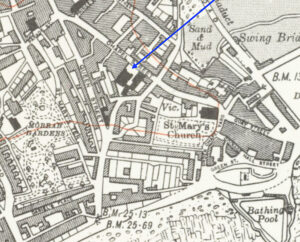
Suzanne Trythall has compiled this profile of Penzance Chapel Street Wesleyan Chapel.
Penzance is a town, civil parish and port in the Penwith district of Cornwall.
1814: By 1800 the Wesleyans were meeting in a building in Queen Street in which John Wesley himself had preached in 1789. They left this building for their new chapel in Chapel Street in 1814 which had 1318 seats. Two houses adjacent to the chapel were occupied by the Wesleyan ministers.
1851: Ecclesiastical Census Return records attendance at morning worship was 950 general congregation and 160 scholars, evening worship 1300. There was free space to allow 200+ standing. A prayer meeting was held in the vestry on Sunday afternoons, usually about 100 attending. The return was signed by Richard Hosking, Steward.
1864: July 13 re-opening service of newly restructured and enlarged chapel. Two additional bays were added which makes it the only Victorian non-conformist chapel in the British Isles to have a front façade of seven bays. New organ was installed by J W Walker of London at a cost of £3,500. The design of the solid mahogany pulpit was based on the pulpit in the now demolished Halifax Place Wesley Chapel, Nottingham.
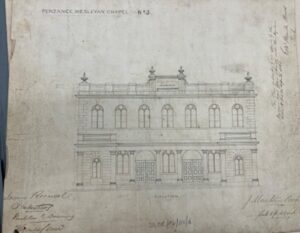 1863 plans for chapel façade. Photo courtesy of Kresen Kernow DDMR/PZ/110/6
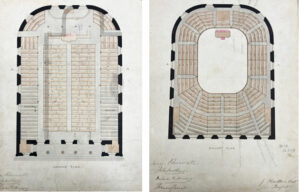 Ground Plan and Gallery Plan: Photos courtesy of Kresen Kernow DDMR/PZ/110/8
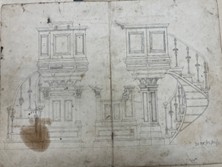 Drawing for double height pulpit: Photo courtesy of Kresen Kernow DDMR/PZ/110/11
The chapel’s quantity and quality of stained glass windows, by makers such as Fouracre of Plymouth and Salisbury of London, ‘are not exceeded by any Wesleyan chapel outside of London ‘ (Horner pg .51). Ground floor windows portray scenes from the life of Jesus and around the gallery the Prophets.
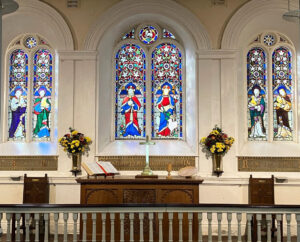 The earliest are behind the communion rail and date from 1814.
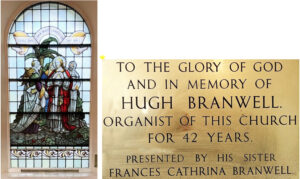 The Branwell family lived in Chapel Street where Maria Branwell was born, mother of Charlotte, Emily and Anne Bronte.
Ground floor central box pews were removed circa 2013. The remaining closed box pews are listed under a preservation order. There is extensive Georgian plasterwork.
The Communion table retains its position against the far wall. The massive roof structure incorporates a timber frame of some 20 metres span and comprising of a grid-work of trusses. A winch is installed on one of the beams to enable the chandelier to be lowered.
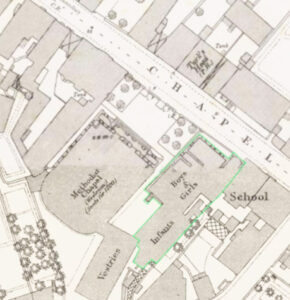 1878 town plan
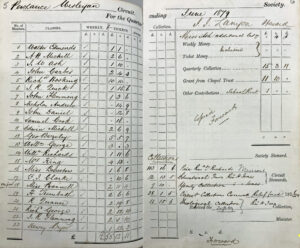 1879: Accounts Wesleyan Chapel Penzance 1858-1879 (Photo courtesy of Kresen Kernow MRPZ/104
1915: the Cornishman edition of 12 August reports the opening of the new Sunday School premises. The day school had left in 1914 and moved to Lescudjack. The full scheme would see the complete renovation of the chapel and the introduction of a modern Sunday School. Renovation of the chapel was completed at a cost of £1063. However, the Sunday School would require a total spend of £1200 and the old day schools were still in use because the scheme had not been completed owing to the war. £916 of the work had been carried out. The door was unlocked by Mr H Pezzack, general secretary and grading officer of schools. He was presented with an inscribed silver key.
1920: Sunday School choir formed by Hugh Branwell and had about 50 members.
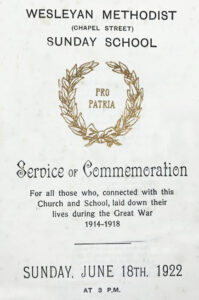 1922: Service of Commemoration 1914-1918 War (Photo courtesy of Kresen Kernow MRPZ/264)
1945: Hugh Branwell purchased the St John’s Hall organ (Bryceson 1867) and a new organ was created combining the best of the existing organ with the best of the St John’s one. Pipes were incorporated by the Sweetland Organ Building Co. of Bath. The finished instrument occupied two sound boxes with console and choir pews between them. Interior
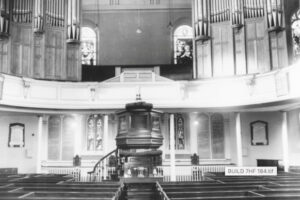 1965: Photo courtesy of the Morrab Library Penzance
1974: Historic England awarded chapel and railings Grade 11* listing.
1983: the back five rows of box pews were removed and a spacious foyer was constructed.
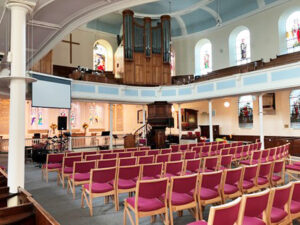 Interior November 2025
Sunday School:
By the 1840s a Wesleyan School had been built on the site of a possible townhouse, a fragment of granite dated 1602 and initialled ‘RD’ is incorporated into a wall. A tithe apportionment describes the site as ‘Chapel Street, School and Playground’ and owned and occupied by the ‘Wesleyan Society’ (May 1841 Apportionment No. 1766c)
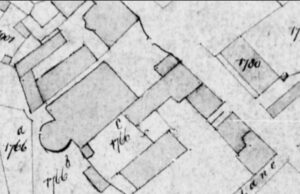 1841 tithe map
The school was subject to a major reconstruction in the 1890s when the infants’ school at the rear was demolished and rebuilt and the main building was modernised. The architect was J W Trounson, the son of the architect of the 1860s building, with Alfred and William Trythall doing the masonry. Cost amounted to about £700. A further £300 was needed for furnishing with desks and other school appliances. It could hold 450 children.
The Cornishman records in October 1895 that the building had a mixed social function in addition to schoolrooms. The large schoolroom was used for lectures.
It was still being used as a Sunday School in the early 2000s, but is now run by a charitable foundation as a dance and creative arts school. Grade 11 listed in April 1999.
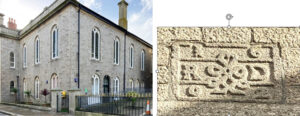 Former Sunday School with Elizabethan stone dated 1602.
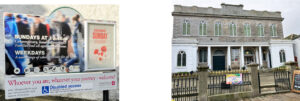 Church Notice Board November 2025 Exterior November 2025
Grateful thanks to Doreen Hocking, Church Steward, who arranged for me to meet with Mary Bennetts. The following photos are courtesy of Mary and were collected by members of her family.
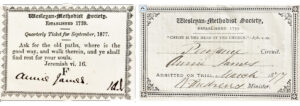
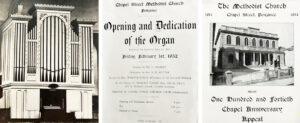
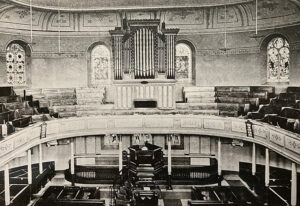 Organ pre 1952
Sources and further reading
Websites:
www.cornishstainedglass.org.uk
www.cornishnationalmusicarchive.co.uk
Newspapers:
Cornish Telegraph
Cornishman
Western Morning News
Wesleyan School Penzance/Heritage Impact Assessment: a report by Enhance
Maps:
The National Library of Scotland
Book:
John Horner, ‘Even in this Place: 19th century Nonconformists & Life in the Borough of Penzance’ by John Horner (2010)
Kresen Kernow
The Morrab Library