
It is a pleasure and a privilege to write about someone who has brought credit to both their name and to their community. Sister Jessie Edith Borlase certainly did that and this article is an attempt to record aspects of her life which may not be fully appreciated.
I will start by saying that it has been compiled in conjunction with two people: Firstly, Paul Phillips, ex-Mayor of Helston and collector of all things Cornish. Paul first brought this lady to my attention and he is understandably proud of her contribution to her town and to her country. Secondly, Les Donnithorne of St Agnes, an ex-military man and a tenacious and assiduous researcher. Les has spent many hours poring over military records and using his contacts to map out Jessie’s career. (Tony Mansell)
Sister Jessie Edith Borlase
“It was at Helston that there was born a nurse who lived in her own time and became famous in the Great War for her heroic services to the wounded. She is remembered as Sister Borlase.” (1)
To that statement we must add that Jessie also nursed the wounded in the Second Boar War (2) so what follows is our attempt to capture her life’s activities including her involvement in both those fields of action.
Jessie Edith Borlase was born in 1854 (baptised 9th January 1856) in Wendron Street, Helston, to Henry William and Frances Rose Borlase (nee Dobinson). Both her father and grandfather were doctors so it was not surprising that she decided to enter the medical profession.
The 1871 census show the family still living in Wendron Street, Helston, but at some time Jessie began her nursing training at the General Infirmary in Leeds.
We have not been able to find her on the 1881 census but in 1891, Jessie is shown as a boarder at 29, New Cavandish Street, St Marleybone, London, with an occupation as ‘Matron of Hospital’. A further source suggests that this was at the London United Kingdom Hospital. (3)
Jessie enrolled in the Princess Christian’s Reserve (4) as No. 694 on the 2nd July 1900.
Jessie joined the Army Nursing Service Reserve as a Nursing Sister and the Anglo-Boer War Records 1899-1902 indicate that she was in South Africa during the Second Boar War.
Two volumes of South Africa Despatches (Mentioned in Despatches) were issued and there is extensive mention of the soldiers and civilians involved including Civilian Jessie Edith Borlase – ‘Specially Good Service – Nursing Sisters’.” (5)
It includes this comment:
“We are most pleased to notice that brave women also come in for a share of gratitude and honour … the officers of the Royal Army Medical Corps, the Army Nursing Sisters, the many ladies who voluntarily offered their services as nurses, and the hospital staffs of all ranks, maintained throughout the siege, a brave and protracted struggle against sickness under almost every possible disadvantage, their numbers being most inadequate for the work to be done …
Jessie also gets a mention in The London Gazette of the 8th February 1901.
Author Sheila Gray has compiled the Service Records of British and Colonial Women serving in The South African War, 1899-1902:
The nurses volunteered in South Africa and were attached to the A N S R for service in military hospitals. They included:
- local and ex-patriate nurses who had previously been working in Cape Colony, Natal, Orange River Colony (formerly the Orange Free State) and the Transvaal.
- Colonial nurses who travelled independently to South Africa.
J E Borlase appears on page 41 where it shows her at the following locations:
14 Stationary Hospital (Maritzburg) Pietermaritzburg on the 28th January 2002.
16 General Hospital Elandsfontein on the 1st August 2002.
General Hospital Ladysmith 8th February 2003.
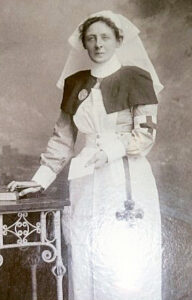 Jessie Edith Borlase – The uniform and badge are of Princess Christian’s Army Nursing Service Reserve, the official Reserve for the British Army Nursing Service active between 1897 and 1908. It is thought that the photo was taken around the time of the Boer War when she served in South Africa.
Following the war, Jessie returned to Britain and at the 1904 annual meeting of the Bangor [North Wales] District Nursing Society, there was a glowing tribute to Jessie’s nursing activity in the area. (6)
In 1906, Jessie was 52, and was listed as one of the successful candidates in The Central Midwives Board examination on the 12th June 1906. The entry reads: “Borlase, Jessie Edith – General Lying-in Hospital,” A lying-in hospital is described as where women were confined in childbirth and it seems likely that this additional qualification related to midwifery. (7)
The Marchioness of Dufferin and Aim, President of the Bangor District Nursing Society, at its 1906 annual meeting, mentioned Jessie in her presidential address by saying she was pleased to be able to report that the nursing of the sick poor had been well done by Miss Borlase, but so much was required that a second nurse ought to be employed. (8)
The Society for the State Registration of Trained Nurses was established in 1902 and Miss J E Borlase, cert. General Infirmary, Leeds, was included as member 1904. (9)
In 1914, Jessie volunteered for service in the First World War and this was written about her:
“Even when she was nearly sixty, and might have considered that she had given a life’s work to her chosen profession, the war broke out and she volunteered for service. She was told that she was too old, but she managed to get to the front by some means or other. That was in fact by joining Lady Paget’s Nursing Unit; Lady Pajet was also a nurse. Jessie went to Flanders, France, Serbia, the Dardanelles, and Gallipoli. She went to Russia and nursed during the Revolution. In Serbia she worked during the great typhus epidemic. She carried on bravely while shrapnel rained over the field hospital, and the sight of the old lady’s cheerfulness encouraged her wounded patients.” (10)
From the British Red Cross records we know that she served in Serbia from the 22nd February 1915 to April 1915 and in the Anglo/Russian Hospital in Petrograd, from 1st November 1915 to March 1916. The records also state that she served in Ostend, Calais, Flanders, Corfu and the Dardanelles.
She also served with the French Red Cross, and one correspondent states that he has a photo of her Ministre de la Guerre [Ministry of War] armband from the local War Memorial Hospital.
1915 Nursing and the War
“Miss Borlase, Leeds, has served in the South African War, France, Serbia, and the Dardanelles.” (11)
1915 Nursing and the War
“There was a large gathering of Australians, both soldiers and nurses, at the Palace Hotel, Bloomsbury, on October 6th including many men who have fought in the Dardanelles, at an entertainment given by the Australian Natives’ Association. Amongst the nurses present was Sister Borlase, who was on active service in the South African War, and more recently in Flanders, France, Serbia, and the Dardanelles, and who in a brief appeal urged the necessity for more nursing volunteers.” (12)
1916 Nursing and the War
“Six more nurses and a doctor have gone out this week to Corfu, under the auspices of the Wounded Allies Relief Committee, of Sardinia House, Kingsway, W.C., to the relief of sick and wounded Serbian soldiers. Dr. Philip Gel Garrett is the doctor, and the nurses are the Misses Agnes Richley, Edith Wedderburn, Jean Miller, Ellen Brimson, Alice Aitchison Brown, and Jessie Edith Borlase.” (13)
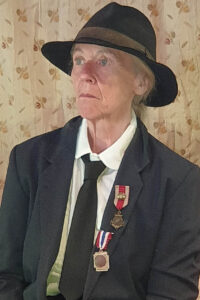 Jessie in later life (Photo ????)
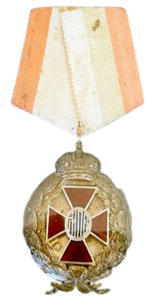 One of Jessie’s Medals
Jessie Borlase died in November 1931: her address at that time was 29, New Cavandish Street, St Marleybone, London.
“Miss Jessie Edith Borlase, who passed away recently at the age of 77 had seen much war service. When the Great War broke out, she offered her services but as she was then 60 years of age they were not accepted. She then joined Lady Paget’s nursing unit and served in Flanders, Serbia, the Dardanelles and Gallipoli. She was buried in Battersea Cemetery [Battersea New Cemetery, Morden], on December 2nd, the coffin being covered with the Union Jack and her many war medals.” (14)
“She lived to be 77, and so poor had her unselfishness left her , she would have been taken to a pauper’s grave had not a charitable fund provided for her funeral, and so she was buried quietly in Morden cemetery, Surrey, in December 1931, but Helston remembers her, and will long be proud of her heroic life.” (15)
Jessie was clearly a lady who earned her place in the hearts and minds of her fellow Helstonians and it was with deep respect and pride that there was a wish to provide some form of lasting memorial in her name.
“Sir, to perpetuate the memory of Sister Borlase, described as “Florence Nightingale the Second,” a fund has been started by the London Cornish Association.
It is proposed to endow a bed in the hospital of her hometown, Helston.
At the outbreak of the war, Nurse Borlase, although 60, volunteered for active service, and being rejected on account of her age, joined Lady Paget’s Unity and served in Flanders, France, Serbia, the Dardanelles and Gallipoli. During the Russian Revolution she carried on nursing duties there, and in the South African War was an Army nurse. She also served in Serbia during the typhus epidemic.
Sister Borlase served her country well for over 50 years and died almost penniless at the age of seventy-seven.
May I appeal through your columns to sympathetic readers to give something towards this Fund? Subscriptions should be sent to the undersigned and will be acknowledged through the medium of the Press.
E Geach, Chairman.
Frank Dunstone, General Secretary.
112, Oxford Gardens, W 10 (16)
The fundraising was successful and its results are shown here:
“Helston. On behalf of the London Cornish Association, Mr. F. Dunstone (secretary) on Saturday presented Helston and District Cottage Hospital with an oak sideboard, two easy chairs, and two rugs in memory of the life and work of Sister Jessie Edith Borlase, daughter of the late Dr Borlase, of Helston, who died in London last year. Over the sideboard will hang a framed photograph of Sister Borlase, together with her Red Cross armlet and medals, presented by her sisters, Misses Maud and Mabel Borlase, of Nailsea, near Bristol. The gifts were accepted by Alderman W J Johns, hon. treasurer of the Hospital Committee.” (17)
“Helston also remembers her by a short road named Borlase Close. Personally, I can’t help wishing it was not a cul-de-sac, as her good works and heroic actions virtually had no end! I wonder how many people, even those who have lived there for many years, know of the connection between Borlase Close and Sister Jessie Edith.” (18)
End notes:
- The King’s England (Cornwall Edition) 1937 by Arthur Mee.
- The Second Boer War, (October 1899 to May 1902), was also known as the Boer War, Transvaal War, Anglo–Boer War, or South African War and was a conflict fought between the British Empire and the two Boer Republics (the South African Republic and Orange Free State) over Britain’s influence in Southern Africa.
- (Lives of The First World War 1914-1918)
- Princess Christian, the third daughter of Queen Victoria, took an interest in military nursing and formed the Princess Christian’s Army Nursing Reserve in 1897, a part of the British Army Nursing Service Reserve.
- The Nursing Record and Hospital World of the 16th February 1901
- The British Journal of Nursing report of the 9th July 1904
- The British Journal of Nursing report of the 7th July 1906
- The British Journal of Nursing report of the 28th July 1906
- The British Journal of Nursing report of the 6th October 1906
- The King’s England 1937 – Cornwall Edition
- The British Journal of Nursing report of the 9th October 1915
- The British Journal of Nursing report of the 16th October 1915:
- The British Journal of Nursing report of the 13th May 1916:
- The British Journal of Nursing report of December 1931
- The King’s England 1937 – Cornwall Edition
- (Cornish Guardian – Thursday 26th May 1932 / Cornishman – Thursday 2nd June 1932)
- (Cornishman – Thursday 31st August 1933)
- Paul Phillips of Helston
Further Reading:
The South African War, 1899-1902: Service Records of British and Colonial Women by Sheila Gray. Publisher: S M Gray 1993
ISBN: 0473019264, 9780473019266

Tony Mansell is a Cornish historian with a diverse interest in Cornwall’s past and present. He is a Cornish Bard (Skrifer Istori), a researcher with the Cornish National Music Archive and Co-editor of Cornish Story.