
Tidal Mills
By Tony Mansell
The concept of using natural movement to produce power has fascinated mankind for generations. Our forefathers recognised that it could be harnessed to provide power and contributed to the wealth of the communities which they served. But to harness the movement of the sea, well that’s another matter! Converting it into energy is a much more recent development – or is it?
The tide flows in and out of our estuaries with a predictable regularity at which we can only marvel and for hundreds of years its movement has been used to turn the cogs and grinding stones of the ingeniously simple, tidal or salt-water mills 1.
A tidal mill is driven by tidal rise and fall, using the energy of the tides to power a mill – mainly a grist 2 mill where grain is crushed. A dam with a sluice is created across a suitable tidal inlet sufficiently close to the estuary that a tidal race could be captured but not so near that it could be affected by waves. As the tide comes in, it enters the mill pond through a gate or sluice which closes automatically when the tide begins to fall. Then, as the tide starts to turn, the sluice automatically shuts, trapping the water in the pond. When the water level in the river is low enough, the sluices are partly opened so that the stored water is released to turn a waterwheel which, in turn, drives the mill mechanism.
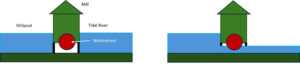
At high tide the mill pool fills to the same level as the river and the sluices are closed. As the tide turns and the river level lowers, the sluices are partly opened and the controlled release of water drives the waterwheel until the mill pool drops to the same level as the river.
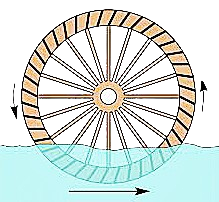 The undershot waterwheel 3 where the passage of the water turns the wheel anticlockwise
Cornish historian, Hilary Thompson, researched three such mills which operated in the parishes of St Gerrans and St Anthony-in-Roseland. Her article was published in the Journal of the Cornwall Association of Local Historians4, October 1992 and with her permission, some of her research has been included here. Her full article can be found here: https://sites.rootsweb.com/~enggerop/Mills_Gerrans.htm
To her words have been added location maps and extracts of the information held by Heritage Gateway5. https://www.heritagegateway.org.uk/gateway/
The tidal creeks of Roseland have provided sites for the milling of corn for many centuries and at the head of Trethem creek there was a water mill. The stream there was of sufficient flow to turn a waterwheel to drive the conventional mill. This was not the case in other locations where the flow was insufficient and so a different sort of mill had to be utilised. The distance from the sea is not much more than a mile for most of Gerrans and the whole of St Anthony and the solution was to use the tidal waters of the river to provide power for the grinding of corn.
Three tide mills were created in the Percuil River: at the monastery of Place, at Froe Creek on the parish boundary with Gerrans, and at the head of Polingey Creek. Dams with sluice gates were constructed at the heads of the creeks and once the pools were filled by the flood tide, the sluice gates were closed, trapping the water. As the water level in the river reduced, a controlled release from the pool was used to turn the undershot mill wheel and the mill-stones within the building. The miller could predict and plan his working hours precisely based on the tide cycle which, of course, varied with the state of the tide. Tides are continuous so there was no problem in times of drought and floods could be controlled by the mill sluices.
In his book, The Roseland between River and Sea, Laurence O’ Toole refers to the profitable nature of tide mills with the miller receiving payment of about one-twelfth of the grain which they ground. He writes that millers were often accused of returning short measure and being a tad dishonest, and refers to the song, The Jolly Miller, where the last two lines are:
“With one hand in the hopper and the other in the bag,
As the wheel went round, they all called ’Grab’.”
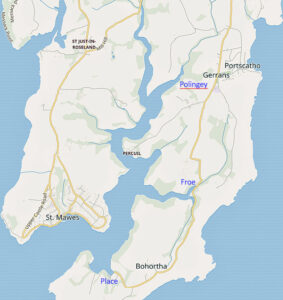 Map of a part of the Roseland which shows the location of the three tide mills
Froe
In 1809, the 99-year lease of Froe Mill was advertised in the Royal Cornwall Gazette:
“A water grist mill, with a new built dwelling house with kitchen and walled garden. The mills worth the attention of flour dealers, being well watered, and erected on such a construction as to be rarely equalled.”
Hilary’s comments:
“Froe is most clearly recognisable, as its dam is intact and a sluice still allows water to be retained in the pool at all states of the tide. Both the census of 1841 and the Tithe Apportionment of 1840 record the miller at Froe as William Dowrick. Ten years later, William Dowrick was still the miller and while there is no further record of a miller at Froe in the censuses, the Post Office Directory lists John Blight as miller at Frow in 1856. The grist mill was unoccupied in 1871 and the house unoccupied in 1881. By 1891 the occupants were of independent means and the nearby cottage was the home of a fisherman. While milling had ceased to be an economic occupation by mid-nineteenth century, the quays continued to be used until well into the present century.”
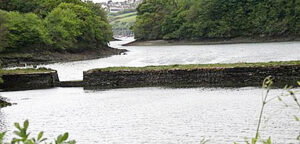 The dam & sluice at Froe
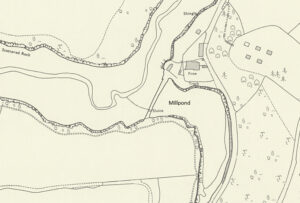 The tidal mill at Froe with the pond indicated
Heritage Gateway record:
“A tide mill and mill house, newly built in 1809, survive today as a causey, millpond, sluice, and wheelpit. An advertisement in the Royal Cornwall Gazette in 1809 records the imminent auction of ‘a new modern-built dwelling house and water grist mills, called Frow Mills. The Mills are worth the attention of flour dealers being well watered and erected on such a construction as to be rarely equalled. The premises are also desirably situated for any person wishing to embark on the coal or timber trade’. A dam or ’causey’ (causeway) constructed across the neck of the creek to create a tidal mill pool indicates that the mill in question was a ‘sea mill’, powered by the tides. The site was advertised again in the following year (1810), and then again eight years later. The details contained in these accounts indicate that the mill had two sets of millstones and was capable of producing fine flour for sale direct to merchants as well as grist for animal feed. It can be inferred that one pair of stones would have been French buhr or Caen stones, whilst the other pair would have been Cornish granite.
The mill buildings are shown on the St Anthony in Roseland Tithe Award map of c1840.
A field visit in Feb 2008 recorded the causey and identified a wheel pit and other features which indicated that the tide mill building was sited at its north-eastern end. A copy of Mr Unwin’s historical research is held in the Information File.” (Heritage Gateway)
Place
Hilary quotes the antiquarian, John Leland, who sometime around 1538, saw Place Mill from St Mawes and described it as:
“half a mile from the hedde of this downward to the haven is a creke in manner of a poole with a round mark made on the charte on which is a mille grinding with the tyde.”
A Tudor house was later erected on the site of the monastery and the mill and mill pool continued to be used until 1862 when the owner, Sir Samuel Spry, had the pool filled in and the mill demolished. A new lawn was created and it was here in 2007 that my daughter, Louisa Mansell, and her new husband, Jai Beetham, held their wedding reception following their marriage at the lovely St Just-in-Roseland Church.
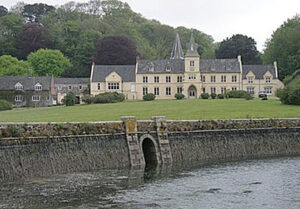 Place House showing the new causeway, the lawn behind was once the mill pool
Hilary quotes several references to this mill in the Spry papers:
“In 1718 it is described as a corn or grist mill with a house, pier and quay. It was advertised to be let in 1812 and again in 1848. The censuses record that in 1841 Thomas Allen, miller, lived there with his wife Amey and five children. In the Tithe Apportionment of the same date he is recorded as occupying, with others, several houses in the vicinity of the mill. Indeed, in 1851 the census enumerator writes of ‘the village of Mill’, undoubtedly an exaggeration, but nevertheless indicating a small cluster of buildings at the water’s edge at that time. There would seem to have been five houses there and one in process of building. William Parkyn was then the miller, described also as a farmer employing one labourer, presumably his nephew Thomas Daniel, who lived with him. By 1861, the miller, now James Borlase, no longer inhabited the mill house. He lived at nearby Cellars cottage with his wife and three-year-old daughter, no doubt contemplating employment elsewhere, as within a year the mill and pool were no more.”
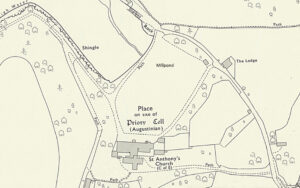 The tidal mill at Place with the pond indicated
Heritage Gateway record:
“A tidal mill belonging to the monks at Place was extant in 1540, and was shown on a map of 1597. The mill was working in 1812 and was advertised for lease in 1848. It was destroyed in 1860, the pond being filled to make the lawn of Place house. The pond and a probable mill building appear on the 1841 Tithe Map.”
Polingey
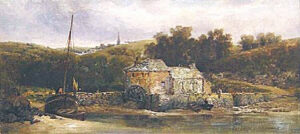 The Old Tide Mill, Gerrans (Polingey Mill) by William Pitt (1818-1900) (courtesy of Elford Fine Art)
Polingey Mill stood at the head of the shorter of the two creeks which feed into the northern extremity of the Percuil river.
Hilary’s comments:
“Henderson quotes a variety of references to the mill in his Topography of Powder, the earliest dated 1416. Sometimes referred to as Gerrans or Tregassick Mill, it was best approached by the little highway leading to the west bank via Polhendra and Lanhay. A farm track led down to the opposite bank from Tregassick. All three were Bishop’s farms. Villagers from nearby Gerrans could reach the mill easily via Well Lane and the Way Field. All that remains of this mill is a mound midstream, a ruined causeway negotiable at low tide, on the Gerrans side traces of the foundations of a quay can be discerned in the sand and in the stream is a section of the wheel shaft with an iron band around it.
The Court Books of the Manor of Tregayre contain many references to the mill copyholders, though it is unlikely that those named necessarily worked the mill themselves. The earliest name is that of Anthony Cruse, who in a survey of 1662 held one salt water mill, worth yearly £10. This family disappeared from parish records by the end of the century and it seems likely that an undertenant lived at the mill. In 1759 to 1793, George Ennis (not Enys of Enys near Penryn) held the mill before it transferred to James West.
The first miller I can identify at Polingey is William Rowe, described as tenant in 1790, when the lease of ‘Tregassick Mills, commonly called Polingey Mills in Gerrans’ was advertised. In the early years of the nineteenth century Henry Merrifield was the miller who is shown as underlessee of the salt water mill in a valuation of these lands. This able young man, who was acting as reeve for the Bishop in 1819, was not to survive long at the Mill. In the West Briton of 27th October 1820 appeared the following announcement: ‘On Thursday evening as a man named Merrifield, who kept a mill near St Mawes, was crossing Falmouth harbour in a boat, with another man and a woman named Menear, the boat was upset by a squall, when opposite Merrifield’s house, and he and the woman were unfortunately drowned; the other man happily reached the shore. Merrifield’s wife was standing on the beach when the accident happened and saw her husband sink without being able to obtain assistance for him’.
It would appear that the Merrifield family continued in occupation of the mill until the arrival of Joshua Rosevear around 1834. Joshua had been born at Sticker near St Austell in 1811, where, according to his obituary in the Bible Christian Magazine, at the age of twenty-four ‘finding his business (as a miller) not prospering… he took a little salt water mill at Gerrans, and here he proved to be the right man in the right place’. At their little mill house he and his wife provided ‘a little chamber with bed, table, stool and candlestick’ for visiting preachers. His life was not without tragedy. In August 1846, his daughter, Sophia, aged three was found drowned in the millpool. Local legend has it that two children of the last miller of Polingey, named Dowrick, were drowned in the mill pool and that this occasioned the demise of the mill. I have found no record of this and assume that confusion arose between this incident and the occupation of Froe Mill by the Dowricks. Grace Ann Rosevear of Polingey Mill aged 16 died in 1850 but there is no mention of the cause of her death, whether by disease or accident.
In 1848, Mr Penhallow Peters advertised ‘the estate of Polingey Mill, now in occupation of Mr Joshua Rosevear, as yearly tenant’. He was looking for an underlessee to take the property for three lives, according to the custom of the manor. A considerable sum was said to have been lately expended on the mill house and premises. It appears to have been taken by Michael Henry Williams, as he surrendered the tenement in 1889. The condition of the mill cannot have recommended itself to a prospective lessee: in a survey of 1853 the Ecclesiastical Commissioners noted that the state of the mill was very poor. It consisted of a small house of three rooms and two garrets, with a small grist mill, one pair of stones. Of stone and cob, worked by tidal water.
Joshua Rosevear remained at the mill for a few more years – he was there in 1851, described as master miller, with his wife and three children. In the 1861 and 1871 censuses the sea mill was uninhabited. One of the millstones is embedded in the platform at the top of the steps of the old barn there. With the departure of the Rosevears, the mill deteriorated, although the ruined walls of the cottage are remembered by some. The state of the premises was well described by the tenant of Polingey House, on the west bank of the creek in 1893. ‘The mill is situated in the middle of the creek with a road connecting the two shores with water above and below at high tides. The sea runs up and down through an opening about four feet wide and the current is very swift and strong and is breaking the stonework away across the opening there is only a single stone about eighteen inches wide and that is in a very dangerous position with no railings to keep anyone from falling overboard. On this stone my children has to pass to go to school. I have five young children under eleven years of age and when the wind is very high they have frequently to crawl across the stone on their hands and knees. …. the mill is unoccupied and in ruins and no house within sight’.
One small reminder of the working mill was a saw in the possession of my grandfather Frederick Chenoweth. It was used to cut the applewood to make the cogs for the mill wheel at Polingey. Sadly, this too has not survived.”
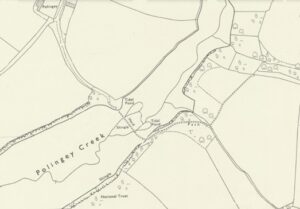 The tidal mill in Polingey Creek with the pools indicated
Heritage Gateway record:
“Polingey tidal mill is recorded in 1540, only half of the dam is recorded in c1908, and little survives today. A ‘mille grinding with the tide’ is recorded at Polingey by Leland in 1540, but the place name implies a mill was here by at least 1416. The 1st Edition 1″ OS map c1813 records a ‘sea mill’ across Polingey Creek. It is recorded in the Tithe Map c1840 and the 1st Edition 1:2500 OS map c1880 record it as Polingey Mill (corn), with a mill pond at SW 8666 3567. By the 2nd Edition 1:2500 OS map c1908, only half the dam is recorded. The dam of the mill pond carried the road from Tregassick to Lanhay; and this is still shown as a footpath or track. A field visit in 2008 recorded that some quite substantial fragments of the dam or causey still survive and there are traces of wall footings on a slight rise in the middle of the creek. Otherwise little survives of this ancient and important structure.”
The tidal mills on the Percuil River had ceased to work by the middle of the 19th century and now there is little evidence of the part they played in the livelihood of the folk who lived and worked in that area of the Roseland.
Hilary’s final comment is that the advent of more efficient methods of grinding corn, together with improved communication, particularly by rail, hastened the demise of the country’s ancient salt and fresh water mills.
My own interest in this area stems from a short period of my life when I lived at St Just-in-Roseland – albeit I was too young to remember – and my extensive family connections which date back to the 1500s. The headstones of many of my ancestors can be found in the various burial grounds and the fact that my daughter and family live at Ruan High Lanes means that I am a frequent visitor from my home at St Agnes.
My thanks go to Hilary Thompson who generously allowed me to use her material. Hilary has written several well-researched books on the history of Gerrans and its people. 6
End notes:
- Tidal or salt-water mills derive their power from sea tides.
- Grist is corn that is ground to make flour.
- An undershot waterwheel is where the water passes under the wheel, turning it in an anti-clockwise direction.
- The Cornwall Association of Local Historians ceased to exist in 2024.
- Heritage Gateway: https://www.heritagegateway.org.uk/gateway/
- Hilary Thompson books: https://sites.rootsweb.com/~enggerop/hilary_thompson_publications.htm

Tony Mansell is the author of several books on aspects of Cornish history. In 2011 he was made a Bardh Kernow (Cornish Bard) for his writing and research, taking the name of Skrifer Istori. He has a wide interest in Cornish history, is a researcher with the Cornish National Music Archive and co-editor of Cornish Story.

Thanks for this article about tidal mills with detailed info. If you or others are looking for info other places it is something I found fascinating in relation to early history Falmouth. Obviously we know the Tudor history of Arwenack, which I think is likely to have been when some of the tidal mills were initially constructed. Another tidal mill was at Swanpool. In my book about Merchants and Smugglers (2019) I wrote briefly about the tidal mills. What I found about the mills was mostly in leases, which are referenced in the book if anyone wanted to look further.