By Merv Davey
The threads that connect Cornwall, Wales and Brittany reach back to the tribes of pre-Roman Britain, the shared origins of the Brythonic languages, the Golden Age of the Saints, placenames, and even the propaganda of the Anglo-Saxon Chronicles make clear the relationship. This article follows one particular thread, that of the “Celtic festival” where cultural traditions of music, dance, sport, and language are shared and celebrated.
Our story starts with three 17th century linguists, Paul-Yves Pezron from Brittany, Edward Llwyd from Wales and Thomas Tonkin from Cornwall. They recognised the links between Irish, Scots Gaelic and Manx in one branch of a linguistic family and Welsh, Breton, and Cornish in the other.[1] Inspired by classical Greek and Roman references to the Keltoi, a generic name for barbarian tribes beyond borders of Greece and Rome, they coined the term Celtic to describe these languages.[2]
The meaning of the term Celtic extended to embrace the lands, cultures and peoples associated with these languages. It became a popular area of study not only for linguists but folklorists and historians exploring the origins of the peoples of the British Isles and Ireland. In 1877, Oxford University created the first Chair of Celtic Studies and appointed the Welsh scholar, John Rhys, to the post. [3] It was John Rhys who introduced the term Brythonic to specifically refer to the languages and culture of Wales, Brittany, and Cornwall.[4]
In Cornwall, this sense of Celtic identity was enthusiastically picked up by 19th Century antiquarians and folklorists. Davies Gilbert describes the Helston Furry as a “specimen of Celtic Musick” and links it to the Rinnce Fada, the long dance, in Ireland.[5] William Bottrell uses the pen name “Old Celt” for his newspaper column on Cornish traditions. Margaret Courtney, perhaps the most scholarly of Cornish folklorists, makes comments like “Cornish people possess in a marked degree all the characteristics of the Celts” [6] and “Like all other Celts, the Cornish are an imaginative and poetical people”.[7] By the end of the 19th century correspondence and commentary in the newspapers regular made reference to Cornwall and the Cornish as Celtic.
The seeds of interest in a pan-Celtic movement can be seen in 1838 when a delegation from Brittany attended the Welsh Eisteddfod in Abergavenny. In 1867 an inter Celtic conference was held at St Brieuc in Brittany. We do not know how many Cornish people attended but Cornwall was represented by Rev John Jenkins who delivered a paper on the comparison between the Breton, Cornish, and Welsh languages.[8] The daytime sessions were largely presentations of academic papers discussing everything from Celtic ethnicity to language and folklore. The evening sessions do hint at the pan Celtic festival as we would understand it today. In this case it was mostly Welsh and Breton folk songs and tunes, featuring the harp but also piano and other instruments.
Some performers appeared in traditional costume. There was poetry, presented as a bardic story telling tradition. Neither social nor display folk dancing is listed in the programme but the binou (Breton Bagpipe) and bombarde (oboe type instrument) do get a mention in the story telling when they play for dancing and religious pardons. It is worth bearing in mind that although social events involving dance and singing are ubiquitous in any folk tradition the Ceilidh and Fest Noz are largely 20th century innovations. [9]
As well traditional music a number of songs were written and performed especially for the event. One such song was “Deut Mad oc’h en hon touez, breudeur a vro Cornwall” (Welcome among us, brothers from Cornwall) and the first verse illustrates just how the relationship between Cornwall and Brittany was perceived from the very outset.
Deût mad oc’h en hon touez , breudeur a vro Cornwall!
0 touar neus douged hon gour-dado gwech ail
0 kwe neus gwaskeded hûn ho bugaligo.
Deut mad oc’h en hon touez ! Deus an eil Vreiz d’eben
Kassomp kevred moezio hon c’halono laouen
Dreist ar mono ledan, a dreus ar meneio.
Welcome among us, brothers of Cornwall!
The land has sheltered our ancestors once more.
The night has watched over your little children.
Welcome among us! From one Brittany to another
Let us send together the voices of our joyful hearts
Across the wide sea, and across the mountains.
Over the next few years similar events were held in various parts of Brittany but although the desire to draw in Ireland, Scotland and the Isle of Man was voiced this did not materialise until there was a renewed interest in the pan Celtic movement towards the end of the 19th Century. In 1901 the inaugural Pan Celtic Congress was held in Dublin and planned as a triennial event. Cornwall’s admission to the Congress was initially deferred due to concerns that Cornish was no longer spoken.
When the Congress was held in Caernarfon in 1904 Cornish scholar Henry Jenner made an impassioned case for Cornish membership. He showed that there had been continuity of people with some knowledge of Cornish throughout the 19th century and that currently there were a number of speakers. He was probably pushing at an open door as all the Celtic languages were suffering from a diminishing number of speakers. There was also a shared experience of aggressive discouragement of the Celtic languages by both the British and French central administrations. The issue was resolved quite dramatically when Henry Jenner received a telegram from the organisers, in Cornish, confirming Cornwall’s membership![10]
In 1917 the pan Celtic movement consolidated to become the Celtic Congress, hosted annually in turn by each Celtic Nation. The format was a mixture of talks, seminars and cultural events which included sports, poetry, storytelling, music, and dance. Cornwall’s turn to host the event came in 1926 and with an active and enthusiastic Celto-Cornish movement was well placed to do this. Unfortunately, a national strike caused the event to be cancelled.
Brittany seems to have a case for holding the first inter-Celtic festival as we would understand it today. It was held in Riec-sur-Belon in August 1927. It was essentially a Breton cultural festival with Bagadou (pipe bands) and dancers from the neighbouring areas and guests from the Celtic countries. Cornwall was represented by Cornish Wrestlers, Wales by a ladies’ choir and Scotland by a pipe band.[11] The Bretons and the Cornish have a shared wrestling tradition going back to the middle ages and this does tend to feature in Breton / Cornish cultural exchange.
The 1932 Celtic Congress was held in Cornwall and intentionally coincided with the recently established Gorsedh Kernow providing for a week-long event of cultural activities culminating in the Gorsedh ceremony itself. At that ceremony representatives from the other Celtic nations were made honorary Bards including Professor Douglas Hyde future President of Ireland.[12] Enthusiasm for combining the congress with existing cultural events seems to have affected the annual pattern of each nation in turn acting as hosts. In 1939 the congress was held as part of a festival in Nantes involving the Breton Gorsedd, the Bodadeg ar Sonerion (Pipers Association) and the Union Régionaliste Bretonne (Breton Regionalists).
The representatives from Cornwall included Mr and Mrs Ashley Rowe who formally invited a Breton representation to the next Celtic Congress in Cornwall. The outbreak of war prevented this from taking place as planned but ironically did result in a strengthening of Breton / Cornish relations. The Rowes had taken a film of the Breton Festival and used this to promote Breton Cornish solidarity. The Breton costumes that featured in the pageants and dance display drew particular interest and comparison was made with Cornish Bal Maidens and thier Gooks (bonnets). In 1940 they set up a Breton-Cornish association to support the Breton community established in Penzance by fishermen and their families who had escaped the Nazi occupation.[13]
Gorsedh Kernow and the Old Cornwall Societies took this a stage further in September 1942 when they co-ordinated a “Breton Cornish” festival to express this solidarity between Cornwall and Brittany.[14] The Breton families were joined by Breton sailors from the Free French Navy and were welcomed in Breton by Robert Morton Nance, Grand Bard of Gorsedh Kernow. The festival program comprised of a parade, which provided large crowds with an opportunity to demonstrate support, moral boosting speeches, and a reception at St Michaels Mount where Breton children in traditional costume presented bouquets to visiting French officers. There was a screening of the film taken of the Celtic Congress in Nantes and impromptu Breton dancing. An evening concert was held with Mousehole Male Voice Choir and dance displays from the Bretons and the Madron Guise Dancers.
The optimism of the immediate post war years was fertile ground for cultural celebration. In 1948 a branch of the Gaelic League was formed in St Ives by members of the Irish Association connected with the Catholic church. They collaborated closely with the Old Cornwall Society in staging events like the Cornish / Irish ceilidh recorded by the BBC on May Day eve 1948.[15] In 1949 they held an inter Celtic festival which was covered in an editorial in the Cornish Scene Review by Denys Val Baker:
“The aim of the St Ives festival will be to recapture the national culture of the Celtic people; the preservation and teaching of Celtic languages; the popularisation of the music dances, games and industries of the Celt …………………… The festival culminates in an all-Celtic Ceilidhe, with teams of visiting dancers, and the famous Helston Furry Dancers are performing the traditional Cornish Dance.”[16]
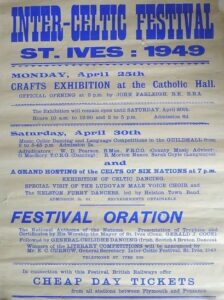 Poster – St Ives Celtic Festival 1949
Although the organisers of the festival in St Ives made clear that this was not a Celtic Congress event it involved much the same people and paved the way for a larger scale festival when the Congress came to Truro in 1950. This was a show piece for the Cornish movement; it dovetailed with the Gorsedh Kernow ceremonies and featured a range of cultural activities. Helena Charles, Cornish activist and founder member of Mebyon Kernow, was part of the organising group. One of her events involved a re-enactment of a Cornish Miracle play at Piran Round, the historic outdoor theatre near Perranporth. As did the original plays, the event was rounded off with community dancing and here she arranged for an exchange of dances between Cornish and Breton groups which she called a Noswyth Lowen (night festival) borrowing from the Breton term for the same, Fest Noz.
Whilst the Celtic Congress of 1950 was exceptional in its scope there remained a festival theme within the Congress for the next two decades. In 1954 the Celtic Congress was held in Killarney and, as in Cornwall, they chose to combine with other cultural events. In this case they combined with An Tóstal , the large annual Irish cultural festival. Cornwall was represented by the Skinners Bottom Singers who were one of the driving forces behind the session singing scene in Cornwall. [17] Their adaption of the Deep River Boys B side single ‘Little Lize I Love You’ became a classic within the ‘shout – Cornish community singing’ repertoire.
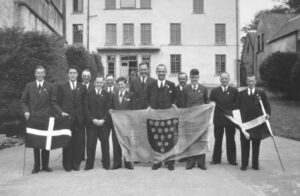 Skinners Bottom Singers at Pan Celtic Festival in Killarney 1954
The huge popularity of music festivals such as Monterey, Isle of Wight and Woodstock in the 1960s spilled over into the Celtic world. In Brittany, Bodadeg Ar Sonerien (pipers association) had been holding pipe band competitions in Brest since their formation in the 1930s. In 1971 they moved the event to Lorient and extended the programme to include some additional folk performers including the Dubliners, Alan Stivell and Cornwall’s Brenda Wootton. It was a great success and in 1972 it was launched as the Festival Interceltique as we know it today and went on to become one of the largest festivals in Europe.
In 1971 a Celtic festival was held in Killarney, and parallel to the Festival Interceltique in Lorient, it was closely associated with Irish pipe band competitions. Following the success of this event the Féile Pan Cheilteach, Pan Celtic Festival was held in Killarney in 1972 with representatives from all six Celtic Nations. As in Lorient the previous year, Cornwall was represented by Brenda Wootton together with a team of Cornish Wrestlers. The pan Celtic cultural movement of the mid-1970s Cornwall found a champion in Betty Pitman of Perranporth. She became involved in organising Cornish representation at both the Festival Interceltique in Brittany and particularly the Pan Celtic in Killarney, eventually taking large groups across.
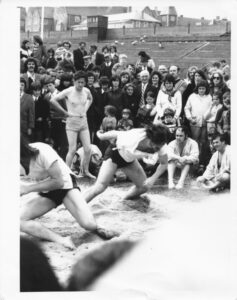 Cornish Wrestling Pan Celtic Festival Killarney 1972
One of the key figures in the revival of the Bodadeg Ar Sonerien was Polig Montjarret and he was a director of the bagpipe festival when it moved to Lorient to become the Festival Interceltique. His counterpart for the Irish Pan Celtic was Con O’Connail, interestingly enough also involved with Irish Pipe Band association. Both were members of the international committee supporting the Irish Pan Celtic Festival where they were joined by Tecwyn Williams who was closely involved with the Welsh branch of the Celtic Congress. All three provided great encouragement for the Cornish representatives and began to talk to them about the possibility of a Celtic Festival in Cornwall. Con O’Connail made several visits to Cornwall, ostensibly promoting the Irish Pan Celtic but also canvassing organisations and individuals that might be interested in a Cornish Celtic festival.
In 1978, Betty Pitman’s group drew upon the community of Perranporth as well as the Fourth Fifths Jug Band and Kemysk, resident singers at the Fal Folk Club in Falmouth. Brenda Wotton and her husband John also attended together with Dick Gendall, the celebrated song writer and Cornish scholar. Dick had written a song in Cornish for Kemysk which they entered in the festival’s Celtic singing competition. The song won the competition and marked the first success for Cornwall at the Féile Pan Cheilteach competitions.
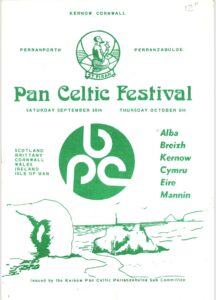 Kernow Pan Keltek 1978 programme
This set the scene nicely for a Cornish festival and on their return from Ireland Betty set up a committee to organise just such an event chaired by John Wootton.[18] A trial “Kernow Pan Celtic” festival was held in Perranporth in October 1978 and proved a great success. Lowender Peran was created the following year and with support from Polig Monjarret, Con O’Connail and Tecwyn Williams went on to become a fixture in the Pan Celtic Festival calendar. The Ponsmere Hotel in Perranporth provided a base for the festival for 25 years. When the hotel closed the festival moved to Newquay and then to Redruth in 2022 where it became simply “Lowender”.
Inspired by their visits to Lowender Peran and meeting Cornish performers at the other Celtic festivals dancers and musicians from the village of Brandivi in Brittany set up a Kernow – Breizh festival in Easter 1987. Initially it took place in Brandivy with Cornish performers and families invited to participate. In 2002 its Cornish counterpart, Aberfest, was created in Falmouth and the two events now alternate, one year in Cornwall and the next in Brittany. [19]
Cornwall has continued to be well represented at both the Festival Interceltique and Féile Pan Cheilteach, with an increasing number of successful entries to competitions at the latter. In 2026 the Festival Interceltique theme is “Cornwall at the Centre of the Celtic Sea” with over 100 Cornish performers travelling to Lorient.[20] A thread which takes us back to 1867 and “Deût mad oc’h en hon touez , breudeur a vro Cornwall”.
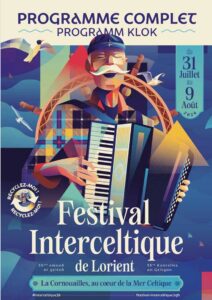 Lorient 2026
End Notes
[1] Lluyd’s Archaeologica Britannica 1707.[ https://archive.org/details/archaeologiabrit00lhuy/page/n3/mode/2up ]
[2] For example “Keltoi” appears in Greek literature in the works of the geographer Hecataeus of Miletus around 517 BC. He used it to describe a people living near Massilia (modern-day Marseille) in southern Gaul
[3] Chair of Celtic Studies, Oxford University: https://www.history.ox.ac.uk/files/jesusprofessorshipofceltic2019pdf
[4] John Rhys, Celtic Britain, (London : Society for Promoting Christian Knowledge, 1904) page 3. https://archive.org/details/celticbritain0000rhys/page/n9/mode/2up?q=Brythonic
[5] Gilbert, Davies. Some Ancient Christmas Carols Second ed. (London: John Nichols And Son, , 1823), The Helston Forey – a Specimen of Celtick Music.
[6] Margaret Ann Courtney,Cornish Folk-Lore. Part 2“ (Continued).” The Folk-Lore Journal Vol. 5, no. 2 (1887), p. 85.
[7] Margaret Ann Courtney, Thomas Quiller- Couch,. Glossary of Words in Use in Cornwall. : West Cornwall by Miss M.A. Courtney. East Cornwall by Thomas Q. Couch. (London, Trübner & Co, 1880), introduction, p.12.
[8] Congrès Celtique International: tenu à Saint-Brieuc, 1867, p.67. Internet archive, https://archive.org/details/congrsceltiquei01unkngoog
[9] Ceilidh is a Scots Gaelic term originally referring to a social gathering where songs and stories were exchanged together with folk dance. Recent usage has moved the focus towards folk dance. Fest Noz, night feast in Breton, is an evening of traditional Breton folk dance.
[10] Bewsskrif Henry Jenner, Dasserghi Kernewek. http://www.dasserghikernewek.org.uk/jenner.html
[11] Erwan Chartier 1927. The Originall Interceltic Festival», Becedia, ISSN 2968-2576, mis en ligne le 5/02/2024.
https://bcd.bzh/becedia/en/1927-the-original-interceltic-festival
[12] Cornishman and Cornish Telegraph, 15/09/32 p.3: https://www.britishnewspaperarchive.co.uk/viewer/bl/0000331/19320915/023/0003
[13] West Briton and Cornwall Advertiser – Thursday 11 July 1940: https://www.britishnewspaperarchive.co.uk/viewer/bl/0000349/19400711/004/0004
[14] Newquay Express and Cornwall County Chronicle – Thursday 27 August 1942. https://www.britishnewspaperarchive.co.uk/viewer/bl/0004246/19420827/004/0004
[15] West Briton and Cornwall Advertiser – 06/05/1948:
https://www.britishnewspaperarchive.co.uk/viewer/bl/0000529/19480506/004/0004
[16] Denys Val Baker, “Editorial” The Cornish Review, First Series, Spring 1949, no. 2, pp. 6 – 7.
[17] Skinners Bottom Choir, RTE Archives. https://www.rte.ie/archives/collections/acetate-disc-collection/11428091-skinner-s-bottom-choir
[18] Kernow Pan Celtic, West Briton and Cornwall Advertiser – 25/1/1978
https://www.britishnewspaperarchive.co.uk/viewer/bl/0003586/19780525/035/0002
[19] https://aberfest.wixsite.com/aberfest/history
[20] https://www.festival-interceltique.bzh/
 Merv Davey Cornish Bard Telynyor An Weryn
Merv Davey is a past Grand Bard of Gorsedh Kernow and a researcher for the Cornish National Music Archive. He was one of the original directors of Lowender Peran and has represented Cornwall at both the Pan Celtic Festival in Ireland and Festival Interceltique in Lorient.