
By Lyndon Allen
To study the history of Par harbour, we first need to peer back through the mists of time to the port of St Blazey. It was here that ships came to the area of Par Beach. Around 400 years ago, it was a small, shallow estuary of the St Blazey (Par) River. The area was originally known as Landreath or Landray. Landreath means ‘church on the sands.’ St Blase was a fourth-century bishop from Sebaste in Cappadocia, as it is now known in modern-day Turkey. He supposedly arrived in the area by sea and landed here. He settled at what we today call St Blazey. This was allegedly how the name originated. According to Charles Sandoe-Gilbert, in 1820, he was also the inventor of wool combing. Richard Polwhele, in his writings, also stated that St Blaise started the settlement of Parr on the St Blazey River. However, I have found no historical evidence of this from that time. It makes me wonder if Polwhele was correct after all. If it is true, was wool one of the early cargos from the quay at St Blasey? The port started to silt up very rapidly from 1750 onwards, and by 1825, it was over a mile from the sea. Thankfully, however, it was well documented with early mapping. In the early days, the settlement grew out of the Priory of Tywardreath. The priory monks would ferry people across the river in a small boat. Par, like a couple of other coastal areas in Cornwall, was the result of sedimentary build-up. Tin streaming and other washings contributed to the silting up of the St Blazey River. Over time, lots of sedimentary waste came down the St Blazey River and formed a large sandbar. In 1830, in excavating the ground for Treffry’s canal at Pontsmill, a stone bridge, formed of long granite blocks, was discovered about 20 feet beneath the gravel which had accumulated upon it. Also at that time, a shaft was sunk near Par. It was ascertained that the gravel brought down by the river and resting upon the sea sand had a depth of 30 feet. Today, the village of Par sits on this sandbank.
Historically, small cargo vessels with a shallow draught berthed around 700 yards in front of the church at St Blazey and had done so for several centuries. Today, this would be around the area of Aberdeen Close. I have been unable to get any information as to the time when that part of the river above St Blazey Bridge was first restricted to a straight channel, and an embankment was constructed for the section between St Blazey Bridge and Middleway Bridges around 1780. Up to which time the river was unrestrained from flowing over any part of the valley. The formation of this channel seems to have been done at the expense of the landowners. After the new river was completed, they agreed with one John Rowe, of St Blazey, to keep the banks in a good state of repair. The cost of these works was estimated to be £125 per year. Rowe ceased to have anything to do with the river in 1806 when he was succeeded by Mr John Keam. He was contracted by Charles Rashleigh (who acted for the different landowners) to keep the banks in repair for a term of twenty years at £40 for the first year, and £20 for each succeeding year. Not many years after Mr Keam took charge of the river, the landowners complained about the quantity of gravel coming downstream, which was being sent down by the tin streamers.
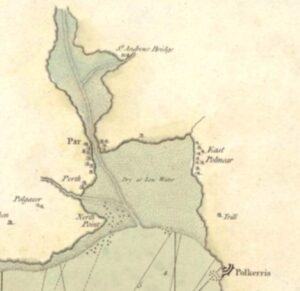 A map showing the estuary, and the map shows a large floodplain, which was created before the building of Par harbour and Village. Photo: Lyndon Allen Collection.
A lot of fuss was made about it, and eventually, an arrangement was made between the streamers and the landowners. Every man employed in a tin stream working from which gravel was sent to the river should pay 17 pence to Charles Rashleigh annually. Rashleigh collected that money, and it formed a part of what was paid to Mr Keam. It is uncertain as to how long a period the tin streamers contributed. Tin streamers pulled down the St Blazey Bridge while streaming for tin around 1790. In 1824, Hitchens and Drew wrote; “Along the vale that leads from Parr to St Blazey Bridge, which is more than a mile distant, the tide regularly flowed within the memory of the last generation; and in periods still more remote, it stretched nearly half a mile further up through the winding valley. At this distant extremity, holes have been discovered in the rocks, now buried in sand, to which the boats were customarily fastened; and at the place where St Blazey Bridge now stands, large boats have been seen within the last seventy or eighty years. But so far is this creek at present choked up with sand and rubbish, that have descended from the hills, that boats at Parr can now scarcely float where vessels of considerable burthen formerly lay to discharge their cargoes. Near a footbridge at Parr, the remains of an ancient quay are still visible; but the rising sands now rival its elevation, and about half a furlong below, a large rock that stood conspicuously in the bed of the river has wholly disappeared within the last forty years; the river now rolling its sands over its most elevated part.”
The rise of Par as a harbour would not have been practical because Charlestown was the prominent port in St Austell Bay. However, due to his financial wrangling with Joseph Dingle, Charles Rashleigh never got to fulfil his legacy of a deepwater port seaward of the port we see today. If this had happened, Par, along with Pentewan, would, in all possibility, not have been built at all. However, historically, there was a small quay at Par from where both John Rudyerd and John Smeaton shipped their granite for the Eddystone lighthouse. Rudyerd used Par in 1704. He shipped over 300 tons of granite from the quay there for the second Eddystone lighthouse. In 1756, Smeaton also used the old Par quay to load granite for the third Eddystone lighthouse. Both men used teams of oxen and horses to haul the granite from Lanlivery Quarry to Par. The vessels that could lift the granite blocks themselves were used, removing the need for a lifting apparatus on-site at Par. Also, granite for the building of the Plymouth Breakwater Lighthouse was shipped from the new harbour at Par. This time, a different quarry was used to obtain the granite. The quarry chosen was Luxulyan Quarry, owned by Joseph Treffry. The granite was shipped from Par to the site in Plymouth Sound in 1843.
John Smeaton and the Granite for the Eddystone Lighthouse
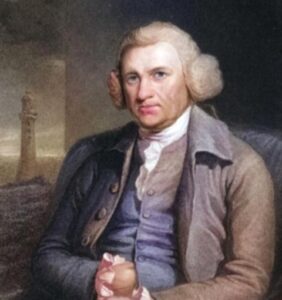 John Smeaton. Smeaton shipped a lot of the granite for the Eddystone lighthouse from Porth (Par).
It is remarkable that with so much written about the Eddystone Lighthouses, so little has been said about Lanlivery, or indeed Par, in connection with them. The following text is from Smeaton’s journal, 1756:
‘Visited Fowey. Next morning, the wind blew hard at S.W., we therefore set out for Lanlivery, about six miles from Fowey, and here we found Walter Treleaven and son, to whom I was directed as the principal people in this district for the working of moorstone. Walter, aged 60, acquainted me that he worked on the stonework for the late lighthouse under his elder brother, Peter Treleaven, who had the contract under Mr Rudyerd. He informed me that none of the stones used therein were above a ton weight, that they were all cramped with iron, each to its neighbour, and the outside courses to those below; but so that none of the cramps could be seen on the outside; that they wore all finished at that place, being tried together upon a flooring of boards, and the cramps let in, and that the cramps were made from a pattern he had received from Mr. Rudyerd.
Peter Treleaven, aged 80, was still alive, but so infirm and ill that he could not see us. I, therefore, desired his brother Walter to ask him a few questions, particularly whether there was any kind of mortar or cement used in the stonework. It being Mr Jassop’s opinion, from what he had observed, that there was not, which Peter confirmed; but it seems that neither he nor Walter had ever the curiosity to go upon the Eddystone Rock.
‘We then went to see the stone and the way by which it was to be carried down to the waterside to be shipped. The pieces of stone here are, in general, of much larger sizes than we saw at Hingstone Downs and are of a quality much freer to work but will not split so truly as I had before been informed. I saw one stone apparently without crack or flaw, which curiosity prompted me to measure and found it to contain no less than 400 tons.’
Smeaton speaks of all the granite worked as surface stone or moorstone.
‘Parr’, the place of shipment, is about three miles distant, through very bad roads, and using carriages, indifferently contrived. Which in this country, they call ploughs; they were not then in practice of drawing above 1 tons at a time, and to move these, they were obliged to yoke a team consisting of a great many bullocks and horses. The stone here was softer than at Hingstone and was easier to work with and yet was hard enough for building. We were informed that a great part of the stone used at Westminster Bridge for walking paths came from here. It is of coarse grain, red and with white spar, two inches long, called Dog’s Teeth, whereas the Hingstone was of a smaller and smoother grain, much interspersed with mica (black), or tale, which is one of its parts.’
A few days later, Smeaton visited Falmouth and Constantine to see other moorstones.
In the end, Smeaton used Lanlivery stone for the chief parts of his lighthouse but was compelled on the score of the economy to employ a variety of Bath Freestone for much of the interior. The quay at Porth is long gone, but it was situated to the northwest of the Par Inn, at today’s Wellington Place. Today, it’s the site of the mini-roundabout on the old crossroads of Harbour Road and Par Lane.
It seems ironic that Smeaton recorded in his journals that he was approached to design a harbour for Par long before Treffry was even born. The original design was for a floating dock with wooden dock gates. According to John Keast in his book ‘The King of mid-Cornwall,’ he states that in the late 1700s, a man called Brooke Watson, a city merchant and friend of Charles Rashleigh, was looking to build a harbour and sought advice from Smeaton; however, it never came to fruition because Smeaton died in 1792, but also possibly because of the Anglo-French war.
Back then, you caught a ferry across to East Polmear. Treffry purchased the ferry operating across the river in 1824 and then replaced it with a new bridge in 1826.
In the Rev. Richard Warner’s book, A Tour through Cornwall, published in 1809, he described the following: “We found another ferry at Par, after a pleasant ride for some distance over the sands; as these are only passable at ebb, owing to a jutting low promontory, which is washed by the sea near the time of flood, it is necessary to be previously acquainted with the state of the tide, and in case of its being near high water, to take a circuitous route, and cross the river at St Blazey.”
A few years later, a large copper mine was opened above the cliffs on the west side of the estuary mouth. Ships in growing numbers came to Par with supplies for these mines, their cargo being discharged on a beach close to the largest mine. The vessels were then loaded up with copper ore for South Wales.
Due to the development of Fowey Consols mines and the construction and maintenance requirements of the port, during the early 1800s, the population increased considerably. In St Blazey, it was reported as being 467 in 1801 and 3,570 by 1840.
Joseph Austen Treffry
Joseph Treffry was born Joseph Austen in 1782. Austen took the name of Treffry when he married into that old Fowey family. He was the owner of several local mines, including Wheal Regent at Crinnis Woods and the very productive Par and Fowey Consols mines. To ship his copper ore to Wales, he decided to build a purpose-built canal to Pontsmill and a breakwater on land he reclaimed from the sea. Historically, there had been a dangerous reef of rocks just east of Spit Beach called the Spit, which was marked with a tall warning pole at its eastern extremity. This reef of rocks would be the base for his breakwater. He initially started work on the canal in 1820 and a harbour wall in the small cove of Porth in 1829. The settlement of Porth was first documented in 1327. The name Porth is derived from the Cornish for harbour. The site lay within the land attached to the manor of Trenovissick. He used rubble or spoil from his mines and, aided by the Par River’s sedimentary deposits, started to reclaim land. Four years later, it was finished, and the first ships used it in 1833.
Joseph Austen Treffry started to build a breakwater at Par in 1829. By 1840, the breakwater enclosed 26 acres and could take up to about 50 vessels of 200 tons burthen. The entrance is 125 feet wide and has 14 feet of water at high-water springs, and 10 feet at neaps, which depths continue all through the channel of the harbour along the inner pier. However, similarly to all our local ports except Fowey, the port of Par was tidal. So the vessels sat on the bottom at low tide. This was problematic because Longshore Drift meant that the entrance was prone to silting. It was constantly dredged. A long reef of granite boulders called the ‘Rampshires ’was set into the beach from the shore in the direction of Killyvarder Rock, falling a hundred metres or so short of the rock itself. These rocks created a natural barrier that slowed down the longshore drift and kept the entrance relatively clear of sand. Killyvarder Rock itself is marked with a pole about ten feet in height with a warning triangle at its top. It is situated on the western edge of the rock itself. You can walk to the rock at Low Water Springs from the eastern side of the harbour channel. However, the southern extremity of the rock remains submerged. When I was fishing, I used to work lobster pots there.
Again, Hitchens and Drew in 1824 wrote, ‘About a mile from this bridge, extending towards the sea, and nearly at the farthest ebb of the tide, a pole is erected at the extremity of a long ledge of rocks, called the Spit, to warn vessels of their danger; its head rising above the surface when it is high water. The expense of keeping this pole devolves on the lords of Rosellian. Parallel with this ledge of rocks is another equally dangerous rock. This rock, which lies to the east and belongs rather to the parish of Tywardreath than St Blazey, is called the Killyvarder. It has proved fatal in former years to several vessels. But no beacon is placed on it to warn the mariner of his approaching calamity; nor can the erection of one be of so much service at present, as it might probably have been in former years, when this creek contained deeper water. Yet even now the erection of a beacon might prove beneficial to strangers, who, without a pilot, might be instructed by this signal to shun the fatal spot.’
Cornish granite was exported from Par in the early days for famous landmarks such as Waterloo Bridge in London, Chatham Docks, and Gibraltar Docks. On the east side of the new harbour, Benjamin Moss, a shipbuilder, started a business building wooden vessels like schooners and ketches. He also built several barquentines that were used in the ‘deepwater’ Newfoundland Trade. Vessels like the ‘Ada Peard’ and the ‘Ocean Spray.’ I have a list that Paul Walkey gave me of all the vessels built or repaired at Par around this time. Much later, around 1857, this business was taken over by the Tregaskes family and eventually, a dry dock was built at Par harbour and the family remained in business up until 1957.
Tregaskes Shipyard
Richard Tregaskes had a timber yard on the western side of Par harbour. Samuel Moss built his beautiful vessels on the eastern dockside at Par. Richard’s son, Benjamin Tregaskes, was an employee of Moss. He started work in the yard aged 11 or 12. While he was in Moss’s employment, he built some beautiful vessels like the ‘Lizzie Tremberth’ in `1867 and the ‘Julia’ in 1870. Whilst Ben was serving his apprenticeship, he was invited to work a passage on his uncle’s schooner around the continent.
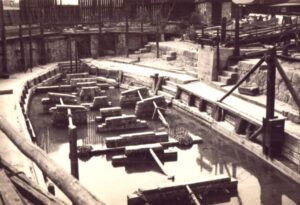 The dry dock of the Tregaskes Brothers at Par harbour. Photo: Lyndon Allen Collection
There was a tradition around that if a boat needed crew, someone, usually of teenage years, would be sent from the yard. He later travelled to and from the USA on a barque for a few years. In 1885, he boarded a liner for his return voyage to the UK. The liner got caught in a terrible storm, and the rudder was damaged. With the captain’s permission, Tregaskes fashioned a new rudder from wood, which allowed the ship to continue on its passage home.
On his return, he settled back into the shipwrighting routine. He could soon see the need for a repair facility, so he approached his father and sought advice on the ambitious construction of a purpose-built dry dock. His father was sceptical about his proposal. Nevertheless, work was started in 1893. At the time, the dry dock was thought to be the only one of its kind in the West. Mr Tregaskes experienced many difficulties. He had trouble making the dock watertight because of a gale which threatened to wash away the gates. He finally succeeded in making a dry dock able to accommodate vessels of up to 300 to 400 tons.
At one period during a storm, the side of the dock was breached, and a gap was made large enough for a horse and cart to go through. There were other challenges. The barquentine Hebe, had to have her rudder unshipped before being docked, because of her length. Another barquentine, Waterwitch, could only be docked by removing both dock gates because of her beam. The Waterwitch was captained by my great-uncle, Captain Charles Henry Deacon. Due to her overall length, another large vessel had her counter well out over the dock gates. The Tregaskes shipyard was well-equipped and able to carry out all repairs to the keels and bottoms, planking, etc. Some of these had new keels altogether, and others were trimmed, and pieces bolted to the old keels. In fixing these keels, it was necessary, of course, to fix shores all along the bottoms of the vessels, to take the weight off the keel blocks.
Many people in Par and St Austell Bay will remember the departure of the barquentine Waterwitch in May 1939. Laid up in the harbour after the death of her owner, Edward Stephens. After serving 65 years at sea, she was finally bought by a group of four Estonian captains to be used for trading timber in the Baltic. She went to Tallinn under her sail. The Tregaske’s yard had a lot to do with the Waterwitch. She was fitted out there for this voyage. The night she left Par, little Margaret Endean, aged 10, jumped aboard with her piano accordion and played ‘Bring Back my Bonny to Me.’ She was later brought ashore by the pilots. Margaret was one of the Par Beach entertainers.
In the early years, the yard employees numbered between 20 and 30 at times. The yard finally closed its doors in 1957.
The following is a list of some of the well-known vessels that have been repaired at the yard, including craft from Russia, Denmark and Ireland and also farther afield.
The Alice Williams, Adelaide, Advance, Alert, Bessie, Bessie Stephens, Carrie Harvey, Crystal Stream, Challenger. Dashing Wave, Dashwood, Devonia, Dinorivic, Elizabeth Hill, Emeline Jenkin. Emily Warbrick, Emma and Esther, Fortuna, Florence, Fairy Maid, Fanny Crosfield, Gavenwood, Guiding Star, Gold Finch, Hannah, Helena Anna, Isabella, I’ll Away, John Clark, John Farleigh, Jane Banks, Jenny Jones, Katie, Lizzie Tremberth, Little Pet, Little Gem, Little Mystery, Lydia Cardell, Lady Agnes, Maria, Mary Barrow, Mary Miller, Pedestrian, Perseverance, Rhoda Mary, R.T.K., Rippling Wave, Sappho, Susannah, St Austell, Sarah Lightfoot, Tulloch Goram, Traveller, Waterwitch, William Shepherd, William Ash burner, Richard Cobden. Leading Light, Der Kurlander, Falke and many, many more.
There were several industries in the early port. These included a brickwork, a foundry, a granite dressing, and a cutting yard. A candle factory was established in 1842. Tallow was imported and at the factory, it was made into candles for Treffry’s mines. It was known as the Chandlery and was run by Samuel Moss. Many miners paid landlords for their ale with candles as they were not generally available in the area. Also at Par was a Galena lead smelter. Galena is also called ‘Lead Glance.’ It is the natural mineral form of Lead Sulphide. A primary element of lead is that it is an essential source of Silver. Shipments of Lead ore came to Par from all over Cornwall. The stack for the associated smelter was known as ‘Par stack’ and was the highest in Cornwall at 235 feet in height. It was constructed using bricks made from the par harbour mud, over 1.2 million of them! Its height was determined by the need to disperse poisonous fumes emanating from the top. It was connected to the furnaces by a horizontal flue 600 yards long. I once read an article that really amused me. In the early 1800s, a sailor called Daniel Ambrose made a bet with some of his fellow crew whilst under the influence of alcohol, that he could climb Par Stack unaided and stand on his head at the top. Unbelievably, I don’t know how, but he did it! Par stack, which was a noted landmark for sailors, was also a great object of interest to visitors to the area. It stood near the docks, and within a few feet of the road leading from Par Moor to Par Station and the village.
The Great Par Stack
The foundation stone of the stack was laid on October 14th, 1864. Twenty men and a few boys were employed to build it under the direction of Mr James Hill. Iron bands, four and a half inches by one inch thick, were built in the middle of the brickwork, at distances of about ten to twelve feet, to make the shaft compact. This chimney stack, at 275 feet, was the highest in Cornwall. As a standing object, it weighed over 3,000 tons. It was originally commissioned by the Treffry estate but later bought by Peter Watson, a lead smelter. Originally, it was connected with silver and lead smelting works, which had closed down many years earlier. A lot of ore had come from the East Wheal Rose and Old Shepherds mines. The reason for the smelting works closure was that lead ore was being taken to Wales to be smelted. Huge cracks had appeared in the stack; these were mostly caused by lightning strikes. In December 1882, two steeplejacks scaled it to repair a broken lightning conductor using just two short 10ft long ladders. They overhanded the ladders for 4 hours until they got to the top! These lightning strikes were so numerous that in the end, the Board of Trade Authorities condemned it and ordered its demolition.
The base was constructed of 12 tons of cut granite stone. It sat on top of a granite outcrop, weighing in at over 1000 tons. The base was 66 feet in circumference and the brickwork was three and a half feet in thickness at the base. The shaft tapered to 30 feet in circumference at the top, where it was about one foot six inches thick.
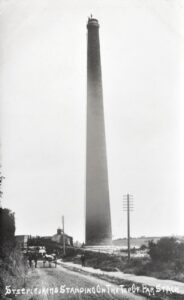 Par Stack and the steeplejacks standing at the top
It was also topped with granite kerbs that weighed 14 tons. It took two years to erect. The work was always done in the daylight hours. The first steeplejack to attempt to knock it down was Mr. C. Capham, of Stratford. He started the work, scaling the shaft employing ladders in five hours. The sixteen ladders used were lashed to iron ‘dogs’ driven into the brickwork. The plan was to knock the bricks off one by one back into the stack itself. As they started to remove the brick they got harder and harder to remove. Capham managed to reduce the stack by 66 feet; unfortunately, Capham realised the challenge was too great and walked off-site. He said that he had ‘never seen a structure so well put together’ and ‘the damn thing would probably stand for a thousand years.’ It took 2 days to remove just ten feet! It also cost him £45. They had only quoted £90 to do the whole job! On that basis alone, they would be significantly out of pocket. Another ‘jack’ was employed, but again it was too high and too challenging. In the end, Mr William Larkins, a London steeplejack, took the contract. Mr Larkins was a famous steeplejack who had repaired the obelisk on Bodmin Beacon in 1882. He decided to knock it down, but chose to undermine one side.
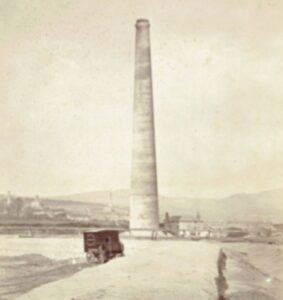 Par Stack in 1874, just ten years after it was built. Over one and a half million bricks were used in its construction. Photo: Lyndon Allen Collection.
However, the authorities thought it too great a risk and offered Larkin a payment of £150 as insurance just in case there were unforeseen challenges. Mr Larkin planned to thin the base of the stack to the extent of a brick and a half. The bottom courses consisted of 6 bricks laid end to end. Then they made a huge gash about chest height and about three feet deep, round half the stack and facing away from the road towards the bit of wasteland in the direction of the sea, where it was intended to ‘throw’ the monument. ‘Throw’ is a term used in steeple jacking.
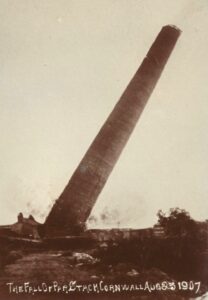 Local photographer Samuel Dalby-Smith perfectly captured the fall of Par Stack.
As the work neared completion, trains were stopped from passing by, and the residents of the adjoining cottages went to the nearby fields and set up tents. It seemed that no one had much faith in Larkin’s ability. On the day of demolition, three workmen started work at dawn. They knocked out more bricks from the already yawning gash at the foot of the stack.
This work continued throughout the day. The men took it in turns to take meal breaks. As daylight faded, the word went round that the stack was likely to fall at any minute. The police moved the rapidly increasing crowds to places of safety. In the dark, the men continued with their work under the light of lanterns. At about nine pm, they decided to cease work for the day. Cracks appeared that were big enough to enable a five-shilling piece to be slotted in. Everyone involved thought it might topple during the night. In the morning, work resumed at seven. a.m., at 08.10 the stack fell. One fellow, a spectator, had stayed up all night to witness the event. Unfortunately, he needed to relieve himself and had disappeared just as it fell!
Afterwards, Larkins was quoted as saying, ‘In the end, I got my chimney down without breaking a single window pane or doing a farthing’s worth of damage on the line. Of course, it is riskier to fell chimneys than to climb them, especially when the felling is done my way. The old method was to undermine the foundations and prop them up with timber saturated in oil and tar. The timber was then set alight, and when it had burned through, down came the chimney. My method is to cut down a chimney just as you would cut down a tree. The advantage is that you can make the huge mass of brick and stone fall exactly where you want it and can fell the tallest chimney in one day. I begin by cutting away the brick on the side where I want the chimney to fall, keeping a sharp lookout aloft. Sometimes, I stand with a twig in the gap, and when this bends, I know that the chimney will topple over at any moment. Then is the time to run.’
After the demolition, the bricks were sold off locally for building projects.
As a footnote, in and around the area of mid-Cornwall in the later part of the 19th Century, gentlemen’s top hats were locally known as Par Stacks. Whilst researching, I found that the vicar at St Blazey had gotten into a fight with a man who had accused him of wearing a Par Stack on his head. It ended up in court at the time.
The stack had become a navigational aid for mariners until 1907, when it was pulled down. Local photographer Samuel Dalby-Smith took some wonderful photos of its demise.
Larkin went on to greater things. Because of his success in demolishing Par Stack, he was awarded a job in Scotland to demolish a 488-foot chimney!
As the port of Par developed in those formative years, ships visited the port almost daily. As with Charlestown, things would change later on with the collapse of mining. But at the start, it was the tin and copper that brought wealth to the area. Treffry employed nearly 2,000 people in his various mining adventures. As the demand for shipping grew, so did the demand for employment. This led to the eventual settlement of the area or village of Par as we know it today.
Vessels either entering or departing the port would have to be towed in or out with a steam tug. Charlestown and Pentewan had warping systems in place, but because the approach to Par was so shallow. So, at Par, a warping anchor would need to be over half a mile from the port entrance. The process would be beset with problems because of the distance.
The tug would tow vessels clear of the shallow ground at the seaward side of Killyvarder Rock. When clear, they would start to raise sails and hopefully ‘catch the wind’ and then make their way out of the bay unaided. Once steam engines became the norm, the need for assistance in arriving and departing was reduced considerably. That being said, a tug was still used to manoeuvre vessels into selected berths alongside the quays.
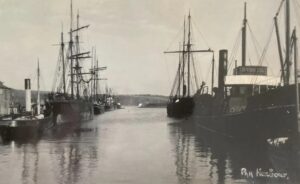 The wooden Barquentine to the left, just in front of the tug, is the ‘Waterwitch.’ Her Master, Capt. Charlie Deacon was an ancestor of mine. She left Par for the very last time in September 1939. No more would she heel over to the breeze in St Austell Bay, a bygone era, and one I’m trying desperately to record for posterity. I have a colour film of her leaving Par that day. Photo: Lyndon Allen Collection.
The harbour at Par grew beyond all comprehension when the railway came to the port in 1859. This meant that clay and other goods could be brought from the main line directly into Par Harbour. Cargos of clay directly from the pits could now also be brought right to the dockside by rail. Locomotives would be based at the docks. They would eventually become a part of Par Docks. These engines were called Sara, Punch, Judy, and Alfred. Copper and tin exports fell away with the collapse of the Cornish mining industry in the late 1870s. China clay would soon become the biggest export for the port of Par. It quickly became one of the busiest little ports in Europe. Now imports of coal, limestone, and fertilizer also augmented the exports of clay that had been brought to the dock by rail. As many as 50 schooners could berth alongside the quays on busy days. Sometimes as many as twenty vessels would be at anchor off Par awaiting berths to load or discharge cargo. This increased demand in cargo handling provided a huge boost to the economy of Par as a whole. Everyone would benefit, from the butcher to the landlord, even the ladies of the night who frequented the quays nocturnally.
As the 1800s turned into the 1900s, things became ever more mechanised. Motorised vehicles supplemented the rail system and increased the port’s productivity. In 1910, an old mill on the eastern dockside was bought by The Beaver Mills Company Limited. Here, they started milling ‘Snow King’ flour for bread making. The manager was called Alan Townsend. This mill later went into liquidation because of competition from other bread makers such as Hovis. In 1926, the mill was purchased again by the Varcoe family and became Cornwall Mills. The company then altered the mill to grind different minerals such as felspar, limestone, and quartz, among others. The company even had its own football team. My father worked there after he left the Royal Navy. He would later become part of the dock staff at Par. Sadly, Cornwall Mills caught fire in the late 1960s and was later demolished. Two gas storage facilities were constructed on the eastern docks and sat next to the old brickworks. Another company to have premises on the eastern portion of the dock was Ricketts. They were a clay haulage company and moved clay via the railway.
Other companies sprang up in those formative years; Taylor Low Brothers had large stores and premises where the Carvear Dryer is situated next to the sluice pond today. They were originally timber and builders’ merchants and later became shipping agents. Clunes and company were next door to TLB, on the western side of their premises. Clunes were also builders’ merchants and coal factors. They also had offices on East Quay near Cornwall Mills. Lots of families also lived in and around the docks in those early years. There were several cottages dotted around the docks. I suppose the most significant of these would have been the old Spit Cottages near the Candle Factory. This site was demolished and cleared in the early 1970s. Its location was just to the north of Spit Beach itself.
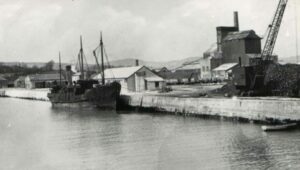 One of the many photos from my collection. It shows a steamer alongside the quay. The building to the right is the Beaver Mills. Also visible is a huge amount of steam coal piled high on the quayside to the right of the photograph. Photo: Lyndon Allen Collection.
In the early 1930s, the Fowey shipping guru Edward Stephens passed away. Some of his vessels were laid up at Par Harbour until buyers could be found for them. A blue line was painted around their topsides. This practice was customary at the time and signified the death of a ship’s owner. The barquentine Waterwitch, the schooners Jane Banks, Emily Warbrick, and perhaps, the most famous of all, the little Schooner Isabella, were all put up for sale. My great-grandfather had spent several years as captain of the Isabella, making record-breaking voyages across the Atlantic. Also, my third great-uncle, Capt. Deacon, worked for Edward and was the senior master of Stephens’ fleet. At the time of Deacon’s death, he was the master of the Waterwitch.
Wartime
With the fall and evacuation of Dunkirk, the head of government, Winston Churchill, set about building a line of coastal defences. By the 29th of June, a mobile lorry battery known as the ‘Cornish Lorry Battery’ was put in place at Par to protect the port and shipping. It consisted of two lorries. Each one had a single 4-inch gun mounted behind the cab. Whilst it was the only one of its kind in Cornwall, there were 38 of them nationwide. The guns came from a German Cruiser called the Paris, which had been taken as a World War One war prize. This mobile battery would serve until a new purpose-built battery was completed a month later. This was constructed on an area known today as The Mount, which overlooked Par Harbour. This battery became known as Number Two Battery. It was officially called ‘Par 393 Coastal Gun Battery.’ This was augmented by two searchlight installations at Spit Beach. These searchlights were located in huts. Sadly, only one remains at the top of Spit Beach today. They were known as CASL, Coastal Artillery Search Lights. The searchlights would illuminate any incoming enemy planes. A Bofors Anti-Aircraft gun was also located nearby to act as a deterrent. Several pillboxes were built. A couple were placed on the Mount and one in the middle of the road outside the Ship Inn at Polmear. Two more were located on the coastal path between Par and Polkerris. A further pillbox was placed by the Par River beside the docks. The beach was cleared of its 300 beach huts. Their owners were given just 24 hours’ notice to remove them. The Army then erected two tubular steel anti-tank defences with 300 feet between them. This area was then covered in rolls of barbed wire and mined. At the end of the war, the Americans cleared the obstructions and bulldozed the whole length of the beach. Slowly, it returned to normality.
In September 1940, a Looe boatbuilder named Frank Curtis started building minesweepers on the east side of the harbour above the beach. Wood was sourced from local farmers’ fields and brought to Par on lorries. The wood was then cut to dimensions by a purpose-built sawmill located next to the shipyard on the dockside. The build sites were at the end of the east quay. There was enough room for five vessels to be built side by side at two sites at the harbour. Purpose-built slipways were constructed of steel railway lines and wood directly astern of the newly built hulls. Later during the war, these slipways were concreted over in pairs and can still be seen today, protruding across the beach from the eastern pier. The Par harbour storage facilities were painted in camouflage colours. To protect the building site, two three-pound guns were installed at the docks on the 11th of July 1940. They were manned by the LDV, which later became known as the Home Guard.
These wooden hulls, once completed, were launched down the slipways and towed around the bay by a couple of fishing boats to Charlestown for completion. Adding engines, wheelhouses, sweeping gear, and armaments was all part of the final fitting-out process at Charlestown dock.
Between the Par and Charlestown shipyards, over a thousand personnel were employed. Shipwrights came from all over Cornwall to work there; many found lodgings with village families just as the evacuees had done a couple of years before. I also have to mention that only registered fishing vessels were allowed out of the ports and in the bays. Anyone wanting to go for a day’s angling or take a pleasure cruise was not permitted to do so.
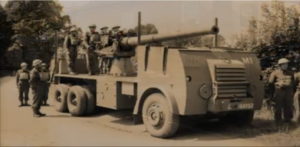 Par Lorry Battery. The battery was set up in the formative years of the Second World War. It was replaced with a permanent battery on The Mount in July 1940. Photo: Lyndon Allen Collection.
One lovely tale I have been told was that some Dutch coasters turned up at Par during the early part of the war. They were at sea when Holland was invaded. Their owners did not want their ships to be taken as war prizes, so they sailed for Par instead. It was decided by the port authority that they could stay for the meantime if they agreed to remove their vessels from the docks if the port was under attack from the air. The port authority didn’t want a vessel sunk in the harbour, causing an obstruction. The ship’s Dutch owners agreed to this. However, the day that enemy planes did bomb Par, the boat crews were allegedly in the Par Inn having a glass or three. Upon hearing the air raid warning siren, they left the pub and rushed towards the docks to get their vessels out of the port. As they ran down the quay, they realised the tide was out, and their vessels were hard aground. They then did the right thing: they went back to the Par Inn!
During the preparations for D-Day, the American Army blew a hole in the western quay wall as part of their training. They were then required to fill it in again. A landing pontoon laid from Par Beach into the bay to practice beach landing was nearly swept away on Boxing Day 1943. Fortunately, a small boat towed it to the safety of the harbour. Exercises continued throughout the spring of 1944.
Clay Drying
Clay was eventually piped to Par from the distant china clay pits. It was during this growth period that drying sheds were erected, firstly in the valley along Par Moor and later in the docks themselves. These pan kilns on Par Moor were Hensbarrow, Hallaze, Pentruff, Great Treverbyn, Ruddle Common, and Carvear. Hensbarrow was the first kiln near the harbour. It was supplied by one of the longest pipelines at the time. It came from Hensbarrow pit, which was just north of Gunheath, near the village of Carthew, St Austell. A distance of five miles as the crow flies.
The dryer was initially built on the waste dumps of Par Consols Mine before the rail siding was established. As a result, it was located too high for a rail connection. Therefore, it functioned as a muck wagon kiln until it was later converted to mechanical drying. The Hensbarrow works may have been owned by F W Berk and later by Steetley Minerals after they acquired the company. It was one of the earliest mechanical dryers installed by an independent company, around 1956.
Hallaze was a pottery kiln used to dry clay from the pit of the same name near Penwithick. Its engine house has been repurposed as a pumping station for South West Water. The kiln was built on the site of the old Par Harbour office, which was bombed by the Germans in 1941. Later on, the dryer was converted into a clay storage facility with a conveyor belt by Steetley Minerals. Clay was transported a short distance from Hensbarrow Dry to Hallaze by trucks for storage and loading into rail wagons.
Pentruff was a large and impressive press kiln that was owned by Parkyn & Peters. The company’s name was spelt out in blue glazed brick on the square-sectioned brick chimney. The clay used in the kiln came from the pit of the same name near Garker. This company was acquired early on by English Clays Lovering and Pochin, and the kiln eventually became part of the Par Moor tank site. The tall height of the linhay allowed small rigid lorries to tip, so it was used as a clay store for a while.
Great Treverbyn & Ruddle Common was a company named after the two pits they owned. The first produced the sky tip that is now preserved on the A-391 near Carclaze. The works featured two huge pans sharing a central stack, an impressive Delabole slate roof, and a central mill for breaking up and bagging the clay. This dry was at the terminus of the rail siding and suffered significant bomb damage during the Second World War. The company was acquired by English Clays Lovering and Pochin, and the kiln ended its life as part of the Par Moor tank site.
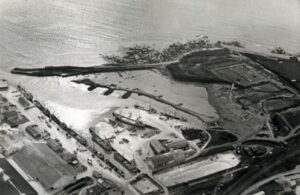 Par docks taken around 1962. It shows the new dryers and also the new berths where Tregaskes shipyard was situated. Paul Walkey kindly gave me this photo. Twelve vessels are berthed. Photo: Paul Walkey Collection.
Carvear Dryer was located at the end of the row and was never connected to the rail siding as originally intended. It was owned by Inveresk, who converted it into a storage facility after constructing the Bodelva Dryer near the harbour. Bodelva Dryer was situated near the old Tregaskes shipyard at the harbour. Inveresk installed a direct-fired rotary dryer fed by rotary vacuum filters, with construction overseen by one of their personnel from the paper mills. This was a unique installation in Cornwall. As the name suggests, this dryer processed clay feed from Bodelva up until the end of production under Goonvean around 1997/1998. Engelhard acquired Inveresk’s clay production subsidiary and shortly after sold it to Steetley, which was acquired by Redland. Redland then sold the clay production subsidiary to Goonvean.
Par Rotaries was constructed in 1951 using surplus frames from RAF dirigible hangars. It also included two second-hand Ruggles Coles B-14 type rotary dryers, which were said to have been peanut roasters in a previous life. These initial rotaries were referred to as Par Rotaries Nos. 1 and 2. In 1954, No. 3 was built in a new building right next to Nos. 1 and 2 and was connected to the linhay of these by conveyor. Additionally, a new building was added to No. 3 in 1958, serving as a trailer store and providing ECLP with expansion capacity to add an additional rotary in the future. Rotary dryers No. 4 & 5 were constructed in a new building next to the trailer store, along with a new large linhay. No. 6 was installed in the trailer store in 1962. Finally, in 1969, No. 7 was set up in the old hangar linhay beside No. 1 and 2. This housed a new type of dryer for ECLP. This was a direct-fired rotary dryer with no combustion chamber. Instead, it was equipped with an Astraflame refractory-less burner. Here, the burner flame was directed straight into the dryer drum, shielded by blown quench air. No. 7 marked the end of rotary dryer development with ECLP, as they exclusively favoured Buell turbo-shelf dryers for the next decade.
In the late 1960s, the old Cornwall Minerals railway line from Par to Fowey was taken up. This line was constructed in 1874 and ran through a long tunnel known as the Pinnock Tunnel. The company was taken over by the Great Western Railway in 1896. In 1948, the GWR was nationalised, and the line from Par to Fowey was closed to passenger traffic in 1965 and to freight in 1968. The tunnel was the longest rail tunnel in Cornwall and was 1,173 yards long. ECC wanted direct access from Par to Fowey docks, so the line was taken up and the track bed was tarmacked over. This construction took place between 1969 and 1972. ECC Heavy Transport division could then have a private haulage road in which to serve Fowey docks. This then supplemented the clay shipments going to Fowey Docks by rail.
Two suction dredgers operated at Par in later years to keep the entrance channel clear of sand. This was augmented with visits by the Fowey Dredger, Lantic Bay. Traditionally, this job had been done with a horse and cart and required a team of men who had to physically shovel the sand into carts to be taken away. It must have been a thankless task, as it only needed a couple of gales for all the hard work to be undone and the channel to fill in once again.
In 1900, the port had only seven working berths. The number one berth wasn’t used much as it was open to the elements. When Tregaskes shipyard closed, the area was developed and new berths opened that numbered 10 to 13. In 1990, a slurry plant was constructed at the port, and my brother worked there. This was known as berth 14. German slurry vessels came to Par to load clay. These vessels were regular runners and were called Eldor, Condor, Pandor, and Tudor.
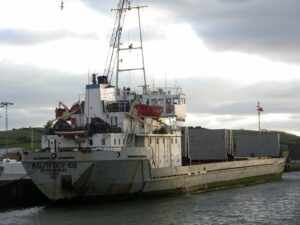 The Russian vessel Baltiysky-102. The last commercial vessel to load at Par in December 2007. Photo: Lyndon Allen Collection
I speak to Paul Walkey occasionally; we’ve had some laughs reminiscing about Par and its glory days. Paul was a ship’s agent and worked for Harris and Company (shipping) Ltd. He fondly remembers when he first started work there in 1965. He was sent out to the end of the quay to look through binoculars and write down the names of the vessels at anchor waiting for berths. There were no ship-to-shore radios at that point. This is another funny story from when he was an agent at Par. Paul said, ‘Back in the 60’s, before we joined the Common Market, it was our job as Agents for every Spanish shipment to send a proforma cargo manifest by taxi to the Spanish Vice Consul at Falmouth, who would put more stamps on it than on a Brooke Bond tea card. Once the loading had been completed, it was then placed on board with all the other documents. On one occasion, I forgot to book the taxi, and the vessel was sailing within the hour. After a period of panic, I took from my desk drawer some Green Shield stamps and used them. For the next four days, I prayed as I waited for a telex stating the cargo had been refused due to incorrect paperwork. But, in the end, all turned out ok thanks to Green Shield and their stamps.’
Par, once a bustling commercial port, closed in 2007, marking the end of an era. It had been known as the busiest little port in Europe based on quay space. Following its closure, aquaculture is set to take its place at the port. Local entrepreneur Gary Rule of West Country Mussels is now renting quay space and operates a fleet of small vessels at Par. He has made a significant investment in a large mussel farm in St Austell Bay, and I sincerely wish him every success in his endeavours.
Plans to transform the port into a marina with 500 houses have also fallen through. The future of Par Harbour remains uncertain, but it is clear that whatever happens next, there should be some form of monument to commemorate its industrial heritage. On 13th December 2007, the Russian vessel BALTIYSKIY-102, built in 1978 in Turku, Finland, for the then USSR, loaded approximately 2,300 tons of clay bound for Rauma, Finland. This marked the last commercial clay cargo shipped from a port that once regularly accommodated between 13 and 15 vessels, each carrying an average cargo of 500 to 800 tons.
Due to changes in shipping routes and declining demand, this shipment symbolised the end of a vibrant era for the port. Remarkably, both Par and Charlestown’s ports shipped their last cargoes on the same date, the 13th of December, although eight years apart. Par Harbour deserves recognition for its historical significance and is a testament to one of Cornwall’s industrial giants, Joseph Treffry, its creator.
 Lyndon Allen
Lyndon Allen grew up in Charlestown, St Austell. He comes from two longstanding historical families in Charlestown, who have been an integral part of village life for over 230 years, particularly in its maritime heritage. Lyndon attended both Charlestown and Penrice schools before leaving in 1981. He pursued a career in the commercial fishing industry, working from the port of Charlestown for thirty-six years, in line with his family’s strong connection to the sea. He retired from the fishing industry in 2019.
Currently, Lyndon operates the award-winning Charlestown Walking Tours, a business he established after the lockdown. He is also an author, a passionate historian, and manages eleven Facebook history groups, including the popular St Austell History Group. Lyndon has authored four comprehensive history books: two on Charlestown’s history, one on St Austell’s history, and a maritime history book about the St Austell and Mevagissey Bays.
His books are available for purchase on his website at www.charlestowntours.co.uk
