
My connection to the Flying Enterprise is deeply personal. During my early years in the fishing industry, the wreck of this famous vessel featured regularly in my working life. The story of the Flying Enterprise – which captivated Cornwall and the entire nation in 1952 – always felt close at hand, not just as a tale of heroism and tragedy, but as a real and physical presence beneath the waves.
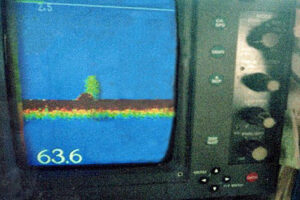
The Echosounder marks a large wreck on the seabed, just like the Flying Enterprise. In this photo I took, you can see a huge plume of fish above the wreck in a green and yellow hue. Copyright, Lyndon Allen Collection.
The wreck itself lies about 35 miles east-southeast of Mevagissey, the Cornish fishing port. Reaching it in an ordinary fishing boat takes around four and a half to five hours in decent weather, longer if the winds or seas are rough. Working on the site was a familiar and often challenging routine.
Our main aim was to catch pollack by setting gill nets – long, fine nets designed to entangle fish – over the wreck. This technique required precise timing and understanding of the tides. We could only attempt this when the tide was at its weakest, known as slack or neap tides. If we tried during spring tides, when the tidal flow is at its strongest, the current would flatten the net against the seabed, and the wreck, making it ineffective except for a brief half-hour window of slack water every six hours, when the net would rise upright and become usable.
Laying the nets was always a job that demanded care and attention to detail. In fishing, we call the process of putting the net into the water ‘shooting’ the net. This simply means feeding the net steadily over the side as the boat moves forward. Shooting the net in this way helps to spread it out evenly along the seabed, making sure it covers as much ground as possible.
First, we’d use a navigation system, and something called an echo sounder – a device that sends out sound waves and creates a picture of what’s below the boat. With the flicker of its blue screen, the echo sounder would reveal the shape of the wreck and the fish swirling above it. Once the wreck’s position was clear, we’d drop floating marker buoys overboard to mark the spot.
The strong pull of the tide and the depth – sometimes 70 or 80 metres – meant we couldn’t start right on top of the wreck. Instead, we began some distance away, at first moving slowly against the current.
When the buoy line was paid out, we turned and dropped a really heavy anchor overboard. Then the bridle would pay out – a sturdy length of rope acting as a connector between the anchor and the net. The bridle helped guide and position the net so it would settle in just the right place.
Now, with the tide behind us, we continued feeding out the net, letting it unfurl in a long, silent line across the water. At the far end, we set another anchor, making sure the net stayed in place. A long buoy line followed, snaking away on the surface as a final marker. Altogether, we might use more than 650 feet of rope for this routine. If everything went according to plan, the echo sounder would confirm the wreck was directly beneath us just as we set the last buoy – and the whole operation would be finished.
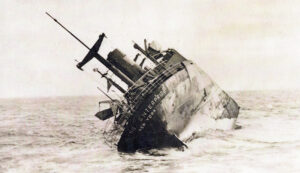
The listing Flying Enterprise, if you look closely, you can see Captain Carlsen on the ship’s starboard side, holding on to the railings. Copyright unknown, but part of my collection.
Most wrecks in the English Channel lie with their bows pointing north-south, since the tides generally run east-west. When a ship becomes disabled, it tends to turn so that its length faces into the tide. The Flying Enterprise was no exception, but what made her unique was how she rested on the seabed. Sometimes, we could haul the nets up easily and without damaging them; other times, they would be torn to pieces. It was only in the 1990s that we learnt the reason: the wreck lies on her port (left) side – the same side she had listed so dramatically before sinking. Depending on which direction we hauled, the nets would either glide over her hull or snag on her superstructure and cranes. If memory serves, hauling “down-channel” was the safer bet, though after all these years I can’t be sure.
Navigating to the wreck in the days before GPS was another challenge entirely. Back then, we relied on the Decca navigation system, which used radio signals to provide coordinates – though it was much more accurate in daylight. The Decca coordinates for the Flying Enterprise were known as South West chain 1 B, Red D.8.20 and Green E.40.40. These designations might sound cryptic now, but they were vital reference points for us at sea.
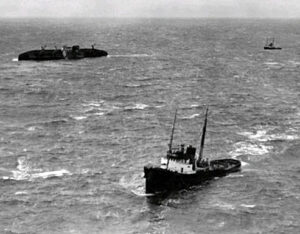
The stricken Flying Enterprise under the command of Captain Carlsen and in the foreground, the Falmouth TUG, Turmoil, under the command of Capt. Parker. Copyright unknown, but part of my collection.
One memory stands out, highlighting how unpredictable life could be on these trips. Just before dawn in the late 1980s, I was sitting above the wreck with a friend, waiting for enough light to set our nets, since Decca was next to useless in the dark. Suddenly, we lost all power – no navigation, no autopilot, not even the electric compass. At the time, we’d noticed two submarines operating nearby; whether they caused the blackout, we never found out.
What followed was a long, arduous journey home. With the wind blowing force 6 to 7 from the west and no instruments to guide us, I had to steer the boat by hand, relying on little more than a small compass to bring us safely back to shore. The experience was a stark reminder of the sea’s unpredictability and the respect it demands from those who work upon it.
The rumour mill was always grinding when it came to the Flying Enterprise, stories of gold on board, vast sums of money and Zirconium, etc. I knew that Captain Carlsen’s lifebelt used to be on display in the pub at Lamorna, the Lamorna Wink.
I can remember discussing this with a dear friend, Ken Norton. Ken had spent many years at sea as a chief engineer. As a boy, though, he told me he was glued to the wireless every day to listen to this ever-unfolding story, waiting each day for an update on the wireless. It captivated him so much that he studied the subject for many years. This is what he told me about the Flying Enterprise:
“Kenneth Dancy was a tanker captain home on leave and stood in for the sick mate on the Tug Turmoil as a temp, never having been on a tug before. He died at the age of 88 in 2013, Capt. Carlsen died in 1989. Kenneth Dancy went ashore a couple of years after and worked for Philips Radio and latterly I.B.M. It was reported in the press that the cargo consisted of zirconium rods (not pig iron ore) used for the manufacture of nuclear reactors and was intended for use in the construction of the American submarine Nautilus. Incidentally, the building program for the submarine was put back by 12 months. Was that a Coincidence? The Turmoil at the time was reported as being the most powerful salvage tug in the Western World, stationed at Falmouth, Cornwall, and was delayed originally as she was already towing a crippled tanker to Falmouth that had been damaged in the same storms.”
The story of the SS Flying Enterprise remains one of the most captivating maritime sagas of the twentieth century. In the winter of 1951–1952, the vessel’s dramatic demise off the Cornish coast gripped not only Cornwall but the entire nation and beyond. Celebrated for the extraordinary courage and perseverance of those involved, the incident has since become a touchstone in nautical history, sparking both admiration and a wealth of speculation. This article offers an analytical and balanced exploration of the Flying Enterprise’s final voyage, distinguishing clearly between established historical records and the conjecture that has flourished in its wake.
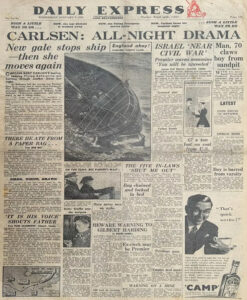
Newspaper headlines at the time.
According to official records, the SS Flying Enterprise was a 6,711-ton Type C1-B cargo vessel, produced during the war, but a more modern design than the Liberty Ships. Originally built in 1944 as the “Cape Kumukaki” for the United States Maritime Commission and later sold to the Isbrandtsen Company in 1947, when she was renamed Flying Enterprise. On 21 December 1951, under the command of Captain Henrik Kurt Carlsen, the ship departed Hamburg, Germany, bound for the United States, carrying a mixed cargo and ten passengers. The ship’s fateful journey began to unravel on Christmas night, 1951. Official reports state that a rogue wave struck the Flying Enterprise in the Western Approaches of the Atlantic, causing her cargo to shift and inflicting serious structural damage. The resulting list quickly became perilous. Despite the worsening conditions, Captain Carlsen refused to abandon his vessel, even as passengers and crew were evacuated by responding ships. For nearly three weeks, Carlsen remained aboard, enduring relentless storms and physical hardship.

The “Flyer”, as we called her in Mevagissey. I felt a deep personal connection to the wreck, even though it all played out 14 years before I was born. Lyndon Allen Collection.
Rescue efforts intensified as the British tug Turmoil, under Captain Dan Parker, reached the scene. According to contemporary news reports and official accounts, Parker’s mate, Kenneth Dancy, risked his life by leaping aboard the stricken vessel to assist Carlsen with securing a towline. The Flying Enterprise was brought under tow, and hopes rose that she might reach Falmouth safely. However, as the ship neared the Cornish coast, a renewed storm snapped the towline. With the vessel beyond saving, Carlsen and Dancy were compelled to abandon ship by walking out along the funnel and leaping into the sea to be rescued by the Turmoil. The Flying Enterprise finally sank at 16:10 on 10 January 1952, just forty miles from Falmouth, concluding a remarkable struggle chronicled in both British and American media.
Official honours followed: Carlsen received a Lloyd’s Silver Medal for Meritorious Service and a hero’s welcome upon his return to New York, while Dancy was awarded the Order of Industrial Heroism and other accolades. These well-documented events have since become central to the ship’s enduring legend.
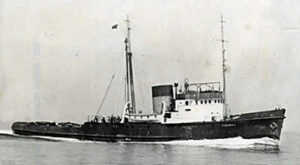
The Cornish star of the show, the tug Turmoil. Lyndon Allen Collection.
With the immediate crisis resolved, attention soon shifted to the nature of the Flying Enterprise’s cargo and the circumstances surrounding her loss—a transition that would fuel decades of debate and conjecture.
According to the ship’s manifest and official documentation, the Flying Enterprise’s cargo comprised 1,270 long tons of pig iron, 486 long tons of coffee, 447 long tons of rags, 39 long tons of peat moss, twelve Volkswagen cars, antiques, antique musical instruments, typewriters, 447 long tons of naphthalene, and ten passengers. There was also a record of 71.8 tonnes of unidentified cargo, which has since attracted scrutiny and speculation. The vessel, a Liberty-type ship hastily constructed during World War II, was reportedly compromised by the storm’s force, resulting in flooding of her forward holds and an irrecoverable list.
The official rescue operation involved several US Navy ships and the British tug Turmoil. Press coverage at the time underscored Carlsen’s steadfastness and the international cooperation displayed during the rescue. Both Carlsen and Dancy were publicly honoured, and financial rewards were distributed among the Turmoil’s crew in recognition of their bravery.
While the facts of the sinking and rescue are well documented, the contents of the Flying Enterprise’s cargo hold quickly became a source of intrigue, prompting a wave of speculation and conspiracy theories.
Some theorists claim that the Flying Enterprise was carrying not only the declared cargo but also secret materials – most notably gold or zirconium, the latter allegedly intended for use in the world’s first nuclear submarine, the USS Nautilus. These assertions are based on speculation and anecdotal accounts rather than official documentation. No extant records confirm that such materials were on board, and the main exporters of zirconium at the time were not Germany, casting further doubt on the theory.
Additional conjecture centres on the behaviour of the US Navy during the rescue operation. Some observers have pointed out that American warships reportedly discouraged merchant vessels from assisting, suggesting this may indicate the presence of sensitive or classified cargo. Reports that the crew of the Turmoil were visited by the FBI upon their return to harbour have been cited in support of these theories. However, these claims remain unsubstantiated by official sources.
In a 2002 interview, a representative from a diving company claimed that the wreck had been tampered with, although no official documentation supports this assertion. Attempts to identify individuals or organisations involved in subsequent dives have been inconclusive, and the suggestion that the recovery of documents from the wreck was prioritised over crew safety is likewise based on circumstantial evidence.
It is important to note that most of these theories rely on circumstantial or anecdotal evidence. The lack of transparency surrounding some salvage operations – such as the Italian company Sorima’s recovery of $210,000 in cash in 1960, protected by confidentiality agreements – has certainly stoked suspicions. Nevertheless, most available investigations point to financial interests rather than clandestine military or governmental motives. Some accounts suggest a consortium of Swiss bankers funded the salvage, while counterarguments highlight the absence of concrete proof for more sensational claims. As is often the case with high-profile maritime disasters, rumour and speculation have flourished where facts are scarce.
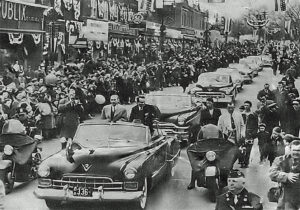
Captain Carlsen received a hero’s welcome in New York, even receiving a ticker-tape parade. Copyright unknown.
Summarising the differing perspectives, official accounts are consistent in their documentation of the ship’s cargo and the rescue operation, while conspiracy theories are largely based on speculation, circumstantial evidence, and the enduring human fascination with the unknown.
The questions surrounding the cargo and the ship’s fate naturally lead to consideration of the salvage operations and the legacy of the Flying Enterprise.
According to official reports, salvage efforts began soon after the ship’s loss. In 1960, the Italian company Sorima recovered approximately $210,000 worth of cargo from the wreck, though the full details remain unknown due to a confidentiality clause in the salvage contract. The secrecy surrounding the operation has only added to the mystique of the Flying Enterprise, with some theorists interpreting it as evidence of hidden valuables or sensitive materials.
In 1976, Bjarne Bekker’s biography of Captain Carlsen further popularised the story, and Carlsen himself was buried at sea at the site of the wreck in February 1990. The ship’s resting place was positively identified in 2001 by British diver Leigh Bishop, whose photographs and research confirmed the location. I will add at this point that local fishermen knew exactly where she was located from as early as the mid-1970s; I knew where she was myself in 1981. The wreck lies on her port side in 84 metres of water in the Western Approaches to the English Channel, and artefacts have been displayed in the Cornish Maritime Museum. Official documentation confirms these discoveries and the subsequent commemorative dives and documentaries.
Speculation regarding the sinking and the cargo has persisted. Some claim, based on interviews and documentaries, that zirconium was on board, possibly registered as pig iron. These theories remain unproven and are not corroborated by official records. While it is known that the US Atomic Energy Commission was acquiring zirconium at the time, there is no direct evidence linking the Flying Enterprise to such shipments.
The enduring fascination with the Flying Enterprise’s fate is reflected in popular culture as well. Hammond Innes’ 1956 novel “The Wreck of the Mary Deare” and its film adaptation drew inspiration from the saga, though they fictionalised the events and characters.
Having explored the salvage operations and their aftermath, it is clear that the legacy of the Flying Enterprise is shaped as much by unanswered questions as by well-documented events.
According to official records, the Flying Enterprise’s story is one of determination, heroism, and tragedy, culminating in the loss of a ship and its cargo but also in the survival and celebration of those who fought to save her. Speculation and conspiracy theories have added a layer of intrigue, fuelled by gaps in the historical record, confidentiality in salvage contracts, and the natural tendency to seek hidden meaning in dramatic events.
For history enthusiasts and general readers alike, the Flying Enterprise endures as a compelling case study in the interplay between fact and fiction. While some mysteries may never be fully resolved, the documented facts provide a foundation for critical analysis and informed debate.
The saga of the Flying Enterprise stands as a testament to human courage in the face of adversity and the enduring allure of maritime mystery. By clearly distinguishing between official accounts and speculation, we can appreciate both the genuine heroism of those involved and the powerful role that uncertainty plays in shaping historical memory. While the gaps and ambiguities in the record invite ongoing curiosity, a critical and balanced approach remains essential for separating fact from fiction and for understanding why this story continues to captivate generations.
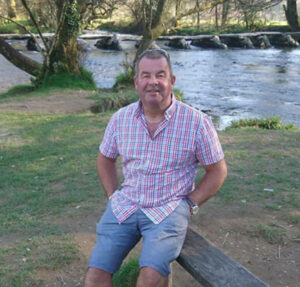
Lyndon Allen
Lyndon Allen grew up in Charlestown, St Austell. He comes from two longstanding historical families in Charlestown, who have been an integral part of village life for over 230 years, particularly in its maritime heritage. Lyndon attended both Charlestown and Penrice schools before leaving in 1981. He pursued a career in the commercial fishing industry, working from the port of Charlestown for thirty-six years, in line with his family’s strong connection to the sea. He retired from the fishing industry in 2019.
Currently, Lyndon operates the award-winning Charlestown Walking Tours, a business he established after the lockdown. He is also an author, a passionate historian, and manages eleven Facebook historygroups, including the popular St Austell History Group. Lyndon has authored four comprehensive history books: two on Charlestown’s history, one on St Austell’s history, and a maritime history book about the St Austell and Mevagissey Bays.
His books are available for purchase on his website at www.charlestowntours.co.uk

Born and brought up in Coventry, The Flying Enterprise was my first link to Falmouth. I remember running home from school at lunch times to hear the one o’clock news on the Home Service, wondering whether Captain Kurt would reach Falmouth safely.