
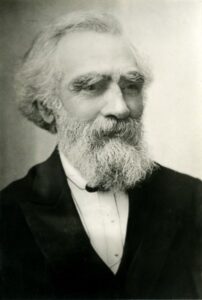
 John Passmore Edwards
By Dean Evans
John Passmore Edwards (1823–1911) was a Cornish born journalist, publisher, philanthropist and Radical politician whose life bridged Chartism, Liberal radicalism and the early labour movement. Briefly Liberal MP for Salisbury in the 1880s, he later described himself as a “Corporation Socialist”, believing that local authorities should provide essential services for the common good. Through his extensive funding of libraries, hospitals, reading rooms, gardens and educational institutions, he sought to extend dignity, health and knowledge to working class communities. His politics were internationalist, pacifist and ethically grounded, shaped by nonconformist morality and a deep commitment to social justice.
Passmore Edwards could not, in a formal or historical sense, be described as a Green. The political ecology that defines modern Green parties lay far in the future. Yet many of the ethical foundations of Green politics were already present in his thought and practice. He rejected laissez faire individualism, arguing instead that freedom depended upon collective provision and civic responsibility. His self description as a “Corporation Socialist” expressed a belief that democratic local institutions, rather than markets or centralised states, should own and run services. This emphasis on place-based democracy, public goods and community wellbeing resonates strongly with contemporary Green approaches to local energy, water supply, transport, health and education.
Unlike many of his contemporaries, Passmore Edwards demonstrated a clear, if implicit, ecological consciousness. He wrote and spoke with affection about his Cornish upbringing, walking the cliffs, breathing sea air and finding renewal in the natural world. He recognised nature not merely as scenery but as essential to physical and moral health. His support for public gardens in working class districts, through the Metropolitan Public Gardens Association reflected a conviction that access to green space was a social right, not a luxury for the affluent. This belief anticipates modern arguments about environmental justice and the unequal distribution of environmental benefits.
His ethical relationship with the natural world was also expressed through personal practice. As a vegetarian, a teetotaller and an outspoken antivivisectionist, Passmore Edwards placed limits on human dominion over animals and on bodily excess. These positions were rooted in compassion rather than environmental science, but they align closely with later Green critiques of exploitation, cruelty and unchecked consumption.
Passmore Edwards’ internationalism further strengthens the comparison. He campaigned against slavery in the United States, editing and publishing Uncle Tom’s Companions, which included testimonies from formerly enslaved people such as Frederick Douglass. He was a lifelong pacifist, active in stop the war campaigns and a regular participant in European peace conferences. He also organised educational trips to Paris for working men at a time of widespread mistrust of France. This was a practical internationalism grounded in empathy, cultural exchange and opposition to violence, echoing Green commitments to peace, global justice and cooperation across borders.
Taken together, these positions suggest that Passmore Edwards did not diverge from the ethical core of modern Green politics so much as precede it. What is absent from his writings is an explicit language of environmental protection or ecological limits, but the underlying values are clearly present: reverence for nature, belief in shared spaces, resistance to exploitation, and a commitment to peace and justice beyond national boundaries.
In conclusion, Passmore Edwards was not a Green by label or historical circumstance. Yet he embodied a form of civic, ethical and ecological radicalism that Green politics later made explicit. If modern Green politics is understood as a synthesis of social justice, environmental care, local democracy and internationalism, then Passmore Edwards can reasonably be seen as one of its nineteenth century forebears.
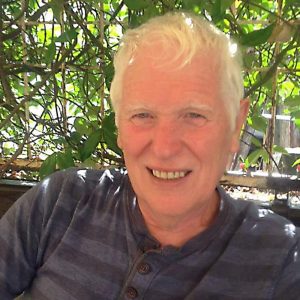 Dean Evans
When I first came to work in Cornwall in the late 1980s I very quickly noticed the name “Passmore Edwards” over doorways to libraries across Cornwall. It was some years later, when taking a night class on website design, and needed a subject for a test website, that I thought that some of these buildings might fit the bill. By coincidence, that weekend, I found a slim biography, “The Life & Good Works of John Passmore Edwards” by R S Best, at a tabletop sale. It really did change my life. The test website developed into www.passmoreedwards.org.uk, with regular trips to London, visiting the British Library and the Newspaper archives, and as many of the Passmore Edwards’ buildings as I could. Online research located descendants, and more books; my knowledge of the Victorian era expanded exponentially. Buying a camera to record images of the buildings led to a new hobby in photography and new friends in Camera Clubs across Cornwall. In 2007, finding the Blackwater Institute closed and semi derelict, I started a campaign to restore the building for use as the village hall, learned new skills in writing bids for grants and seeing opportunities to raise money, found a lasting relationship with this wonderful community, and received a BEM. The website developed into a book, credited with a Holyer An Gof prize, and in 2011 arranging for more than 80 events, held right across the country, from St Ives to Herne Bay in Kent, to mark the 100 years since Edwards died. My interest has made me realise that the issues that Edwards campaigned over are just as relevant today as they were over a hundred years ago. It is an interest that will remain with me for the rest of my life.
