
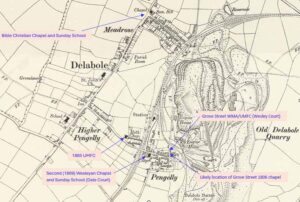
This profile of Delabole Wesleyan Pengelly Chapel has been compiled by Jo Lewis and Tony Mansell.
1784: John Wesley sent Adam Clarke to Delabole Quarry to preach and the spot was named after him as ‘Clarke’s Hole’ and is still called that locally. There is no evidence that John Wesley himself ever came to Delabole but he is known to have visited nearby Trewalder to the south.
First (1806) Delabole Wesleyan Methodist Chapel
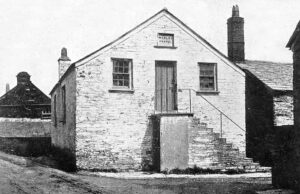 The 1806 Wesley Chapel (https://www.facebook.com/profile/61555801344142/search/?q=grove%20street)
Located in Grove Street in Lower Pengelly (actual location unknown) Given the location of the later (WMA) chapel also on Grove Street, it places the road right at the end of Pengelly near the quarry, as part of the road that now goes to the Fire Station; the cottage on the corner which is Grade 2 listed sits right at the entrance to the Old Quarry; A Royal Coronation booklet of 1837 notes that the old chapel building adjoined the quarry, again confirming its location in this area.
1806: The first Wesley Chapel was built on Grove Street when Robert Blake, quarry owner, is reported to have given John Wesley land, materials and £40 to build it. The given date of 1806 was after John Wesley’s death, and we assume the money was given in the late 1890s with the chapel either built later or the 1806 date refers to the conveyance of an earlier build.
The land was known as Cudlip’s Tenement and was conveyed in Trust on 13th February 1806. It was the first Methodist Chapel in the area. The date stone simply labelled it as Wesley. The chapel had a gallery at the back with the entrance from outside.
In 1847/48 and 1855 there were big religious revivals in the village and there was clearly some competition between the Wesleyans, the Wesleyan Methodist Association and the Bible Christians with newer chapels being built by all.
Second (1869) Delabole Pengelly Wesleyan Methodist Chapel, Delabole ‘Wesley’ Methodist Church
Located in Pengelly (the now lost Chapel was on the south side of the road after what is now The Sidings on the north side; the Sunday School remains)
1869: The new Wesley Premises were built on land purchased in May 1869 from Joseph Hawkey for £30 and the building was arranged to seat 400 people.
The old premises in Grove Street were used as the Sunday school until 1904 when the new school was built next door to this chapel.
Heritage Gateway states this was the Original Wesleyan Methodist chapel, built approximately 1843 (incorrect date) located adjacent to successor Sunday school/chapel/hall. Recorded on the 1st and 2nd Editions of the 1:2500 OS Maps. (https://www.heritagegateway.org.uk/Gateway/Results_Single.aspx?uid=MCO52325&resourceID=1020)
Foundation Stone of Wesleyan Chapel at Delabole
“Delabole. New Wesleyan Chapel. The services in connection with the laying of the foundation stone of the proposed new Wesleyan Methodist Chapel, at Delabole, commenced on Sunday. The Rev Edward S. Banham, of Lewannick, preached morning and evening, and the Rev. C. Evans, of the United Methodist Free Church, in the afternoon. The attendance was very good, especially in the evening, when it is supposed there were 600 present. An arch composed of the green branches of trees was erected across the entrance to the site of the proposed building. In the centre was placed a crown, below which, in letters of blue and red, was the word “welcome.” About three p.m., on Monday, a procession was formed near the old chapel, by Mr. J. Allen, the Revs. J. Brewster, W. Baddeley, James Walter, and Charles Evans, the local preachers and trustees, the ladies who collected purses of money, and the Sabbath School teachers with the children. The company proceeded to the site where the stone to be laid was suspended, ready to be lowered into its place. The Rev. W. Baddeley gave out the 520th hymn, and after it was sung the Rev. J. Walter read a portion of the 29th chap. of the 1st book of Chronicles, and the Rev. C. Evans engaged in prayer. Then Mr. Allen was presented with a mahogany mallet and silver trowel. The bed of the stone having been prepared a bottle containing copies of newspapers – the Watchman and Methodist Recorder – with circuit preachers’ plan, was placed in a cavity for preservation. The stone having been lowered and laid, Mr. Allen made a short and appropriate speech, and concluded by announcing that his sub scription of £50 would be increased to the extent of an additional £10. The ladies then placed their purses on the stone, and the children belonging to the Sunday School put each their mite on it as they passed along. The company afterwards adjourned to the United Methodist Free Church chapel, when the Rev. John Brewster preached an eloquent sermon from the 4th verse of the 27th Psalm. Collections were made at the close of each service towards the building fund. A public tea was provided in the spacious school-room; a large party sat down. About seven in the evening a meeting commenced, presided over by Mr. Allen, and was addressed by the Revs. W. Baddeley, J. Walter, and C. Evans, and Messrs. Menhennick, and Ford, the company regretting the absence of the Rev. John Brewster, who, having to attend another meeting, was obliged to leave. The proceedings terminated about 9 p.m. with votes of thanks to the minister, the Rev. C. Evans, and trustees of the chapel, to the ladies for so nobly collecting for the purses and catering for the tea, and also to Mr. Allen for his kindness in presiding and liberality towards the building fund, which, according to the Secretary’s report, stands thus:—Subscriptions, £96 1s.; building committee, £40; Sunday collections, £5 6s. 6d.; purses, £25 17s.; Mr. J. Allen, £10; Sunday School on stone, £1 2s. 7½d; Monday afternoon collection, £3 9s. 1d. ; proceeds of tea, £7 17s. 6d.; Mr. J. Allen, in memory of a friend, £10; evening collection, £4 6s. 3½d.; making a total of about £213.” Transcribed by Claudia Richards. (https://www.opc-cornwall.org/news/teath_st_news_wesleyan_foundation_1869.pdf)
1878: there was a night school at Wesley with Mr James Allen as headmaster.
1904 Wesley Chapel opened their new Sunday school.
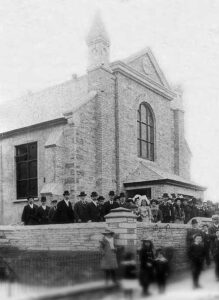 Opening of Wesley Chapel Schoolroom 1904 (Photo: Chris Hore 2000 – 2020 (https://www.delabole2020.uk/pengelly/) We hope there is no objection to this photo being reproduced here.
26th March 1904: Sunday School grand evening concert: https://kresenkernow.org/SOAP/detail/694c7497-f3f7-4e84-9506 6d98f88736db/?tH=%5B%22delabole%22%2C%22methodist%22%5D
1904: The 1806 Sunday school on Grove Street was abandoned by the Wesleyans and reverted back to the quarry ownership.
Mr Alfred Thomas salvaged the Plaque from the 1806 chapel and placed it against a wall of a Memorial Garden he had made.
1907: Wesley Chapel installed a new pipe organ which was the first in the village beating the other chapels to it!
1908: “WESLEYAN LUNCHEON AND BAZAAR. The growth of Wesleyan Methodism at Delabole is evinced by the buildings that have been erected by that body in the place during the past few years. Not a great many years since, the inhabitants used to worship in what is now used as an institute, a building in which it is stated that John Wesley has preached (there is no other evidence for this). After some years it was found that a larger building was required to accommodate the worshippers, and the present chapel was erected, the old chapel being used as a schoolroom. This, however, was found be inadequate for the growing needs of the place, and the society summoned up courage to purchase a site and built new schoolroom at cost of about £1,000. This building, which is said to be the largest of its kind in the circuit, was opened four and half years ago. It consists of a of spacious schoolroom, class-rooms and vestry rooms, and, as might be expected, there is still debt on the premises. On Saturday last, special effort was made to reduce the debt.” (Cornish & Devon Post – Saturday 3 October 1908)
1929: The three village chapels funded the new cemetery in Vale Lane (sold to the council in the 1970s)
1932: The Wesleyan, Primitive Methodist and the United Methodist Church amalgamated to become the Methodist Church of Great Britain.
1932: Became Delabole Wesley Methodist Church; It was in the Camelford and Week St Mary Methodist Circuit.
A Royal Coronation booklet of 1837 notes that the building adjoined the quarry (the 1806 chapel) and was owned by the Slate Company, used as a workers’ dining room and band room.
The Delabole Band practised in the 1806 chapel until the 1950s when the quarry owners found that the building was unsafe and too dangerous for future use. As one of the Band fundraising activities was a Whist Drive in the Band room, this also couldn’t continue. The band moved to the Drill Hall for a few years but when this was needed for the Cadets and TA, the band folded.
1940: Seating capacity 340. (David Easton, Methodist Minister and Researcher)
Heritage Gateway describe the 1904 Sunday School which became the chapel:
“Large Wesleyan Methodist chapel, formerly a Sunday school. Now used as village hall. Recorded on the 2nd Edition 1:2500 1907 OS Map as a Sunday school alongside the original c 1839 (Incorrect, it was 1869) Wesleyan chapel. In use as a chapel sometime after 1907 (much later as the aerial photos show) when the original chapel was demolished.” (https://www.heritagegateway.org.uk/Gateway/Results_Single.aspx?uid=MCO32707&resourceID=1020)
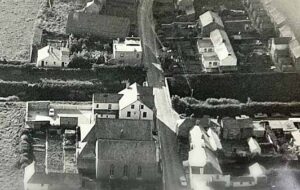 The Chapel and Sunday school (bottom centre) near the railway cutting and Pengelly Bridge
(Photo: Chris Hore 2000 – 2020 (https://www.delabole2020.uk/pengelly/) We hope there is no objection to this photo being reproduced here.
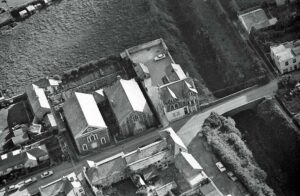 Delabole Pengelly Methodist Chapel and Sunday School close to the redundant railway line (closed circa 1950)
(https://www.facebook.com/photo?fbid=122222587136193378&set=pcb.122222587184193378)
We have been unable to find when the 1869 chapel become redundant and the congregation moved to the 1904 building but we believe that it was during the 1950s or possibly later.
In 1980 the Wesley merged with the other chapels to the Medrose Church
The Wesley organ was sold locally and all the pews advertised for sale and quickly distributed.
In 1981 the Wesley Chapel (it’s unclear whether this was the 1869 or 1904 building) was taken over by Delabole Church Youth Group, subject to them taking on all costs including insurance. The Group was non-denominational and run by committee to provide events for the ‘Young People’ in the village and surrounding area. This included events in the School Room.
Probably circa 1981: The committee agreed that the 1869 Chapel would be demolished and the space used for a car park.
A toilet, kitchen and store extension was added to the 1904 building paid for by grants and village events.
2014/2015: The 1904 Sunday school was redeveloped into 5 properties, called Dale Court. https://www.bopproperty.com/pengelly-delabole/966409
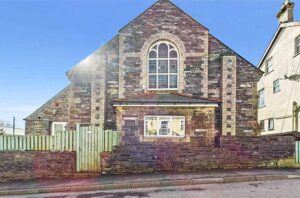 Dale Court
(https://www.rightmove.co.uk/house-prices/details/3f693596-2f7a-4996-8f38-d917e01e16d0)
(https://www.bopproperty.com/pengelly-delabole/966409)
Kresen Kernow information: https://kresenkernow.org/SOAP/search/delabole%20wesley%20/
There is no dedicated Kresen Kernow page but lots of scattered information:
Facebook page for Delabole Methodist Church https://www.facebook.com/profile.php?id=61552833296030
Future researchers should note that a Delabole WMC by a quarry, with a great history of it being built in the 1860s, turned out to be in Australia.
“Built 1866 on side of hill above the village near Delabole slate quarry for convenience of labourers employed there. It is believed that the Chapel was built with volunteer labour by the quarry workers after they had finished their day’s work in the quarry. It was let to a local farmer 1881 and by 1899 the possibility of the sale of the Delabole church was considered by the Willunga Methodist Trust. The village was deserted when the quarry closed 1903. The chapel fell into disrepair, roofing timbers removed 1940s, restored 1990.” https://www.flickr.com/photos/31967465@N04/8268707630/in/photolist-dAFhGE-JDSymc-z55GGK-oTtadz-2iJ2Rvv-fUeBqG-KiFhLn-oBfwZu-fX77EJ-oBfmQy-JAW4uN-2jbVXo2-2rfqVa8-fBF9t5-PeAqgg-jtMW8X-i1MkJr-hvmdxr-i1LqyF-2jbTeZB-2jbTeZr-2jbXgpM-i1LBCV-i1M5Cf-Q2MnhE-i1LYnm-i1LYVU-hvjLLS-J3Rb3U-i1MGxk-25RTZsz-i1Lvwh-amxhqU-i1LSoh-anzyiP-LCAj9c-K2KUfk-J6mEsu-JQ56RQ-J6jMJg-JUSSUi-J6jNDT-2aQmv1w-2q6bc1B-2q6aimn-J6kfdD-2q6bc4C-JYJdhf-JUSnYT-J6jPX4
“Nestled in a valley in the hills above the town of Willunga (south of Adelaide) lies the village of Delabole, once a thriving community of quarrymen and their families. Today the village is fast disappearing and in a few years all remaining evidence of the village will be gone, with the only reminder of its presence being the slate chapel, which was a focus of village life. The cottages of Delabole were constructed of rammed earth walls and since their roofs decayed the walls have become exposed to the driving rains that have gradually destroyed them. Evidence of doorways and windows that were intact in 1968 is now gone and even walls recorded as recently as 1996 have disappeared.” https://www.academia.edu/27359400/From_Cornwall_to_South_Australia_The_Delabole_Quarry_and_Village